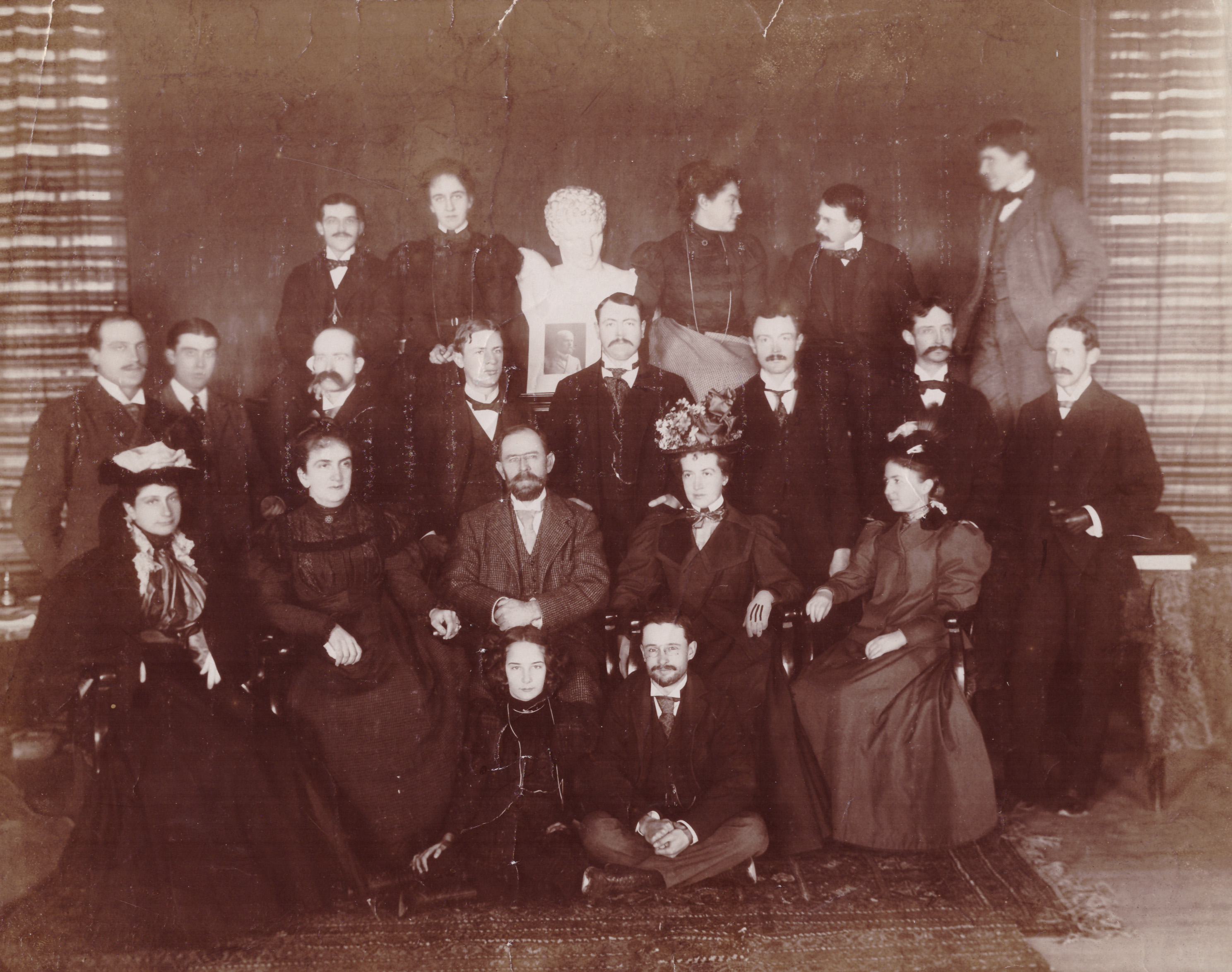
In my January post I explored the first term of Bert Hodge Hill’s long directorship (1906-1926) at the American School of Classical Studies at Athens (ASCSA or the School hereafter), which was the longest of any director. After a trial period with annual directors, the School introduced the five-year term with the possibility of one renewal. Rufus B. Richardson (1845-1914), Professor of Greek at Dartmouth, was the first director to serve two terms. He moved to Greece with his wife Alice Linden Bowen (1854-1948) and their two daughters, Lucy and Dorothy, setting up a bustling household and mingling with the local high society. The wedding of his oldest daughter Lucy to Arthur Morton Lythgoe (1868-1934), an American archaeologist working in Egypt, was the event of the year (1902) in Athens, attended by the Crown Prince and Crown Princess of Greece.
ASCSA members, 1898. Seated on the rug, Dorothy Richardson, unidentified man; first row (l-r): Harriet Boyd, Alice Richardson, Rufus Richardson, two unidentified women; second row (l-r): unidentified men; third row (l-r): unidentified, Lucy Richardson, three unidentified members. Source: ASCSA Archives.
For Richardson’s successor the School appointed a young, highly promising scholar, Theodore W. Heermance, whose untimely death two years later (1905) from typhoid fever left the School in shock. One wonders what would have been the course of the School had Heermance lived longer. His successor Bert Hodge Hill was the first director at the School who was not a professor or held a Ph.D. Hill’s first term (1906-1911) was a trying experience, but he seemed to be able to deal with the challenges of an overseas post. Knowing some of Hill’s weak points –the most conspicuous being his inability to turn in anything in time– James R. Wheeler (1859-1918), the Chair of the School’s Managing Committee and Professor of Greek Archaeology and Art at Columbia University, kept a close eye on him during this first term.
On February 13/26, 1909, William Kelly Prentice (1871-1964), Professor of Greek at Princeton and the Annual Professor of Greek at the School in 1908-09, sent Wheeler his own judgement of the situation in Athens. “The School is running well now. Elderkin is hard at work at vases, [John] Edwards at demes, [Walter] Westerwelt searching the earlier Greek Literature for material on the history of the Erechtheum. It does not seem to me however that [Herbert Percy] Arnold and Miss [Isabelle] Stone are making good use of their time” (ASCSA Archives, AdmRec 301/1, folder 5). George W. Elderkin, who held a Ph.D. from Johns Hopkins, was a second-year fellow and Acting Secretary; he was not Hill’s first choice for the position but since the other candidate, Kendall K. Smith, had returned to America after a serious case of malaria, Elderkin was the next obvious person for the secretaryship.
According to that year’s Annual Report (1908-09), Arnold was studying proverbs in Plato and Miss Stone (who already held a doctorate degree from Cornell University) human sacrifice in Greece. I was able to locate the title of Stone’s dissertation “The Life of Simonides of Ceos, from the Sources” (Ph.D. thesis, Cornell University, 1908). The most interesting piece of information that I was able to gather about her was that in 1934 she established, in honor of her mother, the Mary Isabel Sibley Fellowship, which is still awarded alternately in the fields of French and Greek (as a recipient of this fellowship in 1989 I was able to study at the American School). For a recent criticism of the strange conditions of the fellowship, see James Panero, “Attention all Spinsters,” The New Criterium, 10.05. 2006.
Prentice had some good things to say about Hill. “I am doing and will do everything in my power to galvanize Hill into action. I have not become discouraged yet, for I see and appreciate his good qualities and his real power. The man has ideas and such men are too rare and valuable to neglect.” Prentice’s letter also reveals that Wheeler had submitted his resignation from the School’s chairmanship rather unexpectedly. Not understanding why, Prentice asked “whether your resignation was due in part to your relation to Hill, whether you thought there might have to be a new director and did not want to be in office when the matter came up,” implying that if Wheeler took Hill’s side he would be charged with favoritism, and if he did not support Hill for reappointment, the latter would hold a grudge against him.
The Procrastination – Anxiety Cycle
In addition to Prentice’s assessment of the situation in Athens, Wheeler also received a long letter from his friend and colleague at Columbia University Edward D. Perry, who was visiting Athens in the spring of 1909 and was there for the School’s Open Meeting (ASCSA Archives, AdmRec 310/1, folder 5, April 4, 1909). Hill read a paper on the Western Porch of the Erechtheum, and William B. Dinsmoor, the fellow in Architecture, spoke about the gables of the Propylaea. Perry described it as “a particularly strenuous week for him [Hill]” who “in his usual way postponed the working out of his paper till the last minute and then nearly killed himself to get it done. The result was a most interesting talk, ingenious to the last degree and very valuable […] but Hill was evidently completely exhausted and spoke with even more than his usual difficulty.” Perry further related physical symptoms such as “uncomfortable disturbances of heart-action” which Hill’s doctor diagnosed as “a severely nervous affection.” Hill was probably suffering from what today we call anxiety disorder.
Perry continued with the issue of the long-delayed Corinth Reports. “The Reports have been hanging over his head as a dreadful weight; he has known all the time that he could finish them and the accounts and the estimates [Perry is referring to the School’s plan to enlarge the building] with a few day’s steady work, but he hasn’t seemed to be able to force that steady work, though he could work well enough on other things.” Hill told Perry that “any kind of work where his hands were kept busy otherwise than in writing -as in measuring or photographing or drawing buildings- he could get along without difficulty, but before writing he recoiled every time.” Perry did not neglect to mention that Hill was most helpful to the students, “who according to the Prentices think all the world of him.” Nevertheless, Perry admitted that he found it “very difficult to write about him, at least to do him justice, and sometimes while talking with him I have been quite non-plussed.”
Bert Hodge Hill, 1909. ASCSA Archives, Bert H. Hill Papers
Criticized and Contested
A few months later, however, a letter from Elderkin to Wheeler raised further concerns about problems in Athens. Elderkin protested about unfair comments that someone made about him in the May Meeting of the Managing Committee: “[…] word came to me that there was some discussion of my ‘indifference’ toward the School” (ASCSA Archives, AdmRec 301/1 folder 2, June 20, 1909). Elderkin found it distressing since such a comment could create negative impressions among the members of the Committee and put at stake his future in academia. Nevertheless, in that May Meeting Elderkin was promoted to Secretary, with Wheeler advising him to help “Mr. Hill in his excellencies and in his defects” (quoted in Elderkin to Wheeler, Dec. 4, 1909).
Reading between the lines one could sense that there were issues of communication between Hill and Elderkin and that their relation was not as smooth as described in the Annual Report of 1909-10. The uneasiness between the two men comes up in another letter that Elderkin sent to Wheeler concerning the writing of the Corinth excavation reports. (Hill owed two seasons of reports, 1907 and 1908.) Instead of asking Elderkin, the School’s Secretary, to help him write the reports, Hill invited Kendall Smith, who was recovering in America from a serious case of typhoid fever, to return to Greece: “Mr. Smith in Harvard was asked to interrupt his studies, travel gratuitously to Greece, and help Mr. Hill on reports about excavations at which Mr. Smith and I had been present two seasons.” In Elderkin’s opinion, Hill’s proposal to Smith was “purposeless and condemned to nonfulfillment from the start because Mr. Smith had just recovered from typhoid in Athens and was then studying at Harvard for a doctor’s degree.” After Smith declined, Hill simply handed over his response to Elderkin. By so doing, Hill was not only passing the task of the reports to Elderkin but was also letting him know that he was not his first choice. The root of the problem in their relationship must have been their unequal academic status, with Elderkin holding a more advanced degree (Ph.D.) than Hill (M.A.).
Elderkin confided more grievances about Hill in his long letter to Wheeler. In the School’s administrative records, we have an undated pencil draft of Wheeler’s response, who stood by Hill, brushing off Elderkin’s complaints:
“I know very well how hard it is to keep small matters from obscuring greater ones, but it is what we all have to learn to do, if we are to avoid disappointment and unhappiness” (ASCSA Archives, AdmRec 301/1, folder 2).
George W. Elderkin, 1908. ASCSA Archives.
The enmity between Hill and Elderkin is echoed in another letter sent to Wheeler from Athens. Its author, W.A. Heidel (1868-1941), Professor of Greek at Wesleyan University and a member of the Managing Committee, reported criticism he had heard about both men: “I have heard no criticism of him [Hill] except from one quarter, where it was reported that he was of little service to the members of the School except as playing the part of Advocatus Diaboli, taking the opposite side and offering destructive criticism but without positive suggestions nor encouragement. I have also heard that Mr. Elderkin did not get on well with him and would retire from the secretaryship on that account. Personally I have the impression that Dr. Elderkin is himself not without fault in his relations with Mr. Hill, but I have so little basis for an opinion that I may be wrong.” Heidel continued by telling Wheeler how the directors of the other foreign schools, especially Wilhelm Dörpfeld and Georg Karo, and the Greek archaeologists trusted and respected Hill, consulting him frequently on archaeological questions (ASCSA Archives, AdmRec 310/3, folder 3, April 19, 1910).
The Shadowy Mr. Robinson
If Perry and Heidel were reserved in their criticism of Hill and willing to see beyond his defects, Thomas Dwight Goodell, Professor of Greek at Yale and a member of the Managing Committee, who was in Athens in the early summer of 1920, did not mince his words based on talks he had with Elderkin and David M. Robinson. Robinson, Professor of Greek at Johns Hopkins and Elderkin’s dissertation advisor, had been the Annual Professor at the School in 1909-10. (Robinson would later excavate ancient Olynthus in Chalkidike. For a recent critique of his methods, see Tales of Olynthus: Spoken and Unspoken; and The Modern Greek Exam, “Professor Blank’s” Method, and Other Stories from the 1930s.)
In a long letter to Wheeler, Goodell could not find a good thing to say about Hill, largely focusing on his inability to publish and run the School efficiently.
“Robinson must speak for himself, but he tells me that he cannot but agree with me so far. That Hill is a genius in his way, I do not doubt the value of what he has done, if he could only publish it […]. But what good does it do to see things and then keep them carefully buried in your own mind […]. That he knows more about the excavations at Corinth than anyone at present and ought to be the one to publish the bulletin […]. But what good does that do if he will never publish? And he never will” Goodell predicted. Goodell went as far as to propose a smooth way for Hill’s exit from the School’s directorship: “Hill be made Professor of Archaeology in the School for a year, relieved of all responsibility and authority as Director, the new Director of course taking charge of the house and all business […]. The title is honorable, and ought to be of real [illegible] to him in getting placed in America. He is not yet even Dr., much less Professor.”
Once again Wheeler stood by Hill, reproaching Goodell for putting too much faith in Elderkin’s judgement (ASCSA Archives, AdmRec Box 310/1, folder 4, July 10 and August 25, 1910)
Not everybody, however, was critical of Hill. Abby Leach, Professor of Greek at Vassar, shared with Wheeler “in confidence,” the opinion of Leslie Walker, a Vassar student enrolled in the School’s academic program in 1909-10: “She says Mr. Robinson has worked steadily against Mr. Hill […]. He has spent the whole year talking against Mr. Hill to anyone and everyone.” Walker found Mr. Robinson to be “a man of infinitely less ability and strength of character.” Walker singled out “the high opinion his pupils have of Mr. Hill and the fine impression he makes as an archaeologist” (ASCSA Archives, AdmRec 310/1, folder 5, Leach to Wheeler [1910]). (Leslie Walker would excavate Halae with Hetty Goldman in 1910; for more about her later life, An Unconventional Union: Mr. and Mrs. George Kosmopoulos.)
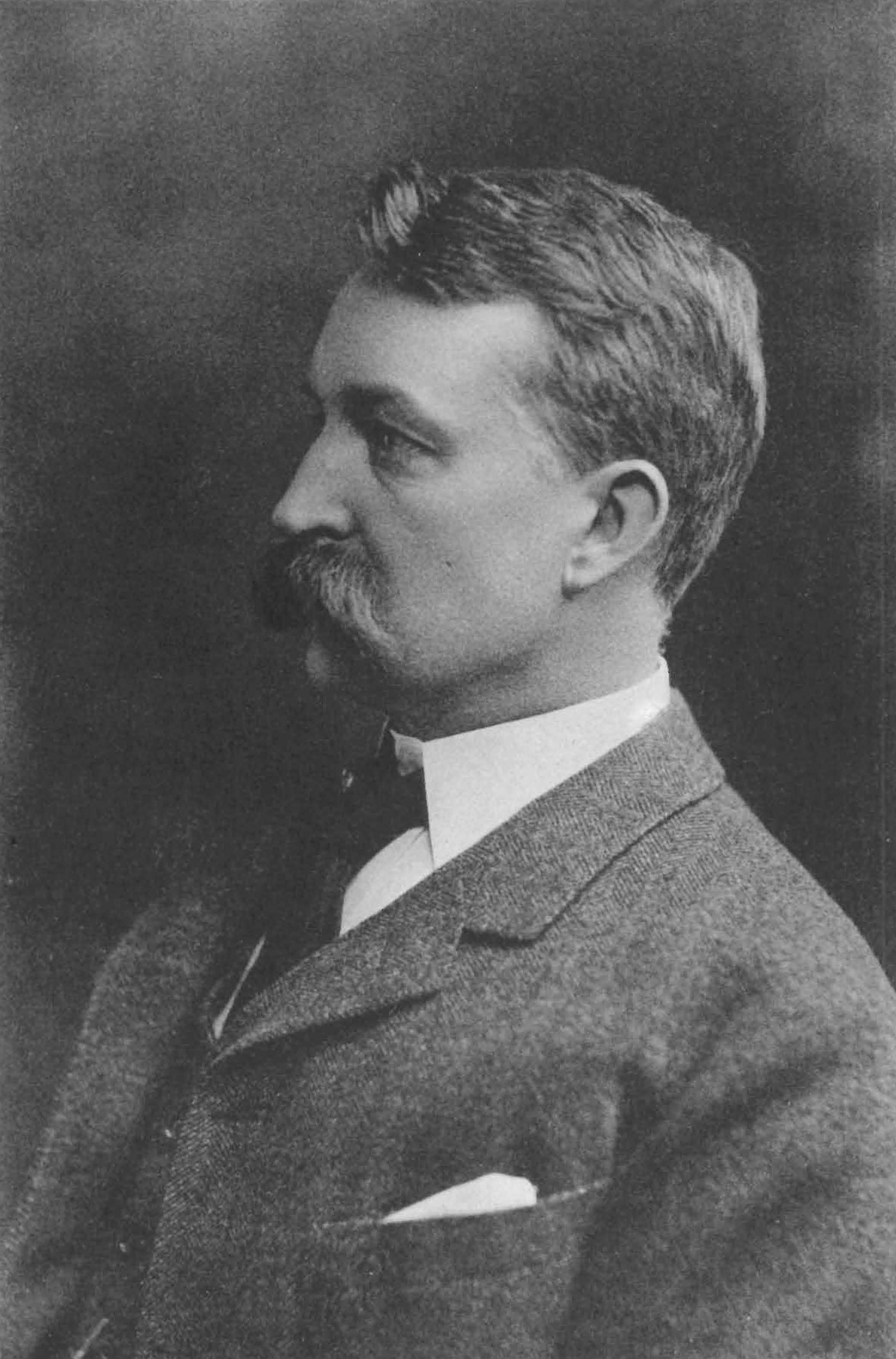
James Rignall Wheeler. Source: Lord 1947, 99.
Wheeler also solicited the opinion of Lacey D. Caskey, Assistant Curator of Ancient Art at the Boston Museum of Fine Arts and former Secretary of the School (1905-1908). Caskey praised Hill for raising the School’s profile among the other foreign institutions in Athens:
“… discovery after discovery made by him has given such striking proof of the keenness and originality of his mind […] and above all his remarkable power of getting people interested in archaeological problems and of training them in accurate and painstaking methods of work.”
He, too, commented on Hill’s “popularity among the members of the School and the Athenian Society, of his hardheaded, practical common sense and business ability.” Caskey wished to emphasize the latter because “of some astonishing remarks” that had reached him (ASCSA Archives, AdmRec 310/1, folder 1, Nov. 12, 1910).
Hill Reelected
Hill must have sensed that his reappointment for 1911-1916 was not certain. He sent a letter to Wheeler on May 3, 1910, marked “Personal.” “My own judgement – and I think you agree—is that it would be wise for me, personally, to continue in my present position. I should not however, of course, become an active candidate for reelection.” If the Committee chose somebody else, Hill would have no complaint, but he wanted to be informed early. Hill was aware that there were discussions for a plan B in case he was not reappointed: “You have suggested a possibility […] of my remaining in some capacity free of administration and household and social duties, so that my time could be given completely to investigation and lecturing. That would be very pleasant for me; but it would also certainly make a different situation for the new Director in spite of the best and good will on his part and on mine.” Instead, Hill proposed, if he were to continue as Director, that the School make the Secretaryship a more permanent position “of four or five years, and with a better salary. “A permanent Secretary might have, besides the care of the Library, responsibility for the house and grounds, for accounts, for much of the correspondence.” And if the Secretary was married and the Director not, even better for Hill: “housekeeping might be in the former’s hands.”
In answering Hill’s letter, Wheeler notified him about the appointment of a Special Committee of seven who would make their recommendation to the Managing Committee at Christmas time. “So you will know the action by Jan. 1. I cannot tell you how matters are likely to come out, for I do not know. I am sure your good work in certain directions is recognized […].” However, Wheeler warned Hill that his “inability to get matters ready for publications” would weigh against his reelection.
On December 31, 1910, Wheeler telegrammed Hill: “Reelected congratulations.”
Hill’s reappointment for a second term (1911-1916) was only the beginning of the longest directorship in the School’s history. Hill served the last year of his first term without a Secretary to help him. However, that year a bright young man from Yale University joined the regular program: Carl W. Blegen. He would become the School’s Secretary from 1912-1920; in 1920 he was promoted to Assistant Director. Hill found in Blegen a hard-working and reliable soul mate, who would make up for the Director’s defects. In 1916, “Mr. Hill, whose term had expired, was reelected Director without term [my emphasis]” (ASCSA Annual Report 1915-16, 8). By then, Europe was embroiled in one of the bloodiest wars in her history with Greece under pressure to join the war on the side of the Allies. With Hill and Blegen holding guard in a shutdown School, Wheeler and the rest of the Managing Committee were more than happy to have two people willing to remain indefinitely in Greece. Hill’s termless directorship ended abruptly in 1926 at the end of his “fourth term” creating a deep rift in the American School community. But this story has been told before.
Afterlives
Elderkin resigned from the Secretaryship in the summer of 1910 to join the faculty at Princeton University; he was part of the founding nucleus of the Art and Archaeology department (Lavin 1983). His first book, Problems in Periclean Buildings, was published in 1912. He published his second book, Kantharos: Studies in Dionysian and Kindred Cult in 1924. That same year he married Kate Denny McKnight (1897-1962), a Vassar graduate with a Ph.D. from Radcliffe. Kate was first cousin of Elizabeth Denny Pierce (1888-1966), who also married Carl Blegen in 1924.
From 1924 -1931, Elderkin edited the American Journal of Archaeology; he is credited for creating a regular book review department. Kate worked for a few years as an associate editor in the AJA, focusing on book reviews. In 1929, Edward Capps, Chair of the School’s Managing Committee and a colleague of Elderkin at Princeton (and the one who orchestrated Hill’s forced retirement in 1926), made the following comment to the then Director of the School, Rhys Carpenter: “Another matter that is being discussed pretty generally has to do with Mrs. Blegen’s News Items from Athens -her playing up to the Greeks in every possible way, her deliberate ignoring of American activities, etc. Elderkin is very much dissatisfied with this situation, but because of the strained relations of Mrs. B. and his wife [Kate McKnight] has hesitated to intervene. The last report in AJA has set up something like a scandal […].”
In the same letter Capps also added that he had information from Elderkin that “Hill’s friends are becoming active in promoting a scheme for the excavation of Antioch in Syria, under his direction, with Blegen a member of his staff […] It would take a very large amount of money, $25,000 as the minimum each year […]. I mention this simply as a matter of interest” (ASCSA Archives, AdmRec 318/2, folder 1, Jan. 2, 1929). But it was not Hill, but Elderkin who oversaw the Antioch excavations starting in 1932. Elderkin returned to the American School as Annual Professor in 1938-1939 to teach a class on Hellenistic Art and Culture.
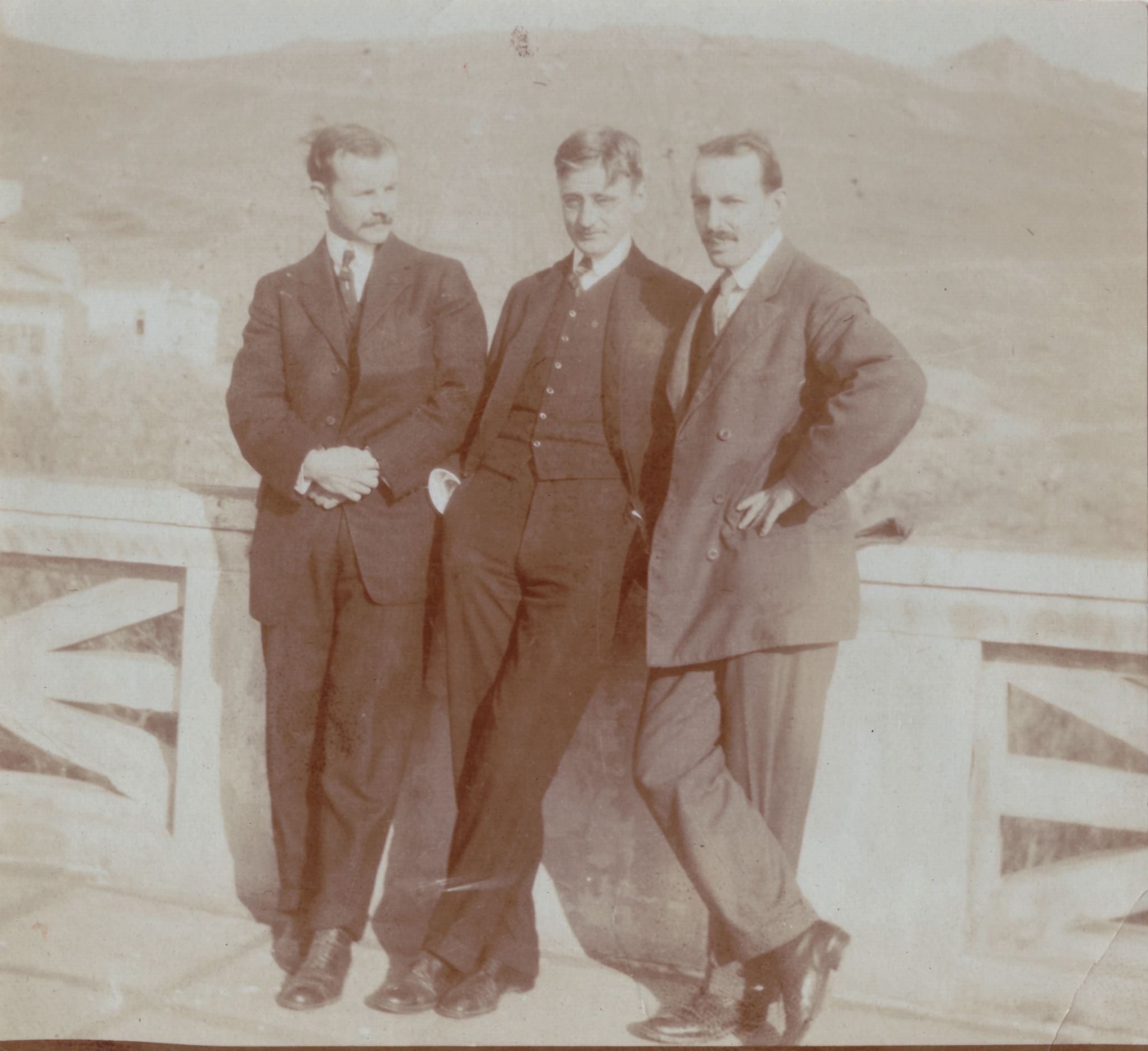
Dunn Wood, George W. Elderkin, and Kendall K. Smith, ca. 1907. ASCSA Archives.
Of the other members of the 1907-1908 class, architect Henry Dunn Wood (1882-1940) went on to have a successful career in a large public utilities company, United Engineers, in Philadelphia. Paul Cret, his mentor, invited Wood to design the interior of the Central Heating Plant of Washington, D.C. in 1933.
Elizabeth Manning Gardiner (1879-1958), the only woman in that class, married in 1913 one of her fellow students, Charles Edward Whitmore (1887-1970), who obtained in 1915 a PhD from Harvard with a dissertation titled “The Supernatural in Tragedy.” In 1915, when Hill was considered for a third term at the School, Elizabeth signing as Mrs. C. E. Whitmore sent a long letter to Wheeler in support of Hill whose competency as director was being challenged once again; in addition, there were complaints that “he had failed to make the position of women students in Athens a comfortable one.” She described her experience with Hill as such: “With a newcomer he (quite deliberately, I think) allowed a certain amount of groping about, a certain sifting of ideas, during which he apparently ignored the student almost entirely. But the moment a student had any definite plan of work to offer, he was untiring in criticism and encouragement, and, if the work proved of any general interest, generous in giving it publicity at open meetings […].” The fact that Hill did not allow women to excavate at Corinth, she judged as a fair decision since American women had hard time establishing authority in a squad of workmen, “keep them on the job, settle disputes, and detect poor work.” Although Manning was not allowed to dig, she had “every opportunity to observe the excavations, discuss problems, and in general absorb as much of the method as could be needed for the preparation of the future classicist or museum official.” Manning concluded her letter noting that if life in Athens seemed challenging to American women, this was not due to Hill but “either to the financial status of the School [referring to the School’s inability to host women in its premises] or to social and physical conditions shared by Athens in common with all southern European countries” (ASCSA Archives, AdmRec 310/1, folder 7, Aug. 29, 1915).
Elizabeth Manning Gardiner (later Mrs. C. E. Whitmore), 1908. ASCSA Archives.
The last person to consider from the 1907-08 class is Kendall Kerfoot Smith (1882-1929), the student that Hill favored over Elderkin for the Secretary’s position. After returning to the States in 1908, Smith earned a Ph.D. from Harvard in 1909. In 1915 he was hired at Brown University where he became head of the Department of Greek and Latin. In 1918-1919 he returned to Greece representing the Y.M.C.A. and establishing “soldier huts” for the Greek army. Blegen noted in his diary on April 13, 1919: “We had 2 YMCA men and Kendall Smith for dinner. Smith is running the YMCA in Athens” (ASCSA Archives, Carl W. Blegen Papers, box 4). Smith served in the Managing Committee’s Executive Committee and the Fellowship Committee. Just before his death in 1929, Samuel Bassett, the Chairman of the Fellowship Committee wrote about Smith: “The Committee has sorely missed the always ready and conscientious assistance of one of its members, Professor Kendall K. Smith. Until the present year, when he has been incapacitated by illness, Professor Smith has always been prompt to give careful consideration to all the problems that confronted the Committee, and each year he has devoted many hours to a thorough reading of the examination papers. He has had no little part in shaping the policy of the Committee and in the selection of the Fellows (ASCSA Annual Report 48, 1928-29, 18-19).
Note: I don’t intend to follow up with Part III, at least in the near future. My next post will be about the 1960s / early 1970s in Greece and at the School.
M. Aronberg Lavin, 1983. The Eye of the Tiger: The Founding and Development of the Department of Art and Archaeology, 1883-1923, Princeton University L. E. Lord, 1947. A History of the American School of Classical Studies at Athens, 1882-1942, Cambridge, Mass.




 From the Archivist's Notebook
Fascinating post as usual, Natalia! I am going to see if I can identify the other folks in that 1898 photograph.
Thanks John! It may be 1897-1898.