Brainerd P. Salmon: American Journalist (and Much More) and Friend of Greece
Posted: April 12, 2023 Filed under: Archival Research, Biography, Modern Greek History, Philhellenism, Uncategorized | Tags: Brainerd P. Salmon, Edward Capps, Eleutherios Venizelos, John Gennadius 4 CommentsIn American Influence in Greece, 1917-1929 (Kent, Ohio 1988), historian Louis P. Cassimatis refers to Brainerd P. Salmon, chairman of the American Chamber of Commerce in Greece, twice. In the Preface, by quoting a line from Salmon’s Glimpses of Greece (1928): “‘American interests in Greece are commercial, financial, educational, and at times philanthropic, but never political’.” And again, in Chapter Five under “Constantine and the Forced Loan of 1922,” when Cassimatis discusses the three-man economic and diplomatic mission that the Greek Government sent to Washington D.C. in the fall of 1921.
The mission composed of John Gennadius, former minister of Greece to Great Britain, Stamos Papafrangos, solicitor of the National Bank of Greece, and Salmon was sent to the United States by the Royalist government of Demetrios Gounaris to obtain recognition of King Constantine as head of the Greek State and request the advancement of the remaining part of the Tripartite Loan of 1918 (about 33 million dollars), which had been suspended. (Until King Constantine formally acknowledged that he had succeeded his dead son King Alexander, the United States could not honor agreements made with the previous Greek government, that of Eleutherios Venizelos.) Failing that goal, the three men had high hopes for a private loan from American banks since there were already several U.S. commercial firms active in Greece in the early 1920s (Cassimatis 1988, 166-172).
According to Cassimatis, the idea of a Greek mission to the U.S. was the “brainchild of Paxton P. Hibben” (1880-1928), a former diplomat and an Associated Press war correspondent sent to Greece in 1915, and a close friend of King Constantine (so close that, in 1920, Hibben would publish Constantine I and the Greek People, in support of Constantine’s decision that Greece should remain neutral during WW I). Hibben’s recommendations included Papafrangos, Philippos Dragoumis, Ion’s younger brother, and Alexander Mercati, “a confidant of the Royal Family” (Malakasses 1976). Gennadius, writing to Demetrios Maximos, Governor of the National Bank of Greece, described in detail his meeting with Prime Minister Gounaris in London in the fall of 1921. According to Gennadius, it was Gounaris who persistently asked him to head the Greek mission to America (ASCSA Archives, Joannes Gennadius Papers, Box 4, folder 15). Maximos must have supported the inclusion of Papafrangos, a lawyer and a high-ranking officer of the National Bank of Greece.
BPS Enters the Scene
But how did an American like Brainerd (or Brainard) Pomeroy Salmon become involved in this mission? I became interested in Salmon because his name kept popping up in the institutional records of the American School in the early 1920s. A google name search produced very little, however. Searching in www.ancestry.com and www.newspapers.com proved more fruitful. Salmon also appears in the Eleutherios Venizelos Papers at the Benaki Museum (accessed through www.searchculture.gr). The Salmon puzzle remains far from complete, but I was able to piece together certain parts of it.
Read the rest of this entry »Blending Two Cultures: The Gennadius Library Dedication in 1926
Posted: June 3, 2018 Filed under: Archival Research, History of Archaeology, Modern Greek History, Philhellenism | Tags: Anna Apostolaki, Edward Capps, Gennadius Library, John Gennadius 3 CommentsPosted by Maria Georgopoulou
Inspired by the recent inauguration of the new Makriyannis Wing, Maria Georgopoulou, Director of the Gennadius Library, here contributes an essay about the festivities that took place during the dedication of the Library in April 1926.
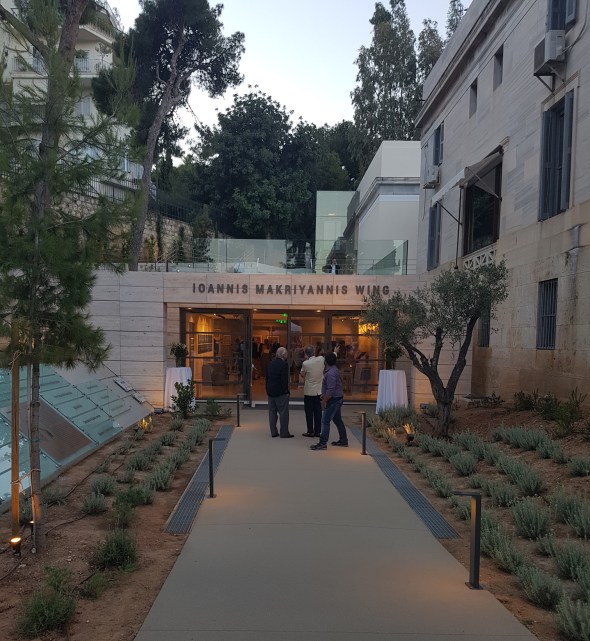
The new Ioannis Makriyannis Wing at the Gennadius Library
On June 2, 2018 the American School inaugurated the new Makriyannis Wing of the Gennadius Library. During the preparations for the opening, I was tempted to look back at the festivities for the inauguration of the Gennadius Library itself in 1926. As with other momentous moments in his life, John Gennadius was keen to keep in his scrapbooks as much information as possible about the events (Opening Exercises of the Gennadius Library, preserved in Scrapbook Φ38, p. 36).
The dedication ceremony of the Gennadeion took place on April 23, 1926 at 4.30 pm, after extensive preparations in America and Athens. The letters exchanged between John Gennadius and Bert Hodge Hill, Director of the American School of Classical Studies at Athens (ASCSA or the School hereafter), in November and December 1925 deal not only with significant matters, such as guest lists, but also with smaller details like the duration of the blessing (αγιασμός). Read the rest of this entry »
Phantom Threads of Mothers and Sons
Posted: May 1, 2018 Filed under: Archival Research, Biography, History of Archaeology | Tags: Anna Blegen, Bert Hodge Hill, Carl W. Blegen, Catherine Munro Schurman, John Gennadius, Phantom Thread, Richard B. Seager, Theodore W. Heermance 8 Comments“Dear Mother: How far are we responsible for already inherited faults? That old Sam Hill, by whom folks used to swear when they dared not take greater names in vain, brought over to Vermont at the end of the eighteenth century among his numerous children one son, Lionel, destined to surpass in dilatoriness all the other slow-going Hills of his generation. He married very tardily and begat two sons, both in due time notable procrastinators, the greater of them being the younger, named Alson, who added to more than a full measure of the family instinct for unreasoning delay an excellent skill in finding good reasons for postponing whatever was to be done. Alson Hill was my father…”. Bert Hodge Hill (1874-1958) addressed these thoughts to his mother from Old Corinth on February 28, 1933 when he was almost 60 years old. Hill, however, never mailed the letter because she had died when he was barely four years old.

Bert Hodge Hill as a young boy and as a middle-aged man. ASCSA Archives, Bert H. Hill Papers.
We will never know what prompted Hill to compose this imaginary missive to a person he never knew. It is the only document, however, that has survived among Hill’s papers that gives us a hint of latent childhood trauma. Just google “mothers and sons” and you will get titles such as “Men and the Mother Wound”, “The Effects of an Absent Mother Figure,” and so forth, with references to a host of scientific articles about the decisive role played by mothers. Hill’s dilatoriness cost him the directorship of the American School of Classical Studies at Athens (ASCSA or the School hereafter) in 1926, after having served as the School’s Director for twenty years. Hill never even finished his imaginary letter to his mother. Had she been around when he was growing up, would have she corrected this family defect and taught him how to prioritize and achieve timely and consistent results? Hill must have wondered. Read the rest of this entry »
The Bohemian Past of Madame Gennadius
Posted: October 2, 2016 Filed under: Archival Research, Art History, Biography, Women's Studies | Tags: Anna Lea Merritt, Edward Sherrard Kennedy, Florence Laing Gennadius, Florence Laing Kennedy, Gennadius Library, John Gennadius 16 CommentsOn Saturday December 27, 1902, a well-publicized wedding took place in London. John Gennadius, former ambassador of Greece to England and a great book-collector, age 58, and Florence Laing, the youngest daughter of Samuel Laing and the widow of painter Edward Sherard Kennedy, age 47, were married in a double ceremony, first at the Greek Orthodox church of St. Sophia and later that day at the Anglican church of St. Peter’s at Cranley Gardens. There are no photos capturing the ceremony or the reception that followed, but Gennadius, the creator of more than seventy scrapbooks, did keep numerous newspaper clippings announcing this celebrated marriage. More than a few of them mention that the bride had an annual income of roughly 8,000 pounds, leading some to hint that it may have been a marriage of convenience. Time proved that their union was a harmonious one; it lasted 30 years until his death in 1932. She outlived him by another twenty years. The Gennadius Library of the American School of Classical Studies at Athens (ASCSA or the School hereafter) was the offspring of their union. The deed of gift was signed in 1922 and the building was completed in 1926.
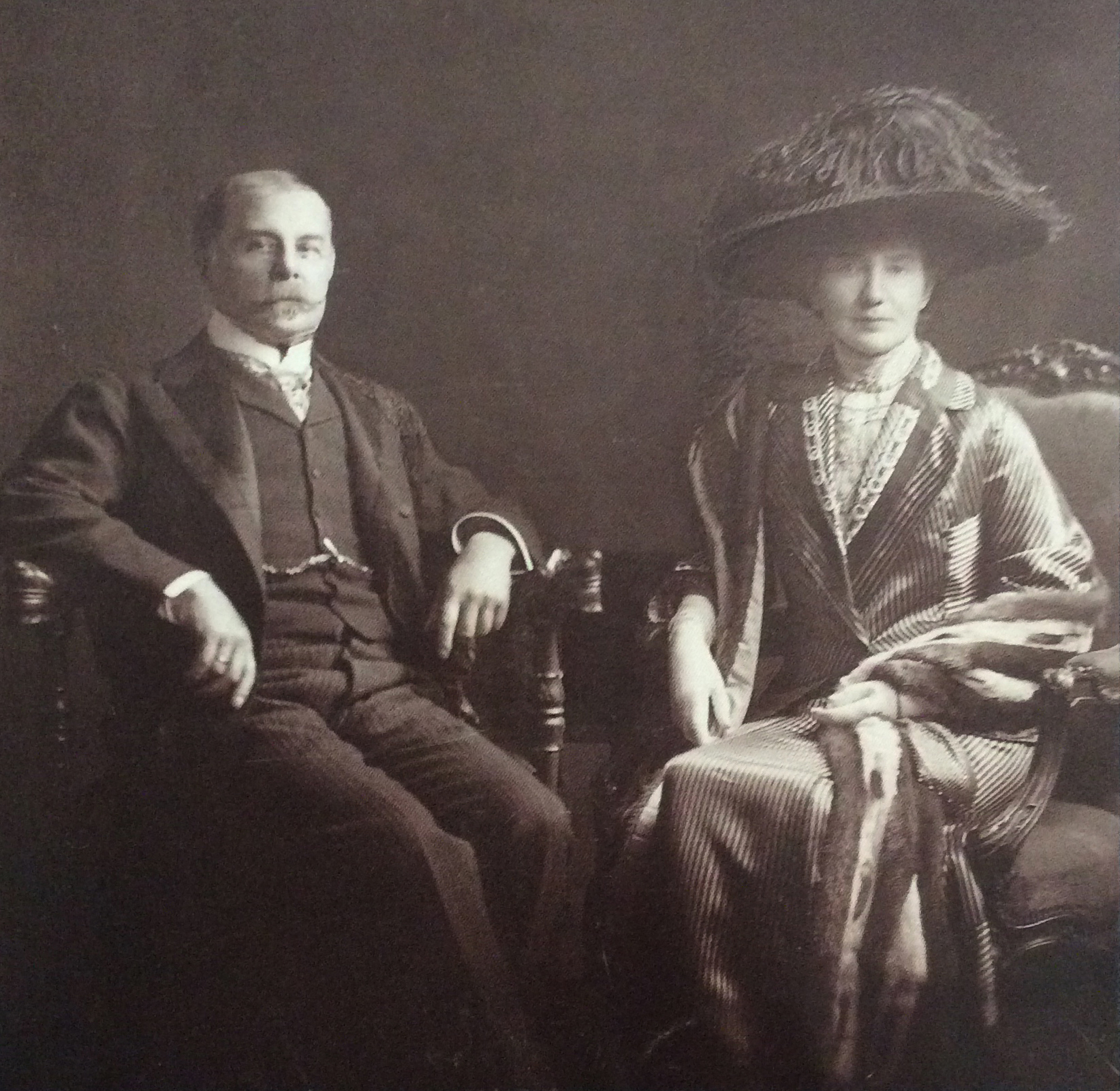
John and Florence Gennadius, 1920. Source: ASCSA, Gennadius Library.
The best source for John Gennadius’s life is a small, but thorough, booklet, Joannes Gennadios, the Man: A Biographical Sketch (1990), by Donald M. Nicol, director of the Gennadius Library (1989-1992). In it, there is very little information about the circumstances of how Gennadius met Florence Laing Kennedy. Nicol suspects that they were introduced by “Prince Alexis Dolgoruki, an acquaintance of Gennadios, [who] had married an English lady, Miss Fleetwood Wilson, who was an old friend of Florence.” In an endnote, Nicol mentions that Florence was an artist in her own right, having exhibited her “genre paintings” in the Royal Academy and other London galleries between 1880 and 1893. Read the rest of this entry »

 From the Archivist's Notebook