Rediscovering the American Pioneer Spirit in Greece, 1928: The Letters of Robert Stroock
Posted: August 1, 2018 Filed under: Archaeology, Archival Research, Biography, Greek Folklore, History of Archaeology, Jewish Studies, Philhellenism | Tags: Robert L. Stroock, Sol M. Stroock 10 CommentsIn the Main Reading Room of the Carl and Elizabeth Blegen Library in Athens, on the narrow side of one of the old bookcases, hangs a heavy bronze plaque inscribed: “In Memory of Robert L. Stroock: A Lover of Ancient Greece. MCMXXX”.
Unlike other commemorative plaques at the American School of Classical Studies at Athens (ASCSA or the School hereafter) which have often changed locations or even have been withdrawn from public view over the years, this one has remained in the same spot since it was dedicated shortly after Stroock’s death in 1930.
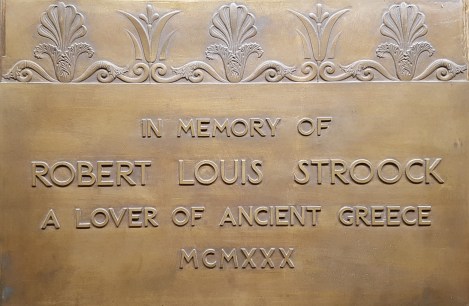
On display in the Carl and Elizabeth Blegen Library of the American School of Classical Studies at Athens
Hetty Goldman: The Potentate of American Archaeology in Greece
Posted: July 3, 2018 Filed under: Archaeology, Archival Research, Biography, History of Archaeology, Mediterranean Studies, Women's Studies | Tags: Alice Leslie Walker Cosmopoulos, Bert Hodge Hill, Eutresis Excavation, Halae Excavations, Hetty Goldman, Piet de Jong 13 CommentsIn 1924, Hetty Goldman (1881-1972), who was directing an excavation at the site of Eutresis in Boeotia, hired architect Piet de Jong to draw some of the finds she had unearthed during the season. To beat the dullness of the evenings, De Jong, who worked for American and British excavations in Greece, made pencil caricatures of his fellow archaeologists which he later turned into striking Art Deco watercolors. The majority of these caricatures once in the possession of Sinclair and Rachel Hood, are now in the care of the Ashmolean Museum. Published by Rachel in Faces of Archaeology in 1998, they constitute visual biographies of American and British archaeologists working in Greece in the 1920s and 1930s.

Hetty Goldman’s caricature by Piet de Jong, 1924. Image reproduced with kind permission of Ashmolean Museum, University of Oxford.
De Jong’s caricature of Goldman depicts her “holding a Neolithic pot of which she was particularly proud. The object behind Hetty’s head is a seated archaic statue found up in a Roman villa which was excavated at some distance from the mound [of Eutresis]… There is the mound itself surmounted by the shelter to protect the diggers from the heat of the sun… The horse, Kappa, on the road below the hill to the right draws the cart containing Hetty herself, Hazel [Hansen], Dorothy [Thompson] and Mitso the driver, on their way to work… a sailing boat or caique refers to the expedition organized by the foreman, George Deleas, to try and row across the Gulf of Corinth from Creusis, the harbor settlement of Eutresis. On the left of the picture at the foot of the mound two village girls with long plaits carry on their heads baskets of washing… Below them is a temple which probably refers to classical architectural findings at Hetty’s previous dig at Halae…” (Hood 1998, p.51). Read the rest of this entry »
General Data Protection Regulations
Posted: June 16, 2018 Filed under: Archival Research Leave a commentDear Friends of “From the Archivist’s Notebook”:
In order to comply with the new General Data Protection Regulation (GDPR), I would like your consent to continue sending you my monthly posts. I take your privacy seriously and I do not use your data (name and e-mail) for any other other purposes.
If you want to continue to receive my posts you don’t need to do anything. Should you wish to stop receiving them, you can “unsubscribe” below.
Best,
Natalia Vogeikoff-Brogan
Blending Two Cultures: The Gennadius Library Dedication in 1926
Posted: June 3, 2018 Filed under: Archival Research, History of Archaeology, Modern Greek History, Philhellenism | Tags: Anna Apostolaki, Edward Capps, Gennadius Library, John Gennadius 3 CommentsPosted by Maria Georgopoulou
Inspired by the recent inauguration of the new Makriyannis Wing, Maria Georgopoulou, Director of the Gennadius Library, here contributes an essay about the festivities that took place during the dedication of the Library in April 1926.

The new Ioannis Makriyannis Wing at the Gennadius Library
On June 2, 2018 the American School inaugurated the new Makriyannis Wing of the Gennadius Library. During the preparations for the opening, I was tempted to look back at the festivities for the inauguration of the Gennadius Library itself in 1926. As with other momentous moments in his life, John Gennadius was keen to keep in his scrapbooks as much information as possible about the events (Opening Exercises of the Gennadius Library, preserved in Scrapbook Φ38, p. 36).
The dedication ceremony of the Gennadeion took place on April 23, 1926 at 4.30 pm, after extensive preparations in America and Athens. The letters exchanged between John Gennadius and Bert Hodge Hill, Director of the American School of Classical Studies at Athens (ASCSA or the School hereafter), in November and December 1925 deal not only with significant matters, such as guest lists, but also with smaller details like the duration of the blessing (αγιασμός). Read the rest of this entry »
Phantom Threads of Mothers and Sons
Posted: May 1, 2018 Filed under: Archival Research, Biography, History of Archaeology | Tags: Anna Blegen, Bert Hodge Hill, Carl W. Blegen, Catherine Munro Schurman, John Gennadius, Phantom Thread, Richard B. Seager, Theodore W. Heermance 8 Comments“Dear Mother: How far are we responsible for already inherited faults? That old Sam Hill, by whom folks used to swear when they dared not take greater names in vain, brought over to Vermont at the end of the eighteenth century among his numerous children one son, Lionel, destined to surpass in dilatoriness all the other slow-going Hills of his generation. He married very tardily and begat two sons, both in due time notable procrastinators, the greater of them being the younger, named Alson, who added to more than a full measure of the family instinct for unreasoning delay an excellent skill in finding good reasons for postponing whatever was to be done. Alson Hill was my father…”. Bert Hodge Hill (1874-1958) addressed these thoughts to his mother from Old Corinth on February 28, 1933 when he was almost 60 years old. Hill, however, never mailed the letter because she had died when he was barely four years old.
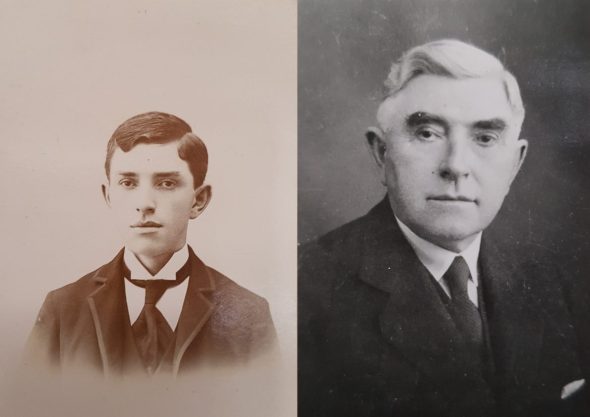
Bert Hodge Hill as a young boy and as a middle-aged man. ASCSA Archives, Bert H. Hill Papers.
We will never know what prompted Hill to compose this imaginary missive to a person he never knew. It is the only document, however, that has survived among Hill’s papers that gives us a hint of latent childhood trauma. Just google “mothers and sons” and you will get titles such as “Men and the Mother Wound”, “The Effects of an Absent Mother Figure,” and so forth, with references to a host of scientific articles about the decisive role played by mothers. Hill’s dilatoriness cost him the directorship of the American School of Classical Studies at Athens (ASCSA or the School hereafter) in 1926, after having served as the School’s Director for twenty years. Hill never even finished his imaginary letter to his mother. Had she been around when he was growing up, would have she corrected this family defect and taught him how to prioritize and achieve timely and consistent results? Hill must have wondered. Read the rest of this entry »

 From the Archivist's Notebook