Recalling a Museum Theft
Posted: April 21, 2022 Filed under: Archaeology, Archival Research, Art History, Classics, History of Archaeology, Mediterranean Studies, Philhellenism | Tags: Athenian Agora Excavations, Charles H. Morgan, Christine Alexander, Eugene Vanderpool, Homer A. Thompson, Γιάννης Μηλιάδης, John L. Caskey, John Meliades 4 Comments“Sadly, the best candidate for him, the beautifully carved [head] 3, facing right, was stolen from the Agora’s dig house in 1955, while the Stoa of Attalos was under construction.” This sentence caught my attention while reading “Classical Sculpture from the Athenian Agora, Part 2: The Friezes of the Temple of Ares (Temple of Athena Pallenis),” published in Hesperia 88 (2019) by Andrew Stewart and seven co-authors (E. Driscoll, S. Estrin, N. J. Gleason, E. Lawrence, R. Levitan, S. Lloyd-Knauf, and K. Turbeville). Further below in the catalog entry for the head, the exact date of the theft is also mentioned: August 22, 1955.
Stewart et al. refer to a fragmentary male head of high craftsmanship that was found in the Athenian Agora near the northeast corner of the Temple of Ares in 1933. Carved around 430-425 B.C. and identified as Hermes, the small head (H.: 0.147m) is one of forty-nine half-size marble fragments which once decorated the friezes of the Temple of Ares in the Agora (originally the Temple of Athena Pallenis at Pallene). A plan of the Agora with the findspots of the sculptures is included in the Hesperia article, and is also available at https://ascsa.net.


Thefts occur in even the best guarded museums and libraries. Every institution has its own story (or stories) to share or hide. And at least some thefts are committed by those who have “hands-on” access to the collections. A recent example was the return of two valuable journals of Charles Darwin, which were stolen two decades ago from the library of Cambridge University. Others remain lost–the paintings stolen from the Isabella Gardner Museum in Boston in 1990, or the Telephus head, an original by Skopas, removed from the Tegea Museum in 1992.
But back to the little head of Hermes that was inventoried as S 305. I was curious to discover more about its theft. A search in the Archives of the American School of Classical Studies at Athens (ASCSA or the School hereafter) yielded considerable information about the event and its aftermath.
Read the rest of this entry »Financing the Reconstruction of the Stoa of Attalos
Posted: March 20, 2021 Filed under: Archaeology, Archival Research, Biography, Classics, Education, History of Archaeology, Philhellenism | Tags: Carl W. Blegen, Charles H. Morgan, Homer A. Thompson, John L. Caskey, Stoa of Attalos, Ward Canaday 4 Comments1946 marked the re-opening of the American School of Classical Studies at Athens (ASCSA or School hereafter) in a country that had been devastated by war. In reading the official correspondence between the Greek Ministry of Education and the ASCSA, it becomes obvious that opening museums and the preservation of archaeological sites ranked highly on Greece’s list of priorities. With the launch of the Marshall Plan in 1947, Greece’s chances of success were also tightly connected with the development of tourism, and a large part of U.S. aid was streamlined in this direction.
“It is well known that travelers come to Greece chiefly for the purpose of seeing the ancient sites and visiting the museums of the country. In other words, the antiquities of Greece constitute a productive source of revenue capable of adding to the national treasury some 30 million dollars in the course of three years… No investment in the economy of Greece can match this for returns” wrote Oscar Broneer, Acting Director of the American School, on June 29th of 1948, in a petition of the School to the Industry Division of the Marshall plan for a $1,149,000 grant that would re-establish the Greek Archaeological Service.
ASCSA AdmRec 804/6, folder 4
Carl W. Blegen, the excavator of many prehistoric sites in Greece who succeeded Broneer in the Directorship of the American School (1948-1949) and had served as Cultural Relations Attaché at the U.S. Embassy in Athens in 1945-1946, also thought along the same lines. In an additional memorandum to the U.S. Ambassador in Athens, in August of 1948, Blegen underlined “the lamentable state of disrepair of the Greek museums,” which looked like empty shells (ASCSA AdmRec 804/6, folder 11). Blegen participated actively in meetings between the Economic Cooperation Administration (ECA) representatives and the Archaeological Service and helped with writing proposals. (The ECA was a U.S. government agency set up in 1948 to administer the Marshall Plan.) Since the American School could not receive direct funding from the Marshall plan, the only way to benefit from it was through collaboration with the Greek Government. The School hoped in this way to secure about $100,000 from the ECA through the Greek Government to supplement the cost of the construction of a museum that would store and display the growing number of finds from the Athenian Agora Excavations that had been accumulated since 1931. Before WW II, the School already had secured a grant of $150,000 from the Rockefeller Foundation to build a museum on the west side of the Agora.
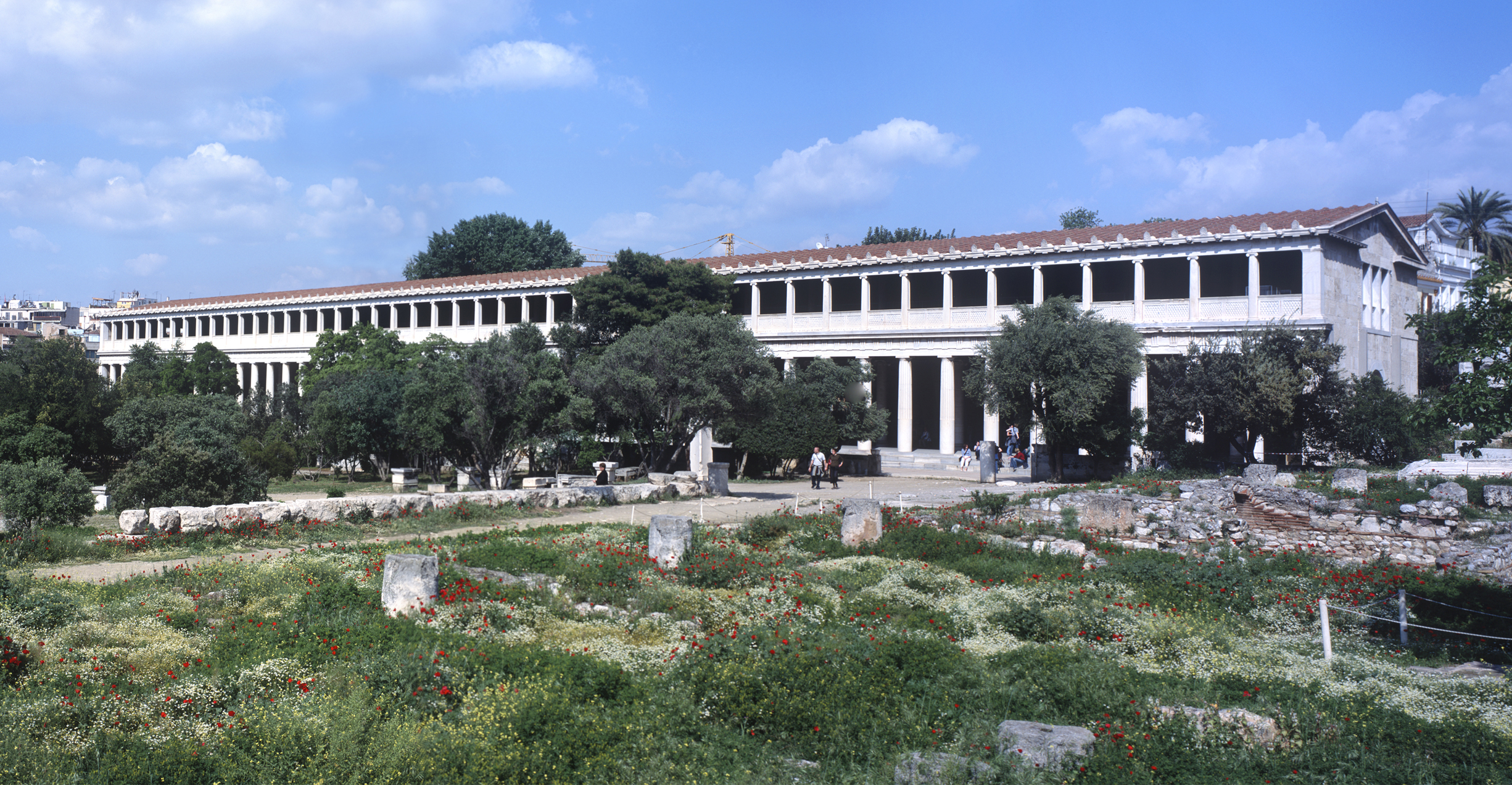
Forced by the War to abandon their plans for an Agora Museum, the Americans resumed work at the Athenian Agora in 1947, conducting excavations at the proposed site, in order to begin construction. The 5th and 4th century B.C. houses and industrial workshops that they found were considered too important to be covered up, and a new site for the museum had to be found. After considering every possible location in the Athenian Agora for the museum, the Americans, following Homer Thompson’s suggestion, came to the conclusion that “another and in many ways preferable alternative would be to restore the Stoa of Attalos and install in it the museum, workrooms, and offices…” (ASCSA Annual Report 1947-1948, p. 29).
The draft of a program agreement between the ECA and the Greek Ministries of Coordination and Education included figures for the preservation of 34 monuments, and the reconstruction of the Stoa of Attalos was first on the list.
Read the rest of this entry »“Anything to restrain the reverend father”: Catholic Clergy at the ASCSA, Pt. II
Posted: March 1, 2018 Filed under: Archaeology, Archival Research, Biography, Classics, History of Archaeology | Tags: Edward Bodnar, Getrude Smith, Homer A. Thompson, John L. Caskey, Raymond Schoder, Thomas Bermingham Leave a commentPosted by Dylan Rogers
Dylan Rogers holds a PhD from the University of Virginia, and he has been Assistant Director of the American School of Classical Studies at Athens since 2015. This essay, the second of two parts, was inspired by recent research in the ASCSA Archives about the Summer Session program.
In my last post, I began an exploration of members of the Catholic clergy at the American School of Classical Studies at Athens (ASCSA or School). My curiosity was piqued by the acerbic comments of Gertrude E. Smith who was not in favor of selecting Fr. Schoder to lead the School’s summer program in 1961. Was the School against admitting Catholic priests and nuns in its programs or was Smith’s dislike of Fr. Schoder personal and exceptional?
Part I examined the figure of Fr. Quinn, an accomplished scholar of Ancient and Modern Greek at the turn of the 20th century. Subsequent to Fr. Quinn ten more priests attended the School’s regular program. In addition, the SS has hosted at least 16 priests and nuns, from 1936 until 1973. The clergy came from a variety of orders, including parish priests, Benedictines (O.S.B.), a De La Salle brother (F.S.C.), a Sister of Mercy (R.S.M.), a Sister of Charity of the Blessed Virgin Mary (B.V.M.), a Sister of Notre Dame de Namur (S.N.D. de Namur), and two Sisters of St. Joseph (C.S.J.). But, by far, most of the priests (nearly 18) came from the Society of Jesus (S.J.), or the Jesuit order. And there were a number of interesting figures in this group, such as Fr. Thomas Bermingham, S.J. (1918-1998), a professor at Georgetown University, who had taught William Peter Blatty, the author of The Exorcist, Latin at Brooklyn Prep in the 1940s. Fr. Bermingham would later advise Blatty on the filming of The Exorcist, and eventually would play Tom, the president of Georgetown, in the film.

Fr. Thomas Bermingham, student at the ASCSA in 1961-62, as President of Georgetown University in The Exorcist.
Archaeological Hikes and Accidental Discoveries
Posted: January 1, 2018 Filed under: Archaeology, Archival Research, Classics, History of Archaeology, Mediterranean Studies | Tags: Bert Hodge Hill, Carl W. Blegen, George F. Bass, John L. Caskey, Princess Alice of Battenberg, Thespiai, William A. McDonald 6 CommentsIn addition to administering the School’s institutional records and hundreds of collections of personal papers in the archival repositories of the Blegen and the Gennadius Libraries (which will soon be consolidated under one roof), the Archivist of the American School of Classical Studies at Athens (ASCSA or School hereafter) also oversees the School’s Antiquities Collection. Catalogued by the School’s former Archivist, Dr. Carol Zerner, and a host of volunteer archaeologists, the Collection features more than 10,000 sherds, hundreds of pots, figurines, fragments of sculpture, various metal objects, and roughly 3,000 coins, all registered with the Ministry of Culture. With one exception, all of the antiquities are kept in a separate, well-guarded room. The exception is a small collection of Geometric vases displayed in the Blegen Library.
“… While on a Sunday excursion we ran across a newly looted Geometric grave out at Thorikos. The sherds showed lots of joins and after talking about the problem to Gene Vanderpool, we took them down the Agora and they were [competent?] to restore a handsome amphora, an oenochoe, a very fine tripod stand and a bowl fitting it. The problem now is to inform the [M]inistry and try to get permission to keep them for the exhibit to be housed in the new wing of the School. I must talk to Mr. Papademetriou this week about it…” confided William (Bill) A. McDonald to Homer A. Thompson, Director of the Athenian Agora Excavations, on November 23, 1958.
Shortly after his discovery, McDonald published the four vases in Hesperia (vol. 30, 1961, pp. 299-304). Dated in the Middle Geometric period, the looted grave at Thorikos belongs to an extensive Early Iron Age cemetery spread on the sides of Velatouri hill. (The Belgian School at Athens has been surveying and digging the site of Thorikos since the late 1960s.) The School also received permission to display McDonald’s finds in the newly built Arthur Vining Davis Wing of the Blegen Library, which was inaugurated in the fall of 1959. Thirty years later, in 1991, when the New Extension to the Blegen Library was completed, the vases were placed (where they still are) inside a vertical glass case, on the ground floor, next to the Rare Book Room. A short text explains the conditions of their discovery.
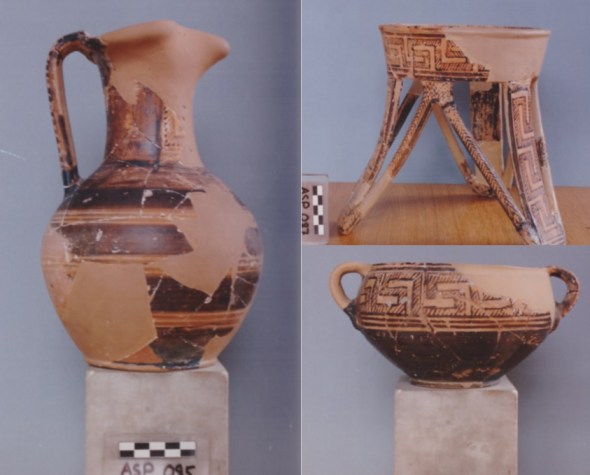
Three of the four Geometric vases (ASP 85-87) that McDonald found on Velatouri Hill, Thorikos. ASCSA Archives, Antiquities Collection.
Barbarians at the Gate
Posted: September 1, 2013 Filed under: Archaeology, Classics, Education | Tags: American School of Classical Studies at Athens, Charles H. Morgan, Emily Vermeule, Fulbright Foundation, Gertrude Smith, John L. Caskey 7 CommentsJack L. Davis, Carl W. Blegen professor of Greek Archaeology at the University of Cincinnati and former director of the American School of Classical Studies at Athens (2007-2012), here contributes to the Archivist’s Notebook an essay about the history of the School’s admission exams.

ASCSA Gate, 1900s
Είναι οι βάρβαροι να φθάσουν σήμερα.
…
Και τώρα τι θα γένουμε χωρίς βαρβάρους.
Οι άνθρωποι αυτοί ήσαν μια κάποια λύσις.
The barbarians are coming today.
…
What will become of us without barbarians.
They were in themselves a kind of solution for us.
Constantine Cavafy, 1908
Are Greek-less barbarians knocking at the gate of the American School of Classical Studies at Athens?
Louis Menand (The Marketplace of Ideas, 2010), has written that there “are things that academics should probably not be afraid to do differently — their world will not come to an end…”. Yet institutions of higher learning are notorious for the “gate-keeping” mechanisms, procedures, and policies they employ to preserve the status quo. Central to the process of academic reproduction are examinations.
Exams have long puzzled me, particularly those administered by the American School of Classical Studies (ASCSA or “the School”). Forty years ago when I arrived as a student, I found in place a system that remains largely the same today. Candidates for the following academic year sit for admission exams. Of the 16 foreign schools in Athens that are recognized by the Ministry of Culture, ASCSA is, I think, the only one that controls membership in this way.
Members of the Managing Committee of the School, representing mostly Classics departments in nearly 200 universities and colleges in the United States and Canada, set the exams. There is one in Ancient History and another in Ancient Greek that all applicants must take, while students may choose between a third in Ancient Greek Literature or in (pre-Byzantine) Greek Archaeology. The prize is a yearlong fellowship in Athens that includes room and board. Read the rest of this entry »

 From the Archivist's Notebook