Barbarians at the Gate: Comments on Comments
Posted: September 15, 2013 Filed under: Archaeology, Classics, Education 3 CommentsJack L. Davis, Carl W. Blegen professor of Greek Archaeology at the University of Cincinnati and former director of the American School of Classical Studies at Athens (2007-2012), here responds to remarks by colleagues concerning his essay “Barbarians at the Gate” of September 1st.
Several hundred visitors from 15 countries have now seen my post, including lost souls from the Isle of Man, Mexico, and Egypt. I am grateful to them and my other readers, particularly to those who have submitted comments.
A response offers me the opportunity to reiterate and clarify my views. I believe that current policies that govern the allocation of resources to first-year students at the American School of Classical Studies at Athens are out of step with its mission statement. As the mission of ASCSA has expanded, procedures for awarding fellowships have failed to keep pace. The School is not the same as it was in 1952, nor is the amount of support for first-year students that it commands. Instead of 2-3 fellowships, we now have 13 and the number is growing. Yet the qualifications for a fellowship remain the same: recipients must be Classicists who have mastered Ancient Greek.

In 1957 Getrude Smith, Chairman of the Committee on Admissions and Fellowships (1945-1963) was awarded by King Paul of Greece the Cross of Commander in the Royal Order of Beneficence (ΕΥΠΟΙΙΑ) in recognition of her contribution to Classical scholarship (ASCSA, Archives).
Such limitations effectively exclude many students who are not trained in Classics, but would find value in the programs offered by ASCSA to first-year students. These students are cut off from ASCSA funding, an action that is particularly discriminatory against those who are not enrolled in prestige universities where alternative sources of support are available. Nor can we ever know how many students chose not to apply to ASCSA because they understood that they had no chance of being admitted because of non-existent or inadequate Ancient Greek. Large numbers, I suspect. If, as Dimitri Nakassis remarks, exams can be a democratic leveling mechanism for those with Greek, they can also sound the death knell for those who are Greekless. We can always imagine that those who choose to spend their first year at ASCSA as Associate members do so from personal preference but how can we know this for certain unless we open our doors to them?
Donald Haggis mentions that his colleagues are discouraging philologists and historians from attending ASCSA, an observation that resonates in my own experience and seems, as he also observes, part of a general trend away from inter-disciplinarity in Classics. I myself often need to assure students in Cincinnati that the Regular program is not just for archaeologists — that, in fact, a majority of students at the School are philologists and historians. And, if Bill Caraher is right, then the situation is even sadder than I would have suspected! ASCSA would be running a program of greatest benefit to philologists and historians, at the same time as they turn their backs on the School in increasing numbers.
I do not believe that today’s student of archaeology can learn by himself all that the Regular program offers. It seems to me that expert instruction by professors of the School, people like Bill Caraher, would trump any mere visit to a site by myself. And I also do not believe that the Regular program should be construed by anyone as a remedial course in archaeology for non-archaeologists.
Is it true that nobody would “seriously entertain the suggestion” that Ancient Greek be dropped completely as a requirement for fellowships? Certainly I am one who would entertain that proposal for a majority of fellowships, and responses that I have received on- and off-line suggest that I do not stand by myself.
The Regular program that I experienced from 2007-2012 was rich and broad. Students learned about prehistoric, Classical, Byzatine, and modern Greece. They benefited from instruction in archaeology, prehistoric and historical, art history, history, literature, and the sciences. Our Mellon professors, visiting Whitehead professors, and the staff of the School cooperate to build an educational program that is truly reflective of the mission statement of ASCSA. Why not now welcome into this marvelous program students who represent a similarly broad range of interests — and make it possible for them to compete for some fellowships without needing to take an exam in Ancient Greek? There can only be benefits for ASCSA in having a more diverse community of students supported by the School to participate in the Regular program.
I do not object to exams, only to the system for awarding fellowships as presently constituted. I see no rationale for continuing to include an examination in Ancient Greek as a requirement for all fellowships. Is Ancient Greek any longer a sine qua non for success in the Regular program of the School? In my experience the answer is “no.”
Change depends on decisions made by duly selected representatives of the Managing Committee (MC), and initiated after thorough investigation of circumstances, past and present. But hasn’t the time passed for entrance exams to be “a lively topic” only at MC meetings? I also doubt that any standing committee of the MC can consider the matter adequately, inasmuch as none represents the full diversity of activities and objectives enshrined in our mission statement. As Haggis writes, what is now most urgent is “a thoughtful assessment of what we think graduate students should know and why, and what relevance it has to their contribution and participation in the program, and ultimately their professional development and contributions to the various fields represented by classical studies.” I would propose the formation of an ad hoc committee to consider these issues and to revise requirements in the fellowship program accordingly, a committee that in its constitution includes representation that is every bit as broad as the School’s mission.
Barbarians at the Gate
Posted: September 1, 2013 Filed under: Archaeology, Classics, Education | Tags: American School of Classical Studies at Athens, Charles H. Morgan, Emily Vermeule, Fulbright Foundation, Gertrude Smith, John L. Caskey 7 CommentsJack L. Davis, Carl W. Blegen professor of Greek Archaeology at the University of Cincinnati and former director of the American School of Classical Studies at Athens (2007-2012), here contributes to the Archivist’s Notebook an essay about the history of the School’s admission exams.

ASCSA Gate, 1900s
Είναι οι βάρβαροι να φθάσουν σήμερα.
…
Και τώρα τι θα γένουμε χωρίς βαρβάρους.
Οι άνθρωποι αυτοί ήσαν μια κάποια λύσις.
The barbarians are coming today.
…
What will become of us without barbarians.
They were in themselves a kind of solution for us.
Constantine Cavafy, 1908
Are Greek-less barbarians knocking at the gate of the American School of Classical Studies at Athens?
Louis Menand (The Marketplace of Ideas, 2010), has written that there “are things that academics should probably not be afraid to do differently — their world will not come to an end…”. Yet institutions of higher learning are notorious for the “gate-keeping” mechanisms, procedures, and policies they employ to preserve the status quo. Central to the process of academic reproduction are examinations.
Exams have long puzzled me, particularly those administered by the American School of Classical Studies (ASCSA or “the School”). Forty years ago when I arrived as a student, I found in place a system that remains largely the same today. Candidates for the following academic year sit for admission exams. Of the 16 foreign schools in Athens that are recognized by the Ministry of Culture, ASCSA is, I think, the only one that controls membership in this way.
Members of the Managing Committee of the School, representing mostly Classics departments in nearly 200 universities and colleges in the United States and Canada, set the exams. There is one in Ancient History and another in Ancient Greek that all applicants must take, while students may choose between a third in Ancient Greek Literature or in (pre-Byzantine) Greek Archaeology. The prize is a yearlong fellowship in Athens that includes room and board. Read the rest of this entry »
“Going Native”: The Unusual Case of George Cram Cook
Posted: August 1, 2013 Filed under: Archaeology, Philhellenism | Tags: American School of Classical Studies at Athens, Angelos Sikelianos, Delphi, Dorothy Burr Thompson, Elias Venezis, Eva Palmer, George Cram Cook, John Anton, Kostis Kourelis, Leandros Palamas, Susan Glaspell 3 Comments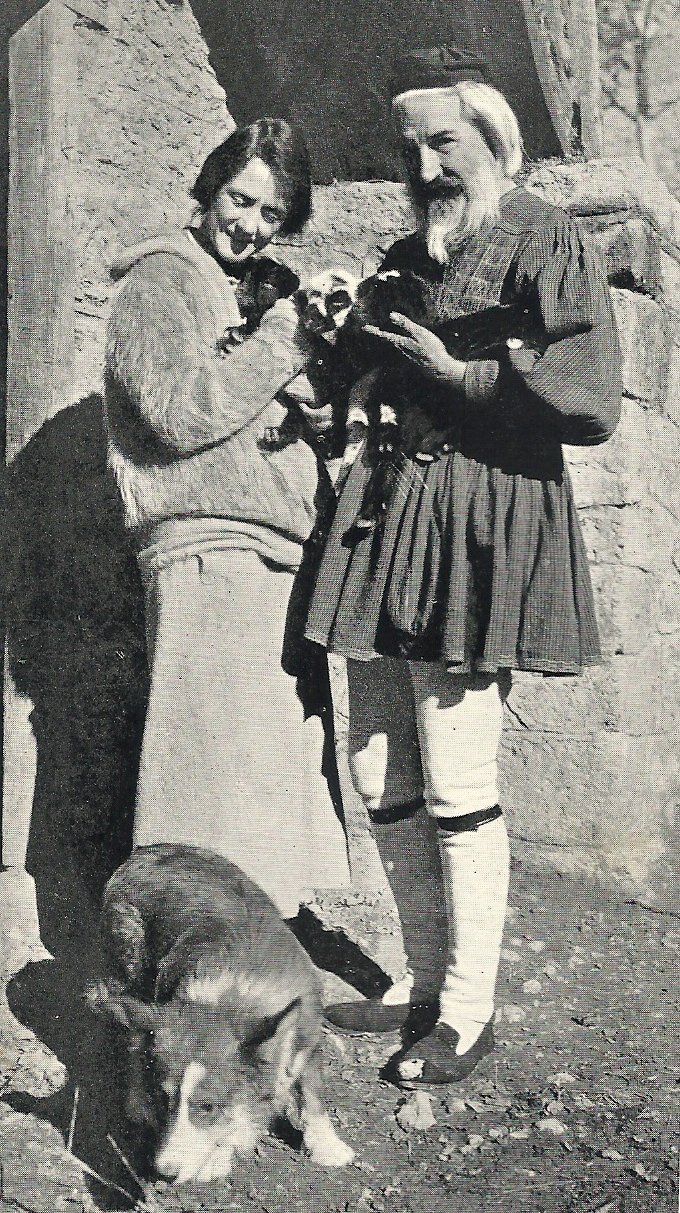
Susan Glaspell and George Cram Cook with their fatal puppy dog at Delphi, 1923.
In The Road to Temple, a biography of George Cram Cook, his wife, author Susan Glaspell wrote: “He liked the shepherd’s clothes, worn also by the peasants. A grey or black tunic, white tights of beautiful wool from the sheep of Parnassos, spun and woven by the women, heavy half-shoes crowned with poms-poms, and a little black skull cap.” Cook had adopted this attire when he decided to move to Greece in 1922 and make Delphi and Mount Parnassus his new home. By January 1924, Cook had died of glanders (contracted from his pet dog) and was buried at Delphi, a column drum from the Temple of Apollo marking his grave. Glaspell published The Road to Temple only two years later.
I did not know who George Cram Cook (nicknamed “Jig”) was until a few years ago. While reading the diaries of archaeologist Dorothy Burr Thompson, I discovered by happenstance the following entry for October 15, 1923: “At supper G. Cram Cook, husband of Susan Glaspell, appeared in Greek costume in the restaurant –looking handsome and ridiculous. He is writing four plays on modern Greece…” There is one more entry in Thompson’s diary about Cook. On January 16, 1924 she mentions his death: “G. Cram Cook died of hydrophobia in Delphi – poor man, his four plays unfinished.” One senses some slight sarcasm in her remark. Read the rest of this entry »
The Not-So-Shallow Waves of Cold War Cultural Diplomacy
Posted: July 16, 2013 Filed under: Archaeology, History | Tags: American Mission for Aid in Greece, American School of Classical Studies at Athens, Carl W. Blegen, Cultural Diplomacy, Evanthis Hatzivassiliou, John L. Caskey, Marshall plan and Greece, Stoa of Attalos 1 Comment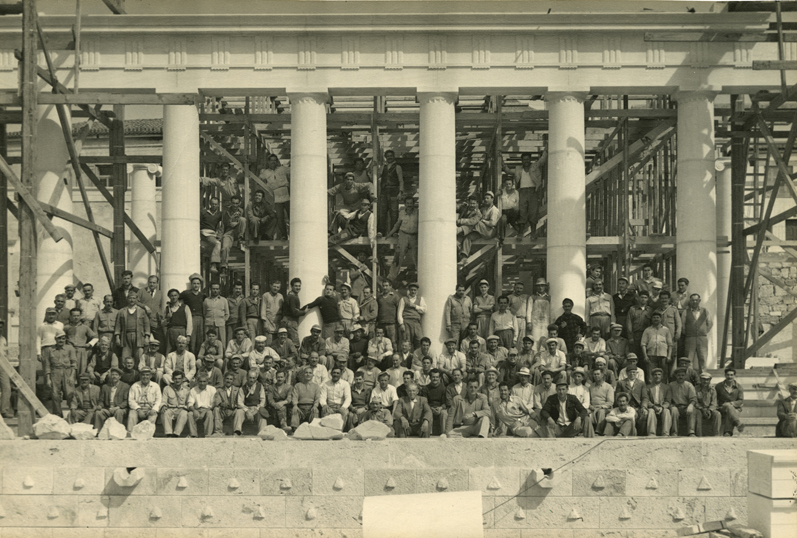
The marble carvers, carpenters, and workers who participated in the reconstruction of the Stoa of Attalos, 1955.
“Often one senses the feeling – and I have occasionally heard it put into words- that since Greece has culture and America money, each should contribute its own commodity to the collaborative enterprise. It is a European outlook, of course; not limited to Greece.”
The excerpt above was written in 1958 from the pen of John (Jack) Caskey, Director of the American School of Classical Studies at Athens (1949-1959). It epitomizes the perception that most Europeans had of America even after European culture had entered into its American phase. It is also a passage quoted in a brilliant review of the development of the Greek-American relationships from 1947 to 1961, published with the title “Shallow Waves and Deeper Currents: The U.S. Experience of Greece, 1947-1961. Policies, Historicity, and the Cultural Dimension,” by Evanthis Hatzivassiliou in Diplomatic History, vol. 37 (2013), pp. 1-28. Read the rest of this entry »
One Portrait, Three Institutions: Anders Zorn’s Portrait of William Amory Gardner
Posted: July 14, 2013 Filed under: Archaeology, Art History, Biography, Exhibits, History of Archaeology | Tags: American School of Classical Studies at Athens, Anders Zorn, Isabella Stewart Gardner Museum, The Groton School, William Amory Gardner 4 Comments
The cover of the exhibition catalog
From February 28 to May 13, 2013, the Isabella Stewart Gardner Museum in Boston hosted a large exhibit titled Anders Zorn: A European Artist Seduces America. The show re-evaluated the famous Swedish painter’s impact in the 1900s on America, where he was once held in high regard before being largely forgotten. The exhibit featured several international loans and was complemented by a series of lectures that experts on Zorn and his period presented.
Why am I writing about a retrospective on the activities of a Swedish painter in Boston? Because the American School of Classical Studies at Athens owns a portrait painted by Zorn—an image of William Amory Gardner (also known as WAG), the nephew of Zorn’s most important American patron and friend, Isabella Gardner. A balding WAG poses in three-quarter view while seated; he wears a black suit with an impressive red rose pinned on his left lapel. WAG himself never liked the portrait. Read the rest of this entry »

 From the Archivist's Notebook