Do I Really Want to Be an Archaeologist?
Posted: July 7, 2024 Filed under: Archaeology, Archival Research, Biography, Book Reviews, History of Archaeology, Mediterranean Studies, Modern Greek History, Philhellenism, Uncategorized, Women's Studies | Tags: American School of Classical Studies at Athens, Archaeology, Athens, College Year in Athens, Eugene Vanderpool, Franchthi Cave, greece, History, Karen D. Vitelli, Porto Cheli Project, travel 13 CommentsThe first time I heard her name was in 1986 at Tsoungiza, Nemea. I had just been awarded a Fulbright fellowship to go to Bryn Mawr College for graduate school. James (Jim) C. Wright, one of the cο-directors of the Nemea Valley Project and a Fulbright fellow himself extended an invitation to me, Alexandra (Ada) Kalogirou and Maria Georgopoulou, the other two Greek Fulbrighters, to join the excavation, as a way of becoming familiar with the American way of life and education system. Ada was going to go to Indiana University to study Greek prehistory with Thomas W. Jacobsen (1935-2017) and Karen D. Vitelli (1944-2023).
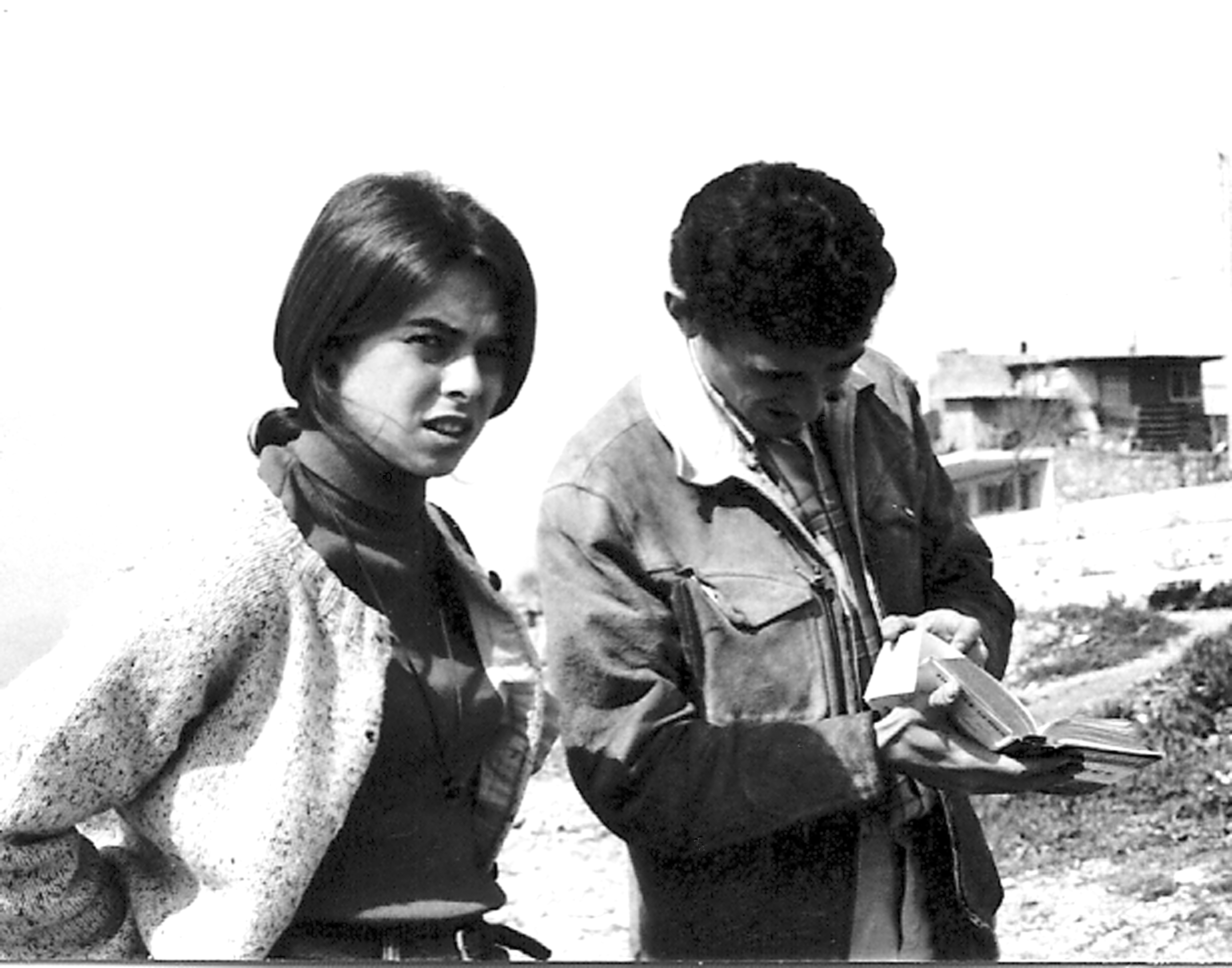
I must have heard about Vitelli on and off over the next 10-15 years, but I never met her in person. I didn’t even know what she looked like. Then, in 2010, as I was preparing an exhibition to celebrate the 130th anniversary of the American School of Classical Studies at Athens (the School, hereafter), I sent an email to various people asking for photos from the time they were students at the School. Stephen (Steve) G. Miller, former director of the School and a student at the School in the late 1960’s, sent me a few. One of the photos showed a tall, slim, dark-haired woman, who made an indelible impression on me. Several years later (2013), Kaddee (as she was known to nearly everyone) appeared at Mochlos together with her friend, archaeologist Catherine Perlès, at a wedding party for Tristan (Stringy) Carter, as guests of Tom Strasser, her former student. (By then Vitelli was Professor Emerita of Archaeology and Anthropology from Indiana University, Bloomington.) That was the first and last time I saw her in person.
Prevailing: Bert Hodge Hill (1910-1915)
Posted: May 4, 2024 Filed under: Archaeology, Archival Research, Biography, Classics, History of Archaeology, Uncategorized | Tags: art, Athens, Bert Hodge Hill, Edward D. Perry, Elizabeth Manning Gardiner, first-world-war, George W. Elderkin, greece, James R. Wheeler, Kendall K. Smith, women 2 CommentsIn my January post I explored the first term of Bert Hodge Hill’s long directorship (1906-1926) at the American School of Classical Studies at Athens (ASCSA or the School hereafter), which was the longest of any director. After a trial period with annual directors, the School introduced the five-year term with the possibility of one renewal. Rufus B. Richardson (1845-1914), Professor of Greek at Dartmouth, was the first director to serve two terms. He moved to Greece with his wife Alice Linden Bowen (1854-1948) and their two daughters, Lucy and Dorothy, setting up a bustling household and mingling with the local high society. The wedding of his oldest daughter Lucy to Arthur Morton Lythgoe (1868-1934), an American archaeologist working in Egypt, was the event of the year (1902) in Athens, attended by the Crown Prince and Crown Princess of Greece.
For Richardson’s successor the School appointed a young, highly promising scholar, Theodore W. Heermance, whose untimely death two years later (1905) from typhoid fever left the School in shock. One wonders what would have been the course of the School had Heermance lived longer. His successor Bert Hodge Hill was the first director at the School who was not a professor or held a Ph.D. Hill’s first term (1906-1911) was a trying experience, but he seemed to be able to deal with the challenges of an overseas post. Knowing some of Hill’s weak points –the most conspicuous being his inability to turn in anything in time– James R. Wheeler (1859-1918), the Chair of the School’s Managing Committee and Professor of Greek Archaeology and Art at Columbia University, kept a close eye on him during this first term.
Read the rest of this entry »Becoming: Bert Hodge Hill, 1906-1910 (Part I)
Posted: January 1, 2024 Filed under: Archaeology, Archival Research, Biography, Crete, History of Archaeology, Mediterranean Studies, Modern Greek History, Uncategorized | Tags: Archaeology, Athens, Bert Hodge Hill, europe, George W. Elderkin, greece, James R. Wheeler, Kendall K. Smith, Mochlos, Richard Berry Seager, Theodore W. Heermance, travel 10 Comments
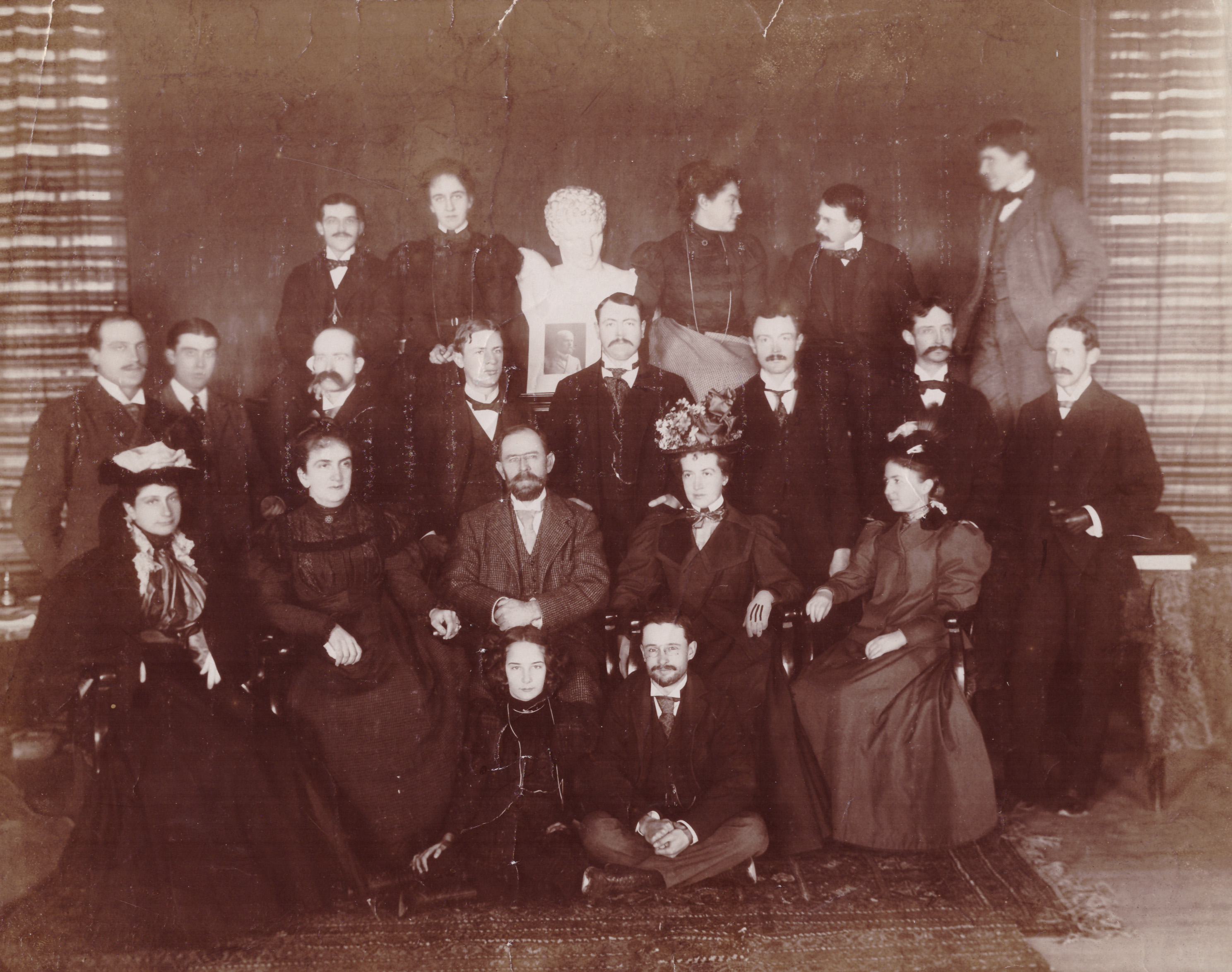
The re-discovery of a small cache of old photos depicting students at the American School of Classical Studies at Athens (ASCSA or School hereafter) from 1907-08 inspired me to write about the first years of Bert Hodge Hill’s directorship at the School. [1]
The photos depict four men and one woman: George Wicker Elderkin (1879-1965), Kendall Kerfoot Smith (1882-1929), Charles Edward Whitmore (1887-1970), Henry Dunn Wood (1882-1940), and Elizabeth Manning Gardiner (1879-1958). Of the five, Elderkin, Smith, and Wood were second year students at the School. In 1908, Elderkin, who already held a PhD from Johns Hopkins (1906), succeeded Lacey D. Caskey as Secretary of the School, a position he held for two years (1908-10). Smith came to the School in 1906 holding the Charles Eliot Norton Fellowship, established by James Loeb in 1901 for Harvard or Radcliffe students. Wood, a trained architect with a BS in Architecture from the University of Pennsylvania, was the second recipient of the Fellowship in Architecture (1906-08) that was funded by the Carnegie Institution in Washington.
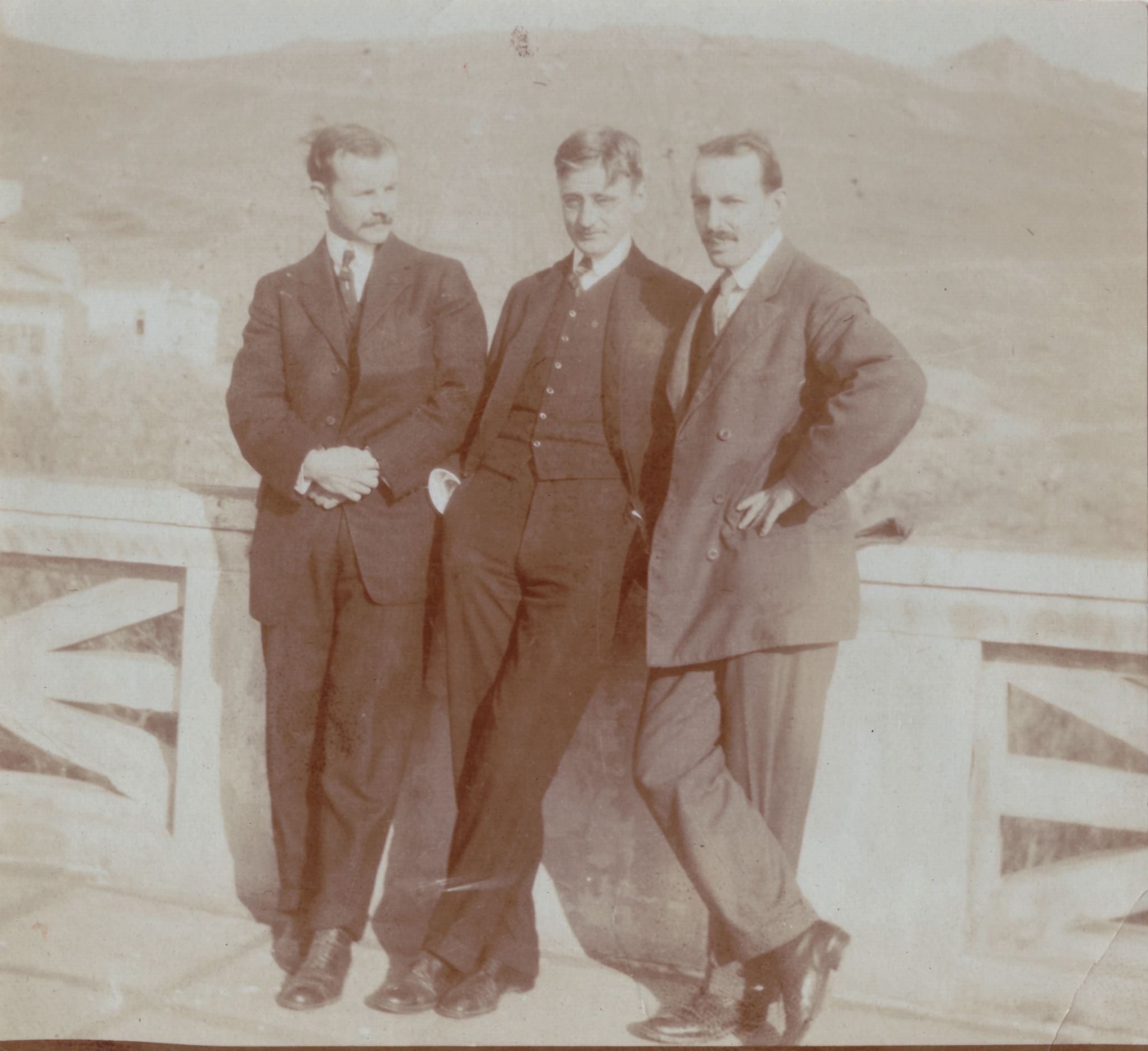
Of the new students, Whitmore, another Harvard man, was the Charles Eliot Norton Fellow for 1907, and Gardiner, the only woman in the photos, was a graduate of Radcliffe College (1901), with an MA from Wellesley (1906), and a recipient of the Alice Palmer Fellowship that supported female students.
Read the rest of this entry »Disjecta Membra: The Personal Papers of Minnie Bunker
Posted: July 8, 2023 Filed under: Archaeology, Archival Research, Biography, Classics, History of Archaeology, Mediterranean Studies, Women's Studies | Tags: Agnes Baldwin, Chaironea Lion, Charles Weller, Constitution Square, Πλατεία Συντάγματος, Minnie Bunker, Nancy Perrin Weston 9 Comments
We have been processing a large shipment of files that the Princeton office of the American School of Classical Studies at Athens (ASCSA or School hereafter) mailed to Greece during their relocation in 2021. The files contain many surprises, especially those associated with the production of the School’s Newsletter. There we found a trove of unpublished (and unknown) photos and among other material an envelope with letters, calling cards, and photos that once belonged to Minnie Bunker (1867-1959).
Minnie was a high school teacher and a student at the School in 1900-1901 who returned in 1906-1907 and again in 1911-1912. She also is no stranger to the School’s Archives which already contained a small collection of her water-damaged photographs and letters, as well as an 1894 Baedeker, which her grandniece Nancy Perrin Weston (1922-2011) mailed to Athens in the 2000’s. After her aunt’s death in 1959, Nancy also spent time in Greece, working for renowned architect Constantine Doxiadis and volunteering in the School’s Library from 1963-1964. Minnie must have transmitted her love for Greece and the School to her grandniece because in 2011, the year of Nancy’s death, the School received $25,000 from her estate.

The thrill of archival research is not limited to discovery but encompasses rediscovery. The envelope that we found in 2020 contained another small cache of Minnie Bunker papers that Weston had shipped to the School’s office in New York in 1981, when the School was actively looking for letters and photos of past students and members on the occasion of its upcoming centenary.
Mrs. Jarley’s Waxworks and a Jolly Jumble of Jests, Christmas 1903
Posted: June 19, 2022 Filed under: Archaeology, Archival Research, Biography, Classics, History of Archaeology | Tags: Edith Hall, Fritz Darrow, Gorham Stevens, Harold Fowler, Katherine Welsh, Lacey Caskey, Theodore W. Heermance, Theosophy 4 CommentsThe story of Mrs. Jarley’s Waxworks forms part of Charles Dickens’s novel The Old Curiosity Shop, published in 1841. Although Mrs. Jarley is a minor character in the plot, her story gained much popularity in British and American amateur theater and was performed widely at private parties in the 19th and early 20th centuries. Inspired by Madame Tussaud’s famous wax models, Dickens’s Mrs. Jarley was the proprietor of a collection of still wax figures which she displayed on a stage protected by a cord.
In 1873, George Bradford Bartlett (1832-1896), an American from Massachusetts, published Mrs. Jarley’s Far-Famed Collection of Waxworks. Enriched with more characters, real and fictitious, Bartlett’s book is essentially a guidebook for staging amateur performances with animated pantomimes, also known as tableaux vivants. Unlike Dickens, Bartlett’s waxworks were fitted with clockworks inside so that they could move and “go through the same motions they did when living.” Louisa May Alcott (1832-1888), the author of Little Women, frequently participated in tableaux vivants, with Bartlett as her stage manager (Chapman 1992).
These kinds of performances were often used as a vehicle for local fund-raising. Socialites such as Mrs. Astor and Mrs. Vanderbilt often hosted tableaux vivants with young, unmarried women of high society performing in various roles (Chapman 1992).
One such performance took place at the American School of Classical Studies at Athens (ASCSA or the School hereafter), on Christmas in 1903. It is one of these rare instances, where an event described blow-by-blow in a private letter, has also its visual match. In the School’s large Archaeological Photographic Collection (APC), in addition to photos documenting excavation and other fieldwork, there is a small number of images capturing more private aspects of life at 54 Speusippou (now Souidias).

According to the author of the letter, Theodore Woolsey Heermance (1872-1905), the idea of a party inspired by Mrs. Jarley’s Waxworks belonged to Mrs. Fowler, “who had seen and participated in several such.” Heermance was the new director of the School, having started his term in the fall of 1903. Just a year over thirty, he had studied at Yale and was the grandson of Theodore Dwight Woolsey, President of Yale University from 1846 to 1871. Helen Bell Fowler (1848-1909) was the wife of Harold Fowler, the School’s Professor of Greek Language and Literature for the academic year 1903-1904.
DRAMATIS PERSONAE
If the original idea of a tableau vivant belonged to Mrs. Fowler, it was Edith Hall “who took the matter up with her usual energy and consented to be Mrs. Jarley. Between them and Miss Welch [Welsh] – a member of the British School, who lives at the same pension as Miss Hall- they planned for the different parts,” wrote Heermance to his mother and sister on December 27, 1903. He further described the costumes “as more or less burlesque, otherwise with a limited outfit they would have fallen rather flat.”
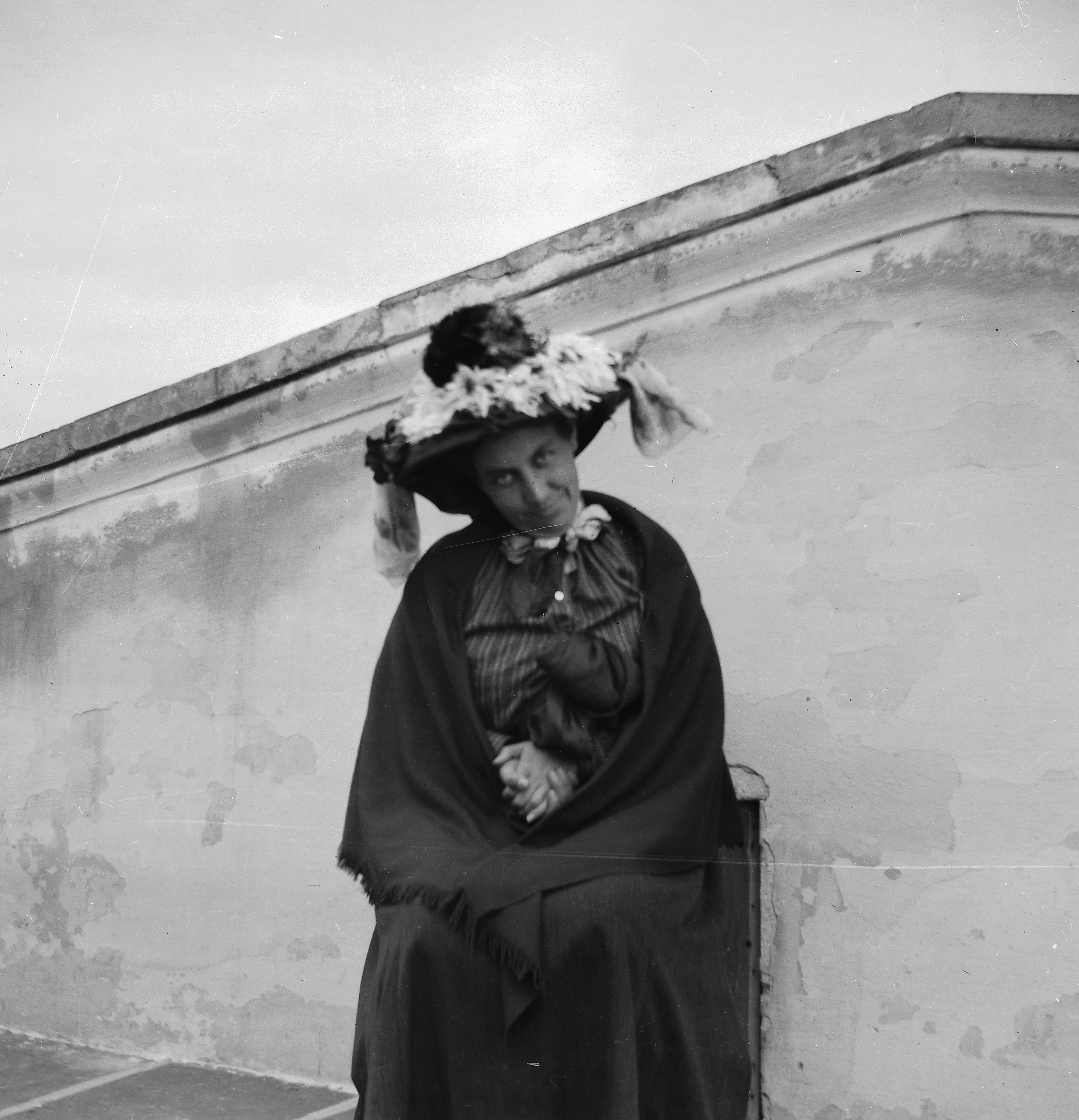
Edith Hayward Hall (1877-1943) was the Agnes Hoppin Memorial Fellow and the only female student at the School that year. Having earned a B.A. from Smith College, Hall had enrolled at Bryn Mawr College for graduate school. That Christmas “Miss Hall as Mrs. Jarley was capital and with a big hat on kept up a continuous stream of description of her automations and of banter with the audience” wrote Heermance and went on to describe the wax figures “in the order they were uncovered and set agoing.”
“Darrow was Xerxes in a golden crown and neck ornaments and red robes. His business was to rise from his throne three times as Xerxes is said by Herodotus to have done on one occasion in anger.” Heermance is referring to a passage from Book VII of Herodotus that describes the Battle of Thermopylae: “And during these onsets, it is said that the king, looking on, three times leaped up from his seat, struck with fear for his army” [7. 212].
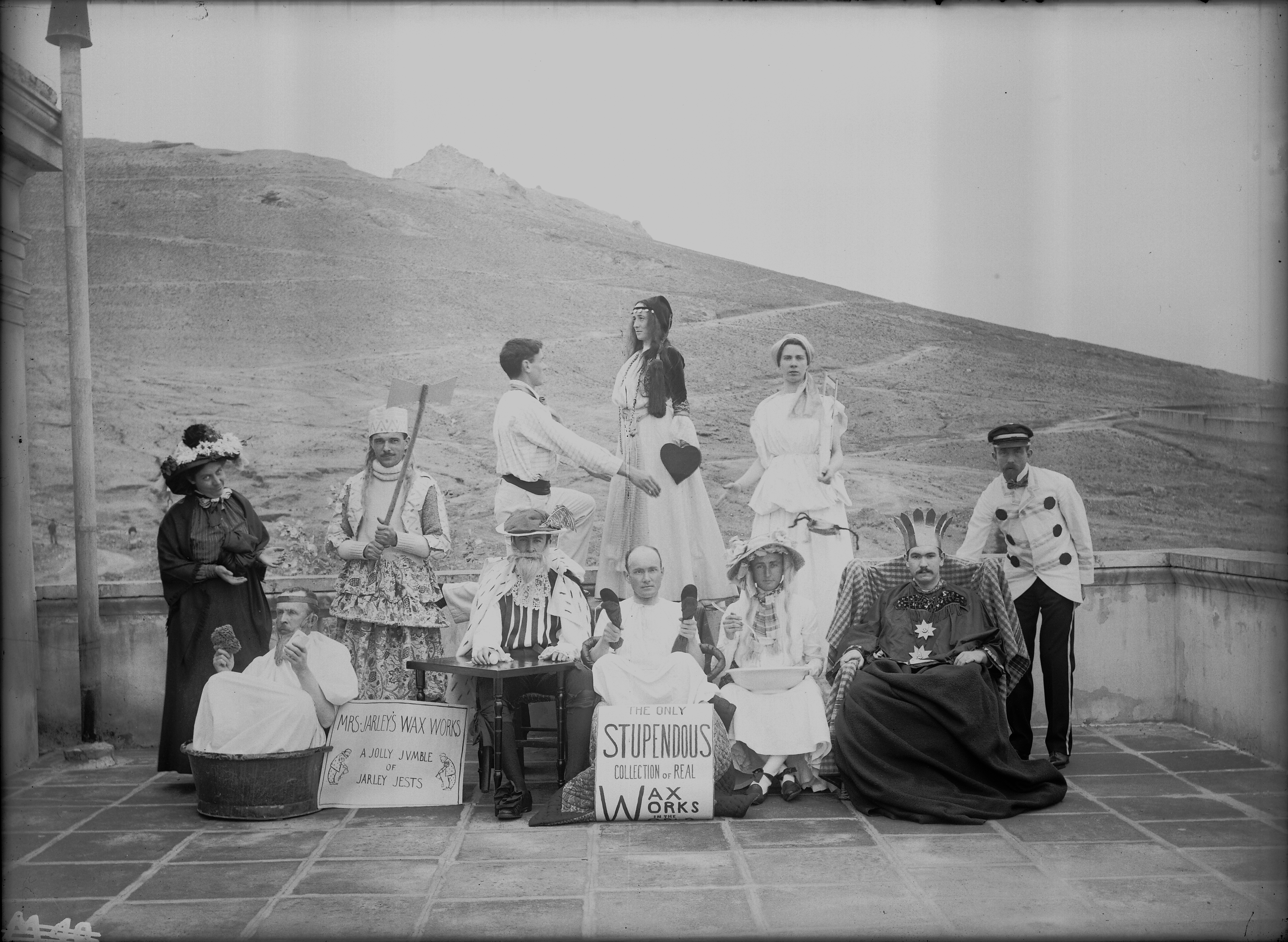
Front row (l-r): Harold Fowler (Agamemnon), Lacey Caskey (Columbus), William Battle (Baby Heracles), Gorham Stevens (Miss Muffet), Fritz Darrow (Xerxes). Back row (l-r): Edith Hall (Mrs. Jarley), Robert McMahon (Klytaimnistra), Harold Hastings (Lord Byron), May Darrow (Zoe or Maid of Athens), Katherine Welsh (Sappho), and Theodore Heermance (Mrs. Jarley’s Assistant).

 From the Archivist's Notebook