Henry Miller’s Timeless Greece through the Drawings of Anne Poor
Posted: June 1, 2015 Filed under: American Studies, Archival Research, Mediterranean Studies, Modern Greek History, Modern Greek Literature, Philhellenism | Tags: Anne Poor, George Katsimbalis, George Seferis, Henry Miller, Lawrence Durrell, Michel Déon, The Colossus of Maroussi 4 Comments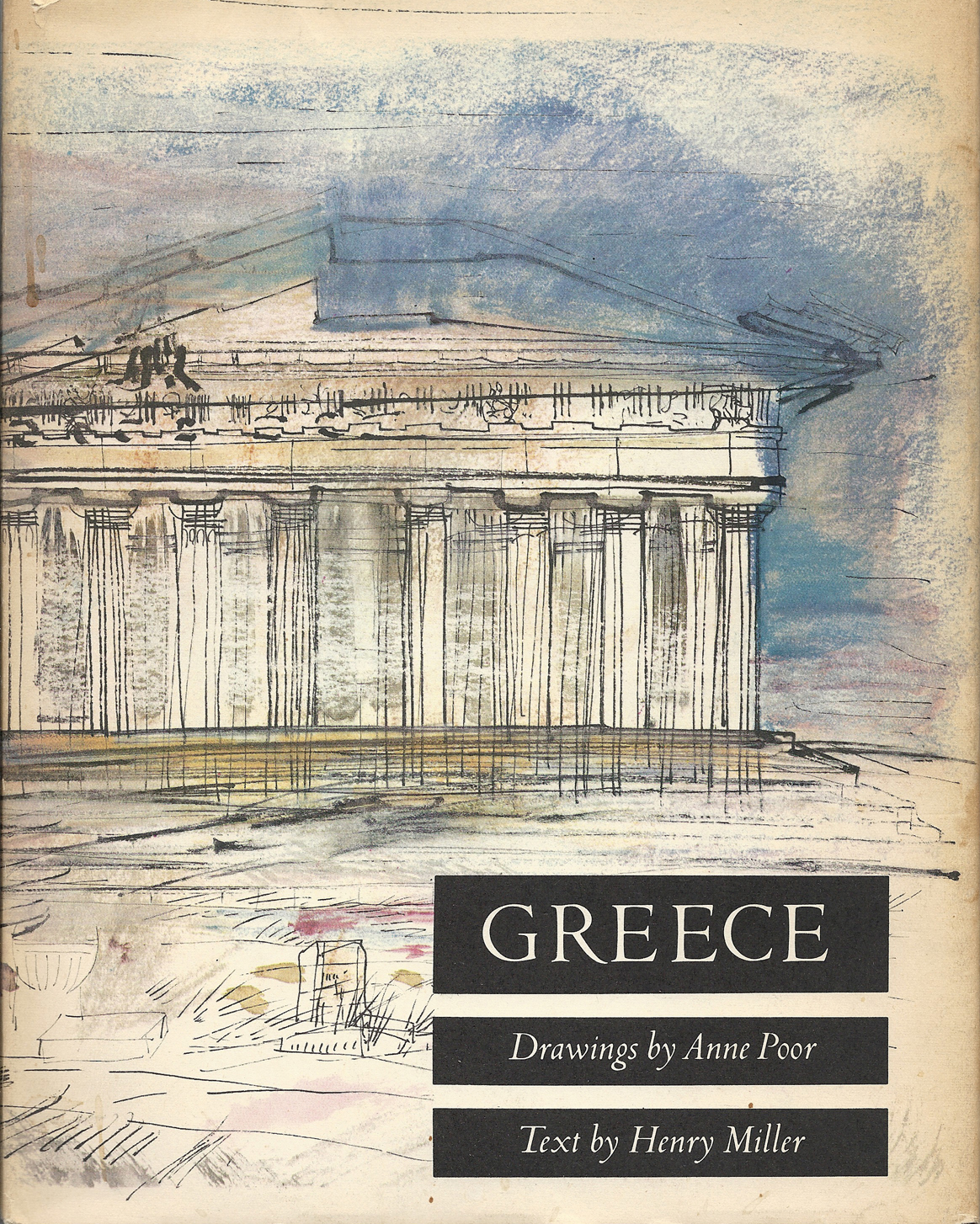
Of Job Security, Personal Dignity, and Efficiency Wages: ASCSA Trustee Fred Crawford and his Corporate Philosophy
Posted: March 2, 2015 Filed under: American Studies, Archival Research, Corporate History | Tags: American School of Classical Studies at Athens, Frederic C. Crawford, John Elton Mayo, John McCloy, Mark Bertolini, Thompson Products, TWR (Thompson Ramo Wooldridge), Ward Canaday, welfare capitalism, Yannis Varoufakis Leave a comment
Excerpt from “The Financial Page,” The New Yorker, Feb. 9, 2015.
Recently on the financial page of The New Yorker (February 9, 2015) staff writer James Surowiecki published “A Fair Day’s Wage,” an article about the decision by Aetna, one of the largest U.S. companies, to increase its lowest wage from twelve to sixteen dollars an hour and offer an improved package of medical coverage. In an era plagued by high unemployment and few raises for the majority of the nation’s workforce, Mark Bertolini, the idiosyncratic C.E.O. of Aetna, made the bold decision to increase the lowest salaries at his company by 33%. “It is not fair for employees of a Fortune 50 company to be struggling to make ends meet” said Bertolini. In addition to a near-to-death personal experience, Bertolini claims that reading Thomas Piketty’s influential Capital in the Twenty-First Century (which he also gave to all of his top-executives) made him realize how income inequality had increased significantly since 2000. Surowiecki, moreover, reminds readers that the benefits of US economic growth in the post-war era prior to 2000 had generally been shared broadly, and that “US companies were responsible not only to their shareholders but also to their workers.” Recent studies have, in fact, shown that companies that invest in workers’ training, reward them with “efficiency wages,” and care about their mental well-being also end up flourishing through the efforts of dedicated employees. “It’s hard for people to be fully engaged with customers when they’re worrying about how to put food on the table,” Bertolini told Surowiecki. (For a more recent interview with Bertolini in The New York Times, see David Gelles, “At Aetna, a C.E.O.’s Management by Mantra,” Feb. 27, 2015). Read the rest of this entry »
A Mycenaean “Matter of Fact”: Part I, Joe Alsop Reports on the Greek Bronze Age
Posted: February 1, 2015 Filed under: American Studies, Archaeology, Archival Research, History of Archaeology, Mediterranean Studies | Tags: American School of Classical Studies at Athens, Carl W. Blegen, From the Silent Earth, Joseph W. Alsop, Maurice Bowra, Pylos Excavations, Susan Mary Alsop Leave a commentJack L. Davis, Carl W. Blegen Professor of Greek Archaeology at the University of Cincinnati and a former director of the American School of Classical Studies at Athens (2007-2012), here contributes to The Archivist’s Notebook an essay about political columnist Joseph Alsop and his passion for the prehistoric archaeology of Greece.
Several months ago Louis Menand’s New Yorker review (Nov. 10, 2014) of Gregg Herken’s The Georgetown Set: Friends and Rivals in Cold War Washington kindled my interest in Joseph W. Alsop (1910-1989), influential journalist, syndicated newspaper columnist, and trustee (1965-1985) of the American School of Classical Studies at Athens. A bit of archival sleuthing at the University of Cincinnati (see below) led to the discovery that on Saturday, December 14, 1963, Alsop had summoned an A-list of Classical archaeologists and art historians to dine with him and his wife, Susan Mary, in their Georgetown, Washington, D.C., home — a strange flock for this longtime Washington insider to host.

On the cover, Joseph and Stewart Alsop (photo by Henri Cartier-Bresson)
Guests included Jack and Betty Caskey, professors at the University of Cincinnati, Emmett Bennett, professor at the University of Wisconsin, Emily Vermeule, then professor at Boston University, Cornelius Vermeule, curator of Classical art at the Boston Museum of Fine Arts, and Sterling Dow, professor at Harvard. Read the rest of this entry »
“So very far away, but maybe it’s only yesterday”: Greece in Crisis, 1964, 2014.
Posted: December 1, 2014 Filed under: American Studies, Archaeology, History of Archaeology, Modern Greek History | Tags: Admiral's House, American School of Classical Stusies at Athens, Athenian Agora, Corinna Tsopei, Corinth Excavations, Gennadius Library, George Papandreou, Greece 1964, Henry Robinson, Ioannis Papademetriou, MONUMENTA, Spyros Skouras, Ward Canaday Leave a comment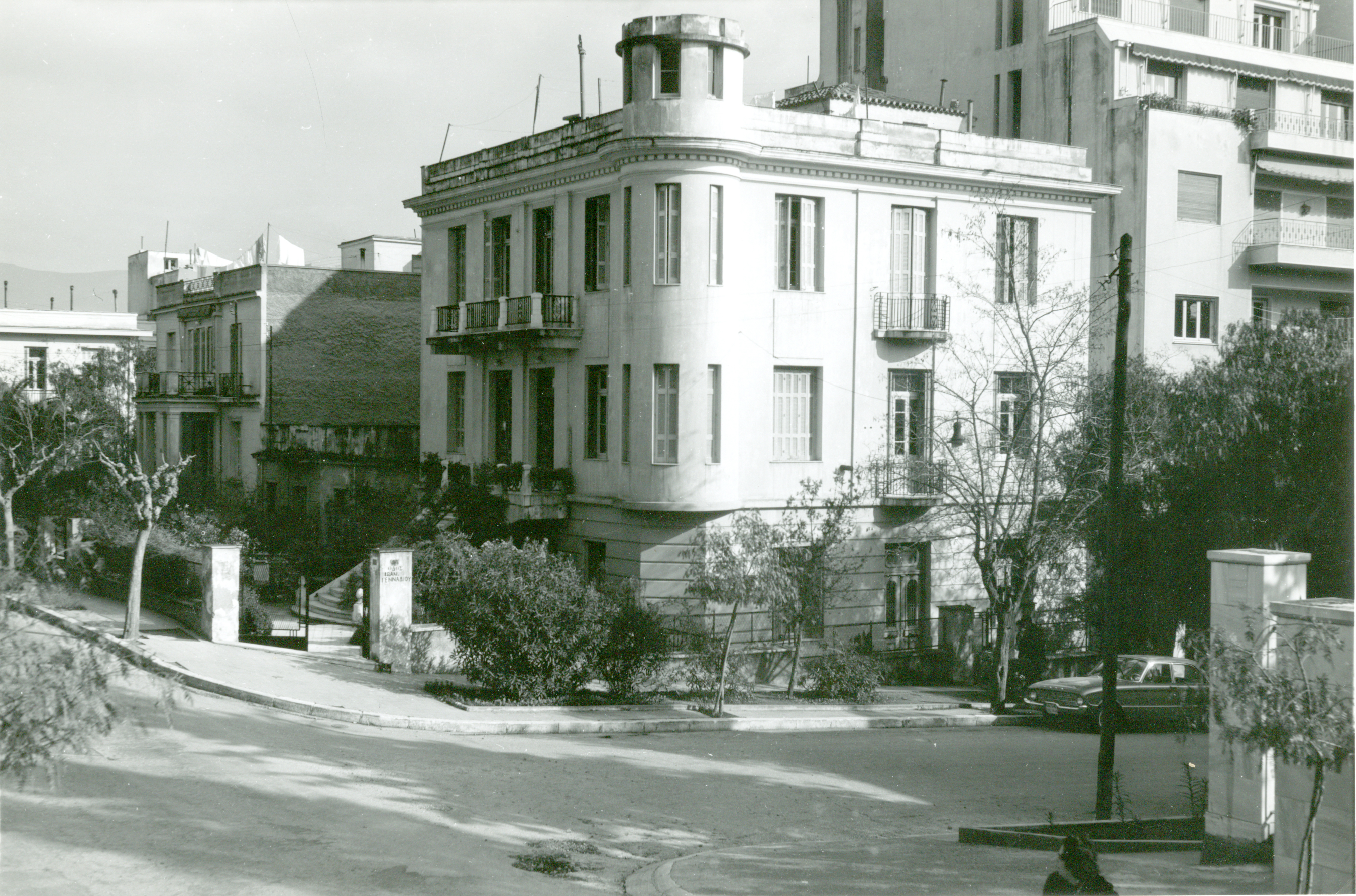
The Admiral’s House, 1964 (ASCSA Archives, Administrative Records)
“The decision made at the last Board of Trustees meeting… was to appoint a committee… to make an immediate study and prompt report on the Admiral’s House which as you know the School for some time has had the opportunity to buy. Will you, as Chairman of the Committee of the Admiral’s House, be good enough to write immediately to Henry Robinson, asking him to request [of] Mr. Kyriakides that he make a careful report as to the desirability of the house, the possibility of obtaining it and an appraisal not only of the price which the School should be willing to pay for it, but also his estimate of the price the owners would accept, the best terms available, the cost of maintenance, the cost of repairs or changes the School would need to make, the use to be made of it by the School, the income which the School would expect to receive from it, and the estimated cost of taxes or any other expenses which would be involved by the School in the advent of its purchase” wrote on December 7, 1964, Ward Canaday, chairman of the Board of Trustees of the American School of Classical Studies at Athens (ASCSA) to Charles Morgan, Trustee of the School and one of its former directors (1936-1938), and chair of the Managing Committee (1950-1960). Read the rest of this entry »
“A Greek Author Travels to the Country of the New Myth”: The Voyage of Elias Venezis to America in 1949
Posted: April 1, 2014 Filed under: American Studies, Book Reviews, Intellectual HIstory, Modern Greek History, Modern Greek Literature | Tags: American School of Classical Studies at Athens, Andreas Karantonis, Eleni Nikolaidi, Elias Venezis, Gennadius Library, Αμερικανική γη, Γιώργος Θεοτοκάς, Δοκίμιο για την Αμερική, Ηλίας Βενέζης, Land of America, Yiorgos Theotokas 6 CommentsThis essay comprises the text of a talk that I presented in the Cotsen Hall auditorium of the American School of Classical Studies at Athens (ASCSA), April 9, 2013, at an evening devoted to novelist Elias Venezis, whose papers reside in the ASCSA Archives. The text was also published (in Greek ) in the “Athens Book Review,” in an issue dedicated to Venezis. Since my essay discusses two of Greece’s most important novelists’ impressions from their journeys to America, I thought that it also deserved to be published in English and be made available to an American audience (here, I must thank my friend and former colleague Stefanie Kennell for her wonderful translation). For half of my life I have studied and worked in a Greek-American environment; there interest lies in examining how foreigners (usually described as philhellenes) perceive(d) Greece, and it is rarely discussed, at least in the broader community of the American School, how Greeks experienced America at critical times, such as in the first decade following WW II. The two authors, Elias Venezis and Yiorgos Theotokas, traveled in America during the period of the Marshall plan and the beginning of the Cold War, just before strong anti-Americanism began developing in Greece. For both, the voyage to America was a journey to a mythical land — as implied by the title of this essay, which is drawn from the title of a talk (“Ένας Έλλην συγγραφεύς στη χώρα του νέου μύθου”) that Venezis delivered at the Greek American Cultural Institution in 1950, immediately after his return from America.

“The Thirties Generation” in 1963
For those who are not familiar with Modern Greek Literature, I should also add a few remarks about the so-called literary “Generation of the Thirties.” As commonly employed, this term describes a group (all male) of novelists, poets, and artists, who came of age in the 1930s. These men continued to be very productive and influential in the following three decades, to the point that a myth with regenerative power was built around them, one that still aspires and inspires (Leontis 2013). Nobel-prize laureate poets Yiorgos Seferis and Odysseus Elytis, novelists Angelos Terzakis, Stratis Myrivilis, Elias Venezis and Yiorgos Theotokas, are some of the most accomplished and distinguished “members” of the “Generation of the Thirties.” The personal papers of most of them have been deposited at the American School of Classical Studies.

Elias Venezis
In 2009, at an event devoted to Yiorgos Theotokas and the republication of his Essay on America, I was introduced to Greek travel literature about America. Theotokas was among the first writers of the so-called “Generation of the Thirties” who visited America a few years after the end of World War II. While taking receipt of Elias Venezis’s personal papers in 2010, I came upon the manuscript of Land of America and then, in discussions with the author’s daughter, Anna Venezi Kosmetatou, I was made aware of the fact that Venezis was actually the first of the famous “Generation of the Thirties” to travel to the U.S., in 1949.
Except for Theotokas’ Essay on America (Δοκίμιο για την Αμερική), which had the good fortune to be re-published a few years ago, travel writing of this type is difficult or impossible to find on the shelves of Athenian bookstores. When I looked for Land of America at a well-known bookstore in downtown Athens, clerks told me that it was the first time they had heard that Venezis had written a book of this sort. Perhaps this is because, in the age of globalization, trips to America have lost some of the magic and myth that used to surround them. Already in the 1970s, as Vassilis Lambropoulos writes, “with the spread of cinema and even more the advent of television in Greece, travel writing is losing its primary function and sparkle. The public does not need the guidance of an eyewitness to get to know foreign countries.”

Αμερικανική γη (Land of America) by Elias Venezis
Unlike the other writers and intellectuals who visited the U.S. in the 1950s and 1960s, Venezis began his long journey without the support of the American government. The famous program of cultural exchanges sponsored by the the U.S. Information and Educational Exchange Act of 1948, popularly known as the Smith-Mundt Act, does not seem to have been implemented immediately in Greece. What is certain is that Elias Venezis and his wife either did not know about or did not expect American government support when they decided in the summer of 1949 to cross the Atlantic. On the opposite shore was Venezis’s brother, Thanos Mellos and his wife, the mezzo-soprano Eleni Nikolaidi, who had settled there just a year before.
Thanos Mellos wrote to his brother Elias and his wife on May 6, 1949, from New York: “I’ve told Elias that a place has been confirmed for his trip to America on a merchant ship that sails from a port in France. Perhaps there’s a way he can embark even from Greece. The trip won’t cost a cent. The steamship owner’s a friend of ours, and he’s offering it to us for free. You only have to get your papers ready, Elias, and send me a telegram.” Read the rest of this entry »

 From the Archivist's Notebook