Connecting the Dots: Peripheral Figures in the History of the American School of Classical Studies. The Case of R. S. Darbishire.
Posted: November 2, 2018 Filed under: Archaeology, Archival Research, Biography, History of Archaeology, Modern Greek History, Philhellenism | Tags: Arnold J. Toynbee, Athens College, Elizabeth Darbishire McNeill, Oscar Broneer, Robert S. Darbishire, William H. McNeill 14 CommentsRevised on July 30, 2022, following communication with the McNeill family. See my endnote.
Steve Jobs once said: “You can’t connect the dots looking forward; you can only connect them looking backwards.” Archives is all about connecting the dots. When processing archival material, you often come across documents, photos, or notes that don’t connect in any obvious way with the rest. For this reason, all finding aids have a “Miscellaneous” section. And such is the case of R. S. Darbishire (1886-1949), a name I came upon in the Carl W. Blegen Papers several years ago, in a booklet of poems; and more recently, while going through a small box of unprocessed material from the Blegen/Hill household on Ploutarchou 9, in a set of architectural blueprints. It took me a while to connect the dots in the Darbishire puzzle.
The Elusive Mr. Darbishire
ASCSA Archives, Carl W. Blegen Papers
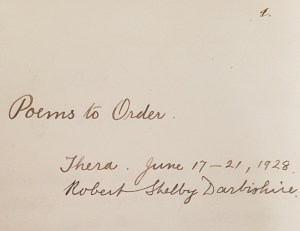
In the Blegen Papers, there is a small booklet with a collection of handwritten poems titled “Poems to Order. Thera, June 17-21, 1928. Robert Shelby Darbishire.” The short poem on the first page is dedicated to CB:
Εξ αδοκήτο [Unforeseen]
You, when I asked, “What shall I do in Thera?”
Unexpectedly in my empty mind
Casually dropped this: “Write pretty!”
Here (unexpectedly) nought else I find.
Darbishire appears in the student list of the American School of Classical Studies (ASCSA, or School hereafter) for the year 1926-27; he is also thanked in the preliminary reports or final publications of a number of excavations conducted in 1927-1928: Prosymna, the Odeum at Corinth, and Olynthus.
There is very little information about Robert Shelby Darbishire on the web, and one has to type his name in various ways in order to retrieve a few scraps. Born in 1886 at Fort Meade, Florida, he was the son of Godfrey Darbishire (1853-1889) -a British surveyor and a famous rugby player, who immigrated to the States in 1883– and Ann Shelby of Lincoln, Kentucky. Robert was unfortunate to lose his father at an early age. Mother and son lived for a while on a farm they owned in Danville, Kentucky before they moved back to England to be near the paternal side of the family. (Darbishire’s grandfather was Robert Dukinfield Darbishire, a well-known philanthropist and lawyer from Manchester.) Nevertheless, the Kentucky farm remained in the Darbishire family’s possession for a long time; mother and son would move back to it after the death of Robert Dukinfield in 1910; and Robert Shelby would retreat to the farm in various periods of his life. In fact, the family papers are deposited at the University of Kentucky Special Collections, and it is from their finding-aid that I managed to obtain good and reliable information about the Darbishires.
“They returned… but stay I did”: Doreen Canaday’s Experience of Interwar Greece
Posted: October 3, 2018 Filed under: Archaeology, Archival Research, Biography, Book Reviews, Classics, History of Archaeology, Philhellenism, Women's Studies | Tags: Doreen Canaday Spitzer, Mariam Coffin Canaday, Ward Canaday 1 CommentI first encountered the name “Canaday” in the mid-1980s when I went to Bryn Mawr College for graduate school. Although we did most of our work in the seminar rooms above the Art and Archaeology Library (now the Rhys Carpenter Library), for books and periodicals about history or classics we had to go to the “big library,” which was none other than the Mariam Coffin Canaday Library.
A few years later when I returned to Greece to participate in the regular program of the American School of Classical Studies at Athens (ASCSA, or the School hereafter), I heard people referring to Canaday House. One of the two marble houses flanking the Gennadius Library at 61 Souidias, it housed temporarily the family of the then Director of the School William (Willy) D. E. Coulson. (The big earthquake of 1986 in Kalamata had caused damages to the Director’s residence across the street.)
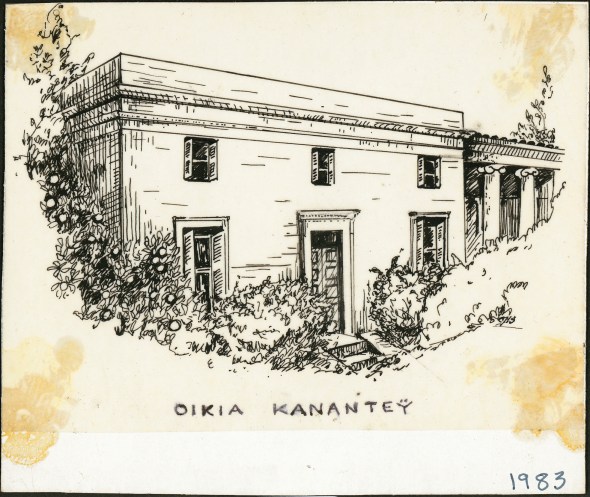
An ink drawing of the Canaday House at the American School of Classical Studies at Athens. ASCSA Archives, Doreen Canaday Spitzer Photographic Collection.
Finally, in the summer of 1990, while digging at Mochlos on Crete, I met Doreen Spitzer on one of the “On-Site with The American School of Classical Studies at Athens” trips that she had been organizing for years, but without realizing that Doreen Spitzer’s maiden name was Canaday. It was only after I started working as the School’s Archivist that I became aware of Canaday Spitzer’s long legacy at the American School. Doreen Canaday Spitzer (1914-2010) served as a Trustee 1978-1996, President of the Board of Trustees 1983-1988, Trustee Emerita from 1996 and President of the Friends from 1988 until her death in 2010. (There is a thorough biographical essay about Doreen Spitzer by Catherine de Grazia Vanderpool in AKOUE 63, Fall 2010.) Her father, Ward Canaday (1885-1976), had also served as a Trustee of the School for almost four decades starting in 1937.
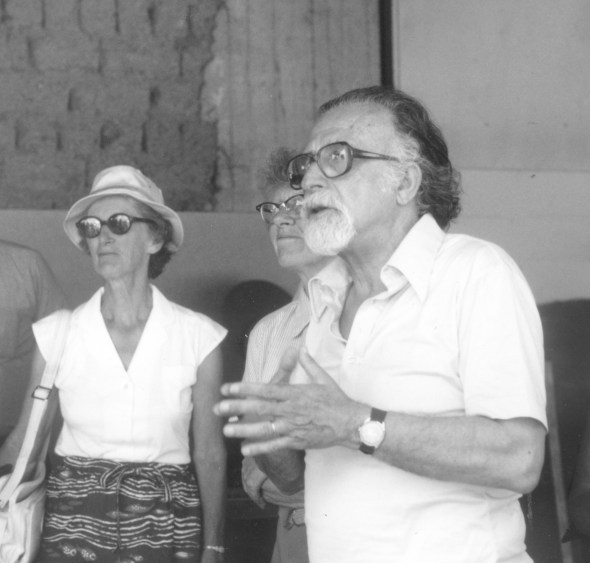
Doreen Canaday Spitzer listening to Manolis Andronikos, excavator of the royal tombs at Vergina, 1981. (Between them, barely visible, Machteld Mellink.) Source: ASCSA Archives.
Spitzer also cared deeply about preserving the School’s history and supported wholeheartedly the creation of an Archives Department during her term as President of the Board. Furthermore, she would contact School members, many of whom she knew personally from her time as a student of the School in 1936-1938, to solicit their personal papers. No wonder why my formal title is the Doreen Canaday Spitzer Archivist. Needless to say that it would have pleased her immensely to see our new and enlarged facilities at the East Wing of the Gennadius Library. Read the rest of this entry »
Rediscovering the American Pioneer Spirit in Greece, 1928: The Letters of Robert Stroock
Posted: August 1, 2018 Filed under: Archaeology, Archival Research, Biography, Greek Folklore, History of Archaeology, Jewish Studies, Philhellenism | Tags: Robert L. Stroock, Sol M. Stroock 10 CommentsIn the Main Reading Room of the Carl and Elizabeth Blegen Library in Athens, on the narrow side of one of the old bookcases, hangs a heavy bronze plaque inscribed: “In Memory of Robert L. Stroock: A Lover of Ancient Greece. MCMXXX”.
Unlike other commemorative plaques at the American School of Classical Studies at Athens (ASCSA or the School hereafter) which have often changed locations or even have been withdrawn from public view over the years, this one has remained in the same spot since it was dedicated shortly after Stroock’s death in 1930.
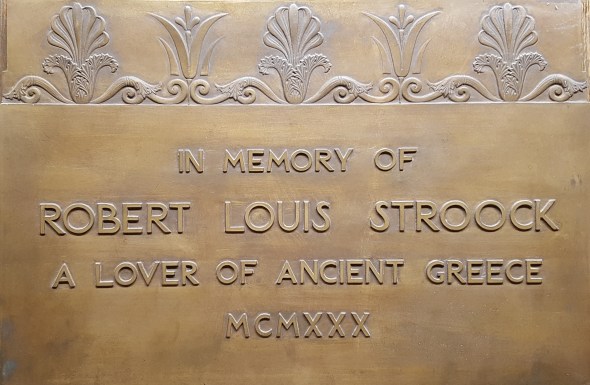
On display in the Carl and Elizabeth Blegen Library of the American School of Classical Studies at Athens
Hetty Goldman: The Potentate of American Archaeology in Greece
Posted: July 3, 2018 Filed under: Archaeology, Archival Research, Biography, History of Archaeology, Mediterranean Studies, Women's Studies | Tags: Alice Leslie Walker Cosmopoulos, Bert Hodge Hill, Eutresis Excavation, Halae Excavations, Hetty Goldman, Piet de Jong 13 CommentsIn 1924, Hetty Goldman (1881-1972), who was directing an excavation at the site of Eutresis in Boeotia, hired architect Piet de Jong to draw some of the finds she had unearthed during the season. To beat the dullness of the evenings, De Jong, who worked for American and British excavations in Greece, made pencil caricatures of his fellow archaeologists which he later turned into striking Art Deco watercolors. The majority of these caricatures once in the possession of Sinclair and Rachel Hood, are now in the care of the Ashmolean Museum. Published by Rachel in Faces of Archaeology in 1998, they constitute visual biographies of American and British archaeologists working in Greece in the 1920s and 1930s.
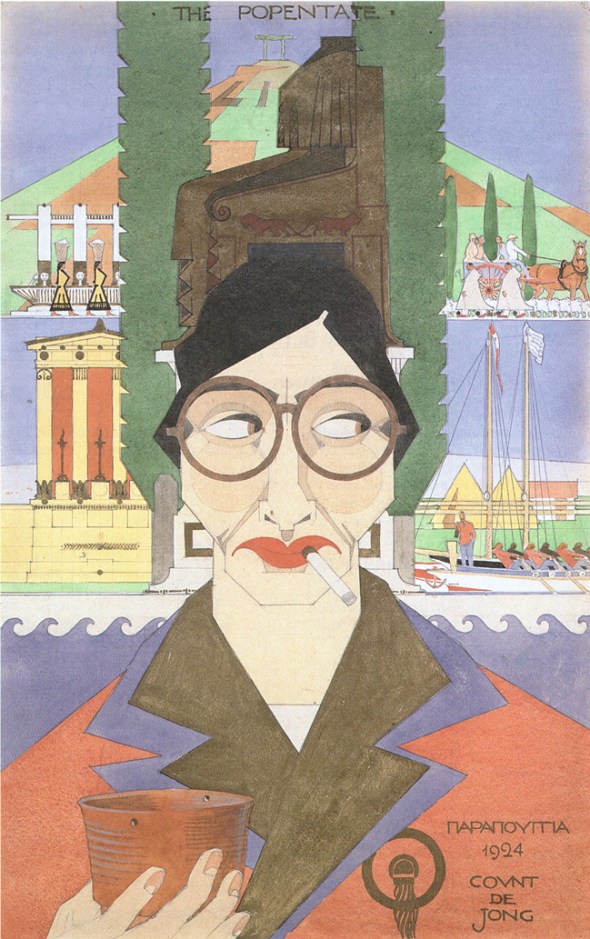
Hetty Goldman’s caricature by Piet de Jong, 1924. Image reproduced with kind permission of Ashmolean Museum, University of Oxford.
De Jong’s caricature of Goldman depicts her “holding a Neolithic pot of which she was particularly proud. The object behind Hetty’s head is a seated archaic statue found up in a Roman villa which was excavated at some distance from the mound [of Eutresis]… There is the mound itself surmounted by the shelter to protect the diggers from the heat of the sun… The horse, Kappa, on the road below the hill to the right draws the cart containing Hetty herself, Hazel [Hansen], Dorothy [Thompson] and Mitso the driver, on their way to work… a sailing boat or caique refers to the expedition organized by the foreman, George Deleas, to try and row across the Gulf of Corinth from Creusis, the harbor settlement of Eutresis. On the left of the picture at the foot of the mound two village girls with long plaits carry on their heads baskets of washing… Below them is a temple which probably refers to classical architectural findings at Hetty’s previous dig at Halae…” (Hood 1998, p.51). Read the rest of this entry »
The Riding Goddess of Mycenae
Posted: April 2, 2018 Filed under: Archaeology, Archival Research, Biography, History of Archaeology, Mediterranean Studies | Tags: George Mylonas, Γεώργιος Μυλωνάς, Ιωάννης Παπαδημητρίου, Μυκήνες, John Papademetriou, Katherine Biddle More, Mycenae, Nikolaos Tombazis 4 Comments“In the summer of 1954, while Dr. Papademetriou and I were investigating the new Grave Circle of Mycenae, we removed the fill to the south of that circle; it proved to have been the dump of a previous excavation. Its position seems to indicate that in all probability it was made up of earth removed either by Mme Schliemann or by Tsountas from the dromos of the Tomb of Clytemnestra. Among other objects found in this earth were two carved gems, one of which bears the figure of an animal, and the other a design not only interesting for its excellence of its workmanship but also important because of the subject represented,” wrote archaeologist George Mylonas in the introduction of his book Ancient Mycenae: The Capital City of Agamemnon (Princeton 1957).
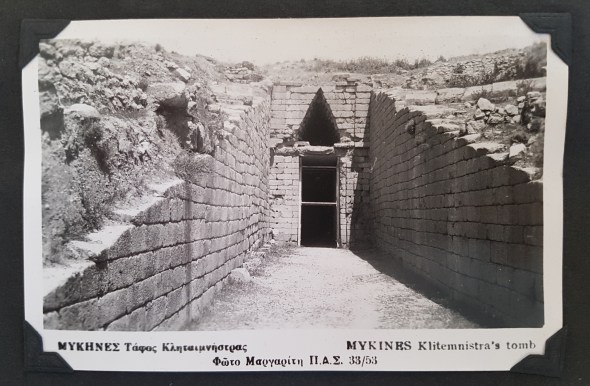
Tomb of Clytemnestra, 1953. Photo: ASCSA Archives, Katherine Biddle More Scrapbook.
The Accidental Discovery of Grave Circle B
The Tomb of Clytemnestra had been robbed by Veli Pasha, the Ottoman Governor of the Morea, in the early 19th century; he had, however, missed the dromos. Years later, in 1876, it was cleared by Sophia Schliemann, while her husband Heinrich was digging the shaft graves of Grave Circle A. The Tomb was properly excavated by Christos Tsountas in 1897, who conducted excavations at Mycenae from 1886 until 1902. After WW II, the Greek Archaeological Service undertook the restoration of the Tomb of Clytemnestra, which, by then, was falling apart and needed urgent care. The restoration, which started in the spring of 1951, was completed by the fall of that year. Read the rest of this entry »

 From the Archivist's Notebook