Becoming: Bert Hodge Hill, 1906-1910 (Part I)
Posted: January 1, 2024 Filed under: Archaeology, Archival Research, Biography, Crete, History of Archaeology, Mediterranean Studies, Modern Greek History, Uncategorized | Tags: Archaeology, Athens, Bert Hodge Hill, europe, George W. Elderkin, greece, James R. Wheeler, Kendall K. Smith, Mochlos, Richard Berry Seager, Theodore W. Heermance, travel 10 Comments
The re-discovery of a small cache of old photos depicting students at the American School of Classical Studies at Athens (ASCSA or School hereafter) from 1907-08 inspired me to write about the first years of Bert Hodge Hill’s directorship at the School. [1]
The photos depict four men and one woman: George Wicker Elderkin (1879-1965), Kendall Kerfoot Smith (1882-1929), Charles Edward Whitmore (1887-1970), Henry Dunn Wood (1882-1940), and Elizabeth Manning Gardiner (1879-1958). Of the five, Elderkin, Smith, and Wood were second year students at the School. In 1908, Elderkin, who already held a PhD from Johns Hopkins (1906), succeeded Lacey D. Caskey as Secretary of the School, a position he held for two years (1908-10). Smith came to the School in 1906 holding the Charles Eliot Norton Fellowship, established by James Loeb in 1901 for Harvard or Radcliffe students. Wood, a trained architect with a BS in Architecture from the University of Pennsylvania, was the second recipient of the Fellowship in Architecture (1906-08) that was funded by the Carnegie Institution in Washington.
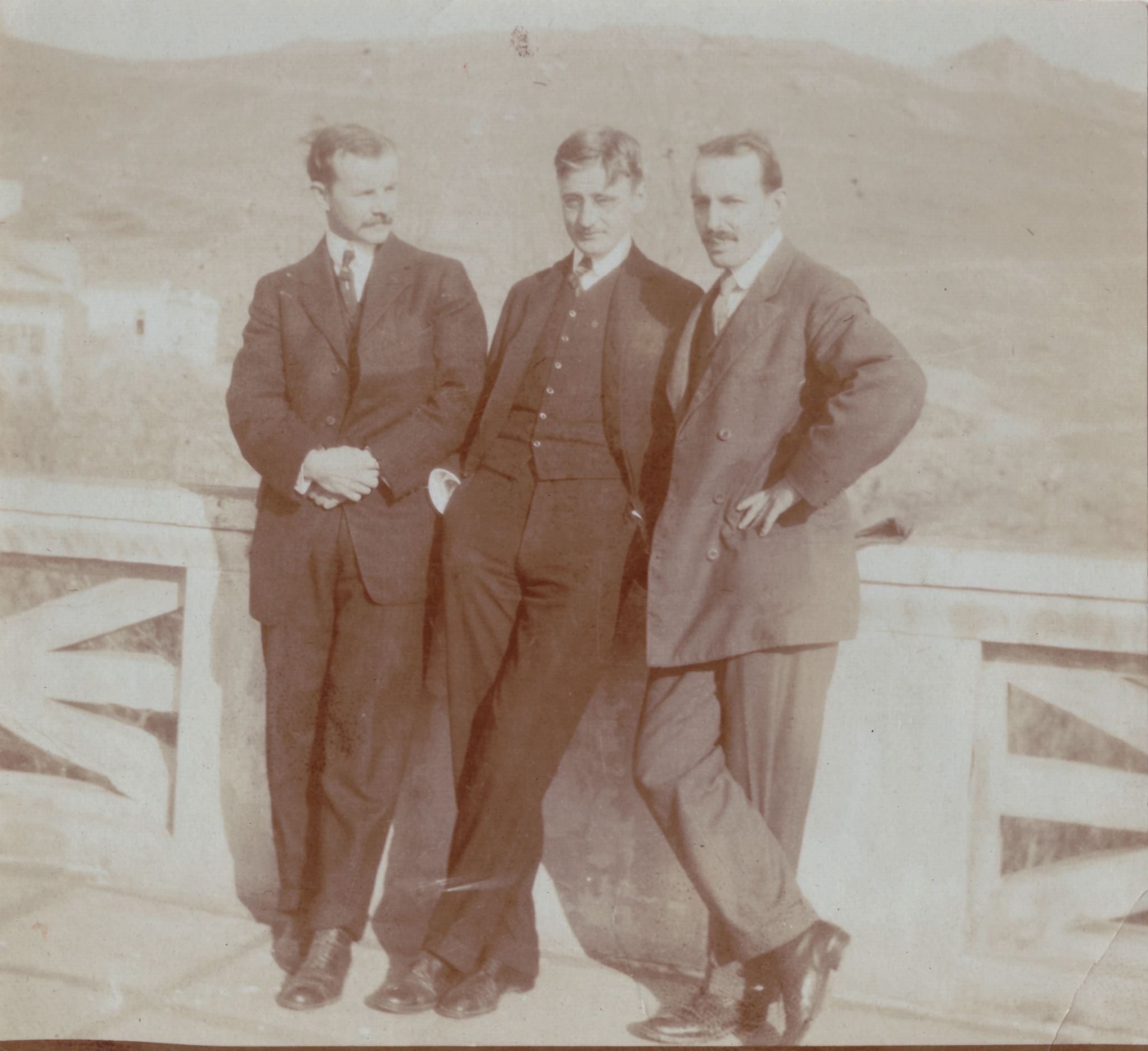
Of the new students, Whitmore, another Harvard man, was the Charles Eliot Norton Fellow for 1907, and Gardiner, the only woman in the photos, was a graduate of Radcliffe College (1901), with an MA from Wellesley (1906), and a recipient of the Alice Palmer Fellowship that supported female students.
Read the rest of this entry »Disjecta Membra: The Personal Papers of Minnie Bunker
Posted: July 8, 2023 Filed under: Archaeology, Archival Research, Biography, Classics, History of Archaeology, Mediterranean Studies, Women's Studies | Tags: Agnes Baldwin, Chaironea Lion, Charles Weller, Constitution Square, Πλατεία Συντάγματος, Minnie Bunker, Nancy Perrin Weston 9 Comments
We have been processing a large shipment of files that the Princeton office of the American School of Classical Studies at Athens (ASCSA or School hereafter) mailed to Greece during their relocation in 2021. The files contain many surprises, especially those associated with the production of the School’s Newsletter. There we found a trove of unpublished (and unknown) photos and among other material an envelope with letters, calling cards, and photos that once belonged to Minnie Bunker (1867-1959).
Minnie was a high school teacher and a student at the School in 1900-1901 who returned in 1906-1907 and again in 1911-1912. She also is no stranger to the School’s Archives which already contained a small collection of her water-damaged photographs and letters, as well as an 1894 Baedeker, which her grandniece Nancy Perrin Weston (1922-2011) mailed to Athens in the 2000’s. After her aunt’s death in 1959, Nancy also spent time in Greece, working for renowned architect Constantine Doxiadis and volunteering in the School’s Library from 1963-1964. Minnie must have transmitted her love for Greece and the School to her grandniece because in 2011, the year of Nancy’s death, the School received $25,000 from her estate.

The thrill of archival research is not limited to discovery but encompasses rediscovery. The envelope that we found in 2020 contained another small cache of Minnie Bunker papers that Weston had shipped to the School’s office in New York in 1981, when the School was actively looking for letters and photos of past students and members on the occasion of its upcoming centenary.
Christmas in Athens in 1915
Posted: December 25, 2022 Filed under: Archival Research, Biography, History of Archaeology, Modern Greek History, Philhellenism, Uncategorized | Tags: Christmas 1915, John A. Huybers 12 CommentsOn February 17, 1916, The Nation published in its “Foreign Correspondence” section a long essay by John A[lfred] Huybers, titled “Christmas in Athens.” Huybers is no stranger to this blog. Three years ago, I wrote an entire post about him, “On Finding Inspiration in Small Things: The Story of a Pencil Portrait,” after discovering a pencil sketch of Bert Hodge Hill by him.
An English Australian, Huybers earned his living as an illustrator in America, and from about 1915 until his death in 1920 as a foreign correspondent for The Nation and The Christian Science Monitor in Greece. He must have been friends with many members of the American School of Classical Studies at Athens (hereafter ASCSA or the School) including Bert H. Hill, Carl W. Blegen, and Edward Capps. Capps, who became the School’s Chair of the Managing Committee in 1919, remembered Huybers in the ASCSA Annual Report for 1920-21 (p. 21) with mention of a fund created in his memory (the Huybers Fund amounted to $714.53 in 1921, which is the equivalent of about $18,000 today):
“[He] was for many years a resident of Greece, whence he sent to the American press, and particularly to the Christian Science Monitor, admirable articles on Greek affairs. He died at Phalerum in 1919 [sic]. His writings showed such admirable sanity of judgement, good information, and genuine philhellenic sympathy and understanding that his friends in America, chiefly those of Hellenic descent, desired to perpetuate his memory in connection with the School, which they highly regard as the permanent symbol in Greece of American-Hellenic unity. We are indebted to Professor A. E. Phoutrides of Harvard University, for conceiving this idea and carrying it to completion, and to His Excellency Mr. Tsamados, then Minister Resident of Greece in Washington for generous assistance. A principal fund of $545 was contributed.”
During my research on Huybers, I found sixteen of his essays in The Nation, including one about the American School, large parts of which l presented in my post of April 2019. Lately, I rediscovered in my notes another one he published in February 1916 after spending Christmas in Athens (since Greece was still following the “old calendar,” Christmas was celebrated thirteen days later, on January 6th).
Wanting to experience Christmas Eve shopping, Huybers took a walk on Athinas Street (described as Rue d’ Athènes) which was and still is the largest market: “Not merely the booths in the market, but all the surrounding shops are open, without windows. The places that are most crowded, where most business is being done, are the shops in which the different varieties of cheese and olives are sold, which, with the excellent bread, are the main staples of life in Greece.” He then proceeded to explain that sheep were not raised just for wool and meat, but also for their cheese, and one would be surprised “at the variety of delicious and wholesome cheeses made from their milk.”

A Journey in the Mediterranean on the Eve of the Great War, 1914.
Posted: November 20, 2022 Filed under: Archival Research, Biography, History of Archaeology, Mediterranean Studies, Modern Greek History, Philhellenism, Uncategorized | Tags: Alice Calvert Bacon, Dardanelles, Delphi, Francis H. Bacon, Great War, Guy B. Pears, Julia Dragoumis, Olympia, Poros Island 6 CommentsOn July 4th, 1914, Francis Henry Bacon (1856-1940) and his wife Alice (née Calvert) departed from New York aboard the S.S. Kaiser Frantz Joseph (the ship would be renamed the President Wilson shortly thereafter). The Dardanelles were their destination, where the Calvert family owned an estate, as well as a farm in nearby Thymbra. This is where Bacon had first met Alice in 1883, when the members of the Assos Excavations received an invitation to dine with Alice’s uncle, Frank Calvert (1828-1908). An amateur archaeologist, Calvert had conducted several excavations in the Dardanelles. Perhaps more importantly, he suggested that Heinrich Schliemann (1822-1890) look for Troy at the site of Hissarlik, not far from Thymbra, in the late 1860s. The Calverts were English expatriates long established in the Dardanelles, who made a living trading commodities with the benefit of consular posts.
The time was not good, however, to travel to Europe and especially to the Balkans and Turkey. Just a few days before, on June 28, 1914, Archduke Franz Ferdinand, the heir to the Austro-Hungarian throne, and his wife had been assassinated in Sarajevo. His death sparked a series of events that led Austria with the support of Germany to declare war on Serbia a month later. Within a week, the great powers of Europe were forced to ally with or against the main belligerents. Greece tried to remain neutral until 1917 (in no small part because the Greek King was married to the Kaiser’s sister and thus sympathetic to the German side), but the Ottoman Empire openly supported the Germans.
Retracing his Steps
Bacon, a graduate of M.I.T (1876), first traveled to Greece in 1878, before the American School of Classical Studies was even founded. In 1881 he would join, as chief architect, the Archaeological Institute of America’s excavations at Assos in Western Turkey. Following Assos, Bacon pursued a successful career in interior design on the East Coast of America about which I have written before (Francis H. Bacon: Bearer of Precious Gifts from the Dardanelles). He is also credited with the design of the Shrine of the Declaration of Independence in the Library of Congress. Because of Alice’s attachment to the Calvert house in the Dardanelles, the Bacons frequently crossed the Atlantic. Occasionally, Francis would make a stop in Greece to retrace his steps.
After several stops including the Azores, Algiers, and Naples, the Bacons finally reached Patras on July 16th, where the couple parted. Alice continued on another steamer to the Dardanelles, while Francis planned to spend a week in Greece, starting from Olympia. “Splendid Victory of Paionios, and then the lovely, beautifully finished Hermes of Praxiteles – about the only authentic ancient masterpiece in the world,” Bacon scribbled in his notebook. The authenticity of the statue –whether it was a 4th century B.C. original or a fine Roman copy- had not yet been challenged.

From Patras, Bacon took a little steamer to Itea. At Delphi he was much impressed by the restoration of the Athenian Treasury, which the French had completed a few years earlier (1903-1906.) He only wished that “they had restored the acroteria, two horses with naked riders prancing off the corners of the pediment.” Bacon, an ardent photographer, did not miss a chance to capture monuments and landscape, as well as to experiment with interior photography, which was exceptionally difficult at the time. “Back to the Museum where the Ephor Contoleon is very obliging and invited us to photo and measure anything we like.” I cherish Bacon’s interior photos because we catch glimpses of the old museum displays. To him we owe a partial view of the old Delphi Museum, built in 1903, and several charming photos of the local children who had befriended one of his fellow travelers. See slideshow below.
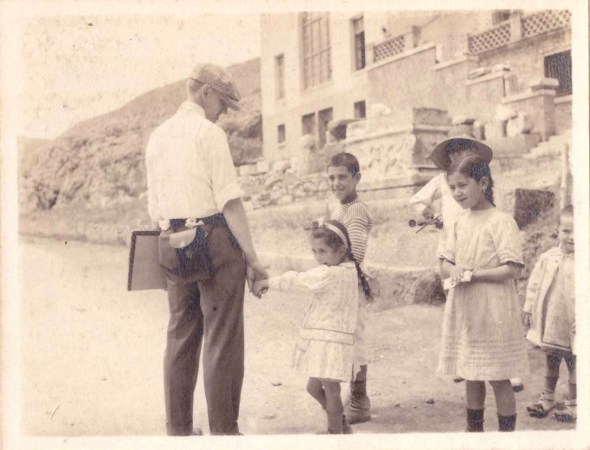
At Delphi, outside the museum, 1914. ASCSA Archives, Francis H. Bacon Papers. 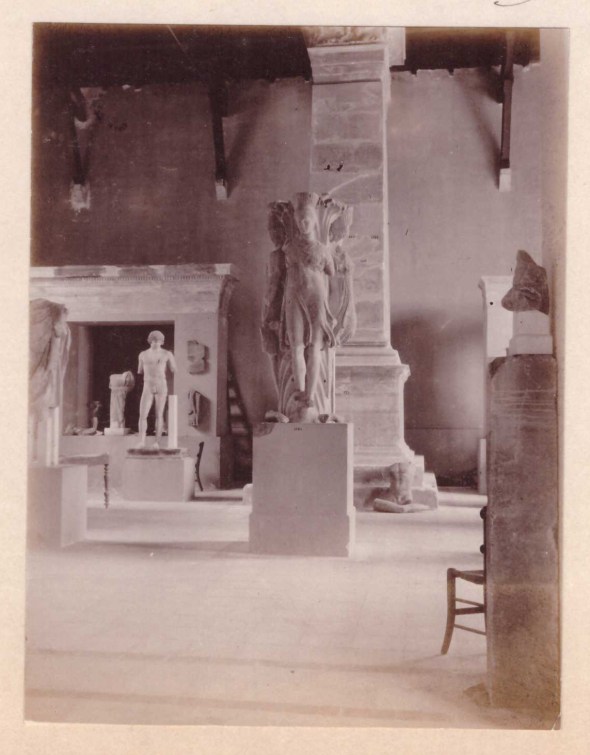
Delphi Museum, interior, 1914. ASCSA Archives, Francis H. Bacon Papers. 
Francis H. Bacon next to the Naxian Sphinx, Delphi 1914. ASCSA Archives, Francis H. Bacon Papers. 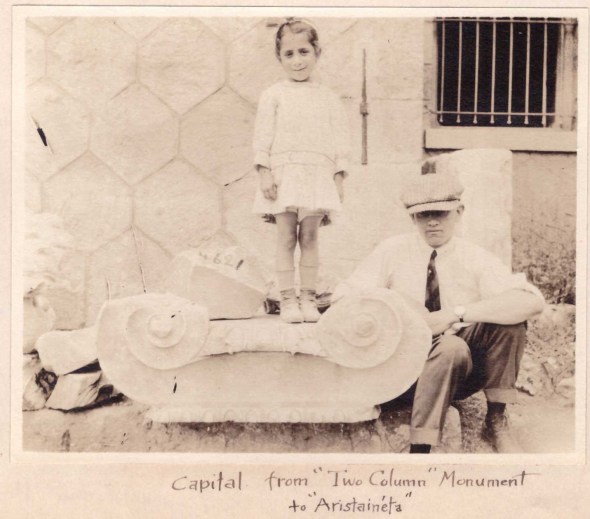
Outside the Delphi Museum, 1914. ASCSA Archives, Francis H. Bacon Papers.
After two days at Delphi, Bacon headed off for Athens. “Start at Itea at 5 A.M. Steamer at 6:30 for Corinth Canal and Piraeus. There has been a landslide in the canal and the little steamer almost climbs over a pile of clay and earth in the narrow channel. Reach Piraeus at 4 P.M. Drive to Athens over the dusty road. Go to Hotel Minerva where I spent winter in 1883, now rather dirty and forlorn.”
(The Hotel Minerva located at Stadiou 5 operated until 1991. When Bacon first stayed in it in 1883, it was known as Αι Αθήναι. For more information and a photo of the hotel, check out the site of the Greek Literary and Historical Archive.)
Read the rest of this entry »The Forgotten Olympic Exhibition: Georg Alexander Mathéy’s Contribution to the 1936 Summer Olympics in Berlin.
Posted: August 2, 2022 Filed under: Archival Research, Art History, Biography, Exhibits, History of Archaeology, Modern Greek History, Philhellenism | Tags: Georg Alexander Mathéy, Polyxene Roussopoulos Mathéy, Walter Hege 3 CommentsBY ALEXANDRA KANKELEIT
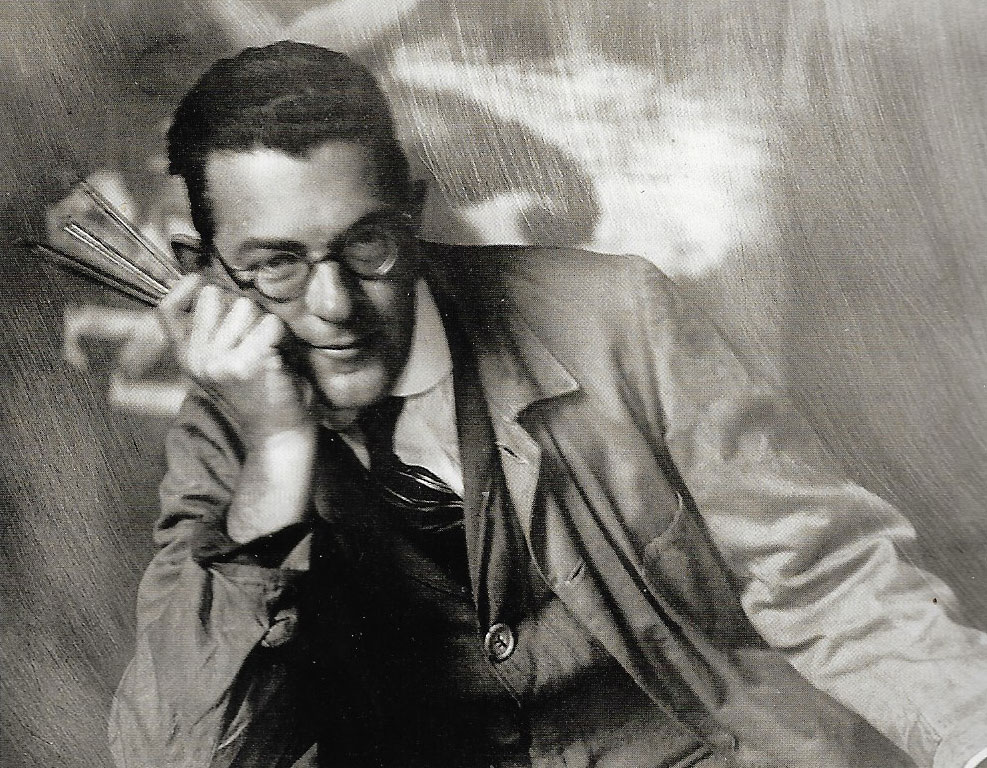
Alexandra Kankeleit is a German-Greek archaeologist and historian. She has been researching German archaeology in Greece during the Nazi period for several years. Since July 2021 she has been working for the CeMoG (Centrum Modernes Griechenland) at the Freie Universität Berlin, where she will teach a seminar on the 1936 Summer Olympics in the upcoming winter semester. Here she contributes an essay about the German artist Georg Alexander Mathéy (1884-1968), who lived in Greece in the 1930s and whose work was displayed in the Summer Olympics of 1936.
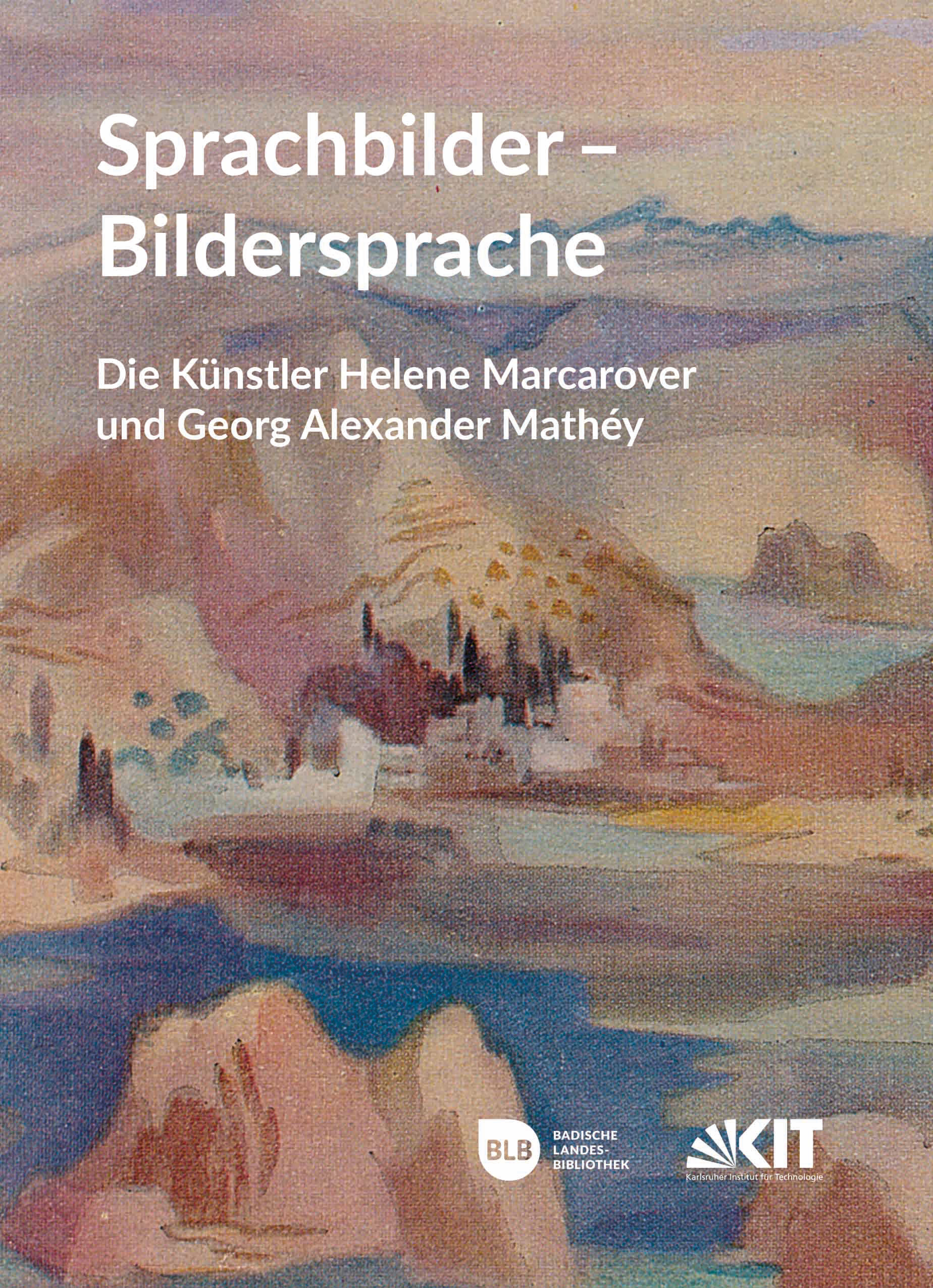
The Badische Landesbibliothek in Karlsruhe (BLB) has held a large part of the estate of painter and writer Georg Alexander Mathéy (1884-1968) since 1993. In 2017, the BLB organized an exhibition, titled Sprachbilder – Bildersprache: Die Künstler Helene Marcarover und Georg Alexander Mathéy, to showcase the works of Mathéy together with those of another artist, the painter and poet Helene Markarova (1904-1992). Both artists, whose work was shaped by the two wars, by migration and alienation, were able through literature to transform images into words, and vice versa. A wonderful accompanying publication provides insights into Mathéy’s life and creative work (Axtmann – Stello 2017).
Trained as an architect in Budapest, Mathéy made his name as an illustrator of numerous books and magazines, achieving commercial success already at a young age. He also designed stamps, textiles, and a Rosenthal coffee service. Two of his stamp designs are still remembered today because of their intense colors and memorable motifs: the “bricklayer” (1919) and the “post horn” (1951). They can be described as classics of German stamp design.


In addition to this modern, highly reductivist formal language, Mathéy also mastered other, more traditional media, primarily in his large-scale watercolors and oil paintings.
I became interested in Mathéy’s largely forgotten contribution to the 1936 Summer Olympics in Berlin. The starting point is material from the archives of the BLB, which provided new and important information about Mathéy. (I would like to thank the director of the BLB, Julia Hiller von Gaertringen, for her interest and active support in my project. A detailed German version of this article can be found on the BLBlog.) Further information can also be found in an unpublished research paper on Georg Alexander Mathéy, which the designer Ulrike Jänichen completed in 2003 under the direction of Professor Mechthild Lobisch at the Burg Giebichenstein Kunsthochschule in Halle. She kindly made her work available to me.

 From the Archivist's Notebook