Orientations in Sunlight: With Durrell in Rhodes
Posted: November 1, 2019 Filed under: Archival Research, Biography, Book Reviews, History, Mediterranean Studies, Modern Greek History | Tags: Florestano di Fausto, Italian Colonies, Lawrence Durrell, Marine Venus, Mario Lago, Rhodes 9 Comments“In Rhodes the days drop as softly as fruit from trees. Some belong to the dazzling ages of Cleobolus and the tyrants, some to the gloomy Tiberius, some to the crusaders. They follow each other in scales and modes too quickly almost to be captured in the nets of form,” wrote Lawrence Durrell (1912-1990) in the first pages of his acclaimed memoir Reflections on a Marine Venus: A Companion to the Landscape of Rhodes (1953). More than seventy years later, if Durrell were still alive, he would have added “… some to the crusaders, some to the Italians.”

Durrell was stationed in Rhodes for two years when the Dodecanese was under British Administration (1945-1947). As Information Officer, he supervised the publication of three daily papers, in Greek, Turkish, and Italian. (I found copies of the Greek one, ΧΡΟΝΟΣ, in the Nicholas Mavris Papers in the ASCSA Archives. Mavris, a prominent member of the Greek American community, in 1948 became the first governor commissioner of the freed Dodecanese.)

ΧΡΟΝΟΣ, Aug. 8, 1945. ASCSA Archives, Nicholas Mavris Papers.
WW II had just ended and the fate of the Dodecanese was still uncertain. Despite their Greek past, these islands in the southeastern part of the Aegean (also known as Southern Sporades) did not join Greece until 1947, having passed from the Ottomans directly to the Italians in 1913, from the Italians to the Germans in 1943, and from them to the British. In 1946, the Allied Forces in Paris finally agreed upon the integration of the Dodecanese with Greece. It was not until the 31st of March 1947, however, that the British officially delivered the administration of the Dodecanese to the Greek State.
Durrell did not write Marine Venus while on Rhodes but a few years later, relying on his memory and “sifting into the material, now some old notes from a forgotten scrapbook, now a letter” (Marine Venus, p. 3).[1]
“Of Paradise Terrestre” Read the rest of this entry »
How Modern Greek Came to America
Posted: October 1, 2019 Filed under: Archival Research, Biography, Classics, Language Studies, Modern Greek History, Philhellenism | Tags: John Pickering, Nikolaos Tziklitiras, William Jenks 3 CommentsPosted by Curtis Runnels
Curtis Runnels, Professor of Archaeology at Boston University and an expert in Palaeolithic archaeology in Greece, here contributes to From the Archivist’s Notebook a story about how Americans first heard Modern Greek being spoken in the early 19th century. An aficionado of antiquarian shops, Runnels has frequently discovered unique documents of great historical and informational value, such as the four documents presented below, which tell us the story of a Greek merchant, Nikolaos Tziklitiras, who, after landing by accident in Boston in 1813, became the first Greek teacher in town and laid the foundations for the spread of Modern Greek studies in America.
On a late autumn day in 1813 the ship Jerusalem made its way slowly into Boston harbor. She was a long way from home. The 750-ton ship began her journey in Smyrna with a Greek-speaking crew bound for Cuba to take on a cargo of coffee, sugar, copper, and hides for Boston. Unfortunately, things did not go exactly as planned. Contemporary reports in the Niles Weekly Register, a popular news periodical of the day, relate that the Jerusalem was detained in September on her way to Boston by the British on account of the copper ingots in her cargo, and the ship was diverted to Halifax, Nova Scotia. She evidently put into Boston on her way to Canada (“September 18: The Greek Ship Jerusalem”). Now, in November, having sorted out her difficulties with the British authorities, she was at last bringing her cargo to Boston (“November 27: The Greek Ship Jerusalem”).
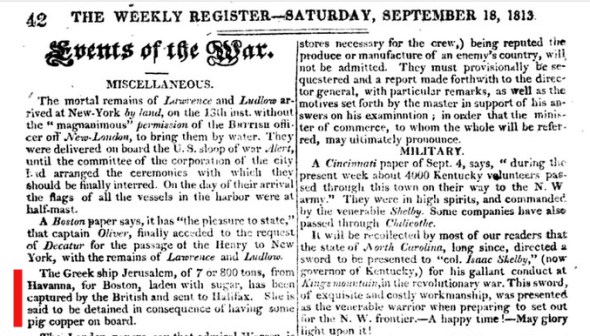
The news of Jerusalem’s detention as announced in Niles Weekly Register, Sept. 18, 1813.
The arrival of the Jerusalem in Boston was newsworthy because as far as the authorities knew she was the first Greek ship to reach the United States. It was something of a sensation, and members of the public, along with officials, merchants, students, and at least one Harvard College scholar, Edward Everett, flocked to the dock to see the ship. One man in the throng, however, was not interested in the story of her voyage and capture, nor was he interested in her cargo of Cuban sugar and coffee. John Pickering (1777-1846) had come to hear the crew talk.
Mycenaean Mementos and the Govs: The Materiality of the Wace-Blegen Friendship
Posted: September 1, 2019 Filed under: Archaeology, Archival Research, Biography, History of Archaeology, Philhellenism | Tags: Alan J. B. Wace, Émile Gilliéron, Carl W. Blegen, Kim Shelton, Rookwood Pottery Company 5 CommentsPosted by Jack L. Davis
Jack L. Davis, Carl W. Blegen Professor of Greek Archaeology at the University of Cincinnati and a former director of the American School of Classical Studies at Athens (2007-2012), here writes the biography of three objects, modern copies of Mycenaean originals, which once belonged to Carl W. Blegen and Alan Wace, the “Govs” of Mycenaean archaeology. These objects were once woven in some way into the personal relationship of these two individuals who shaped the field of Mycenaean studies.
They will honor him in their heart as if he were a god
And send him to his dear homeland in a ship
With gifts of bronze, gold, and fabrics in such abundance
As Odysseus would never had taken from Troy
If he had arrived home unscathed with his share of booty.
(Od. 5.36-40)
Such is Zeus’s prediction of Odysseus’s fate among the Phaeacians. And guest gifts are a phenomenon not only well-known to Classicists, but a concept that has had an impact on anthropological thought for nearly a century — at least since the publication in L’Année Sociologique of Marcel Mauss’s “Essai sur la donne” in 1925 — and, through it, on the interpretation of patterning in archaeological data. Mauss demonstrated that in pre-modern exchange systems there were obligations to give and receive, but especially to reciprocate in the presentation of gifts, practices deeply embedded in social systems. In the field of archaeology, gift exchange has been seen, prominently since the 1970s, as a mechanism that accounts for distributions of material goods (e.g., T.K. Earle and J.E. Ericson eds., Exchange Systems in Prehistory, New York 1977), and studies of the cultural biographies of exchanged artifacts have been popular (A. Appadurai, The Social Life of Things, Cambridge 2013).
This post is not, however, concerned with archaeological finds, but rather with the histories of a few mementos owned by two of the most famous Greek prehistorians of the 20th century, Alan Wace and Carl Blegen, best friends and colleagues,“the Govs” as they called themselves (see Y. Fappas, “The ‘Govs’ of Mycenaean Archaeology: The Friendship and Collaboration of Carl W. Blegen and Alan J. B. Wace as Seen through Their Correspondence,” in J.L. Davis and N. Vogeikoff, eds., Carl W. Blegen: Personal and Archaeological Narratives, Atlanta 2015, pp. 63-84). The copies of Mycenaean artifacts that I consider here have sometimes been thought to have been material manifestations of their friendships, mutually reciprocated gifts. But were they really? Read the rest of this entry »
To Live Alone and Like It: Women and the American School of Classical Studies at Athens Between the Wars.
Posted: August 5, 2019 Filed under: Archival Research, Biography, Greek Folklore, History of Archaeology, Mediterranean Studies, Modern Greek History, Philhellenism, Women's Studies | Tags: Alison Frantz, Priscilla Capps, Rhys Carpenter 10 Comments“But it is not education only that is needed. It is that women should have liberty of experience… to idle and loiter, the mental space to let your mind wonder,” wrote Virginia Woolf in A Room of One’s Own in 1929. The work was based on lectures she delivered in October 1928 at Newnham College and Girton College in Cambridge (both for women). She further advised her female audience “to drink wine and have a room of their own.” I will not dwell on the issue of wine because women of all classes had access to alcohol, at least privately, but for a woman to have a room of her own was highly unusual before WW II, especially for women who had not inherited wealth. Woolf would be eternally grateful to her aunt for leaving her a lifelong annual stipend of 500 pounds.
 That a woman could live alone by her own choice was almost unheard of. Young women who moved to the big cities in search of work were usually sharing apartments with others of the same sex, for a few years at most, until they got married. However, WW I upset traditional demographics by creating a population imbalance in the western world: more women than men. To put it bluntly, for these extra women it meant that the prospect of marriage was less attainable (Scutts 2017). If Virginia Woolf (1882-1941) was fighting her own battles in ultra conservative England, Marjorie Hillis (1889-1971), an American writer and contemporary of Woolf, was sufficiently daring to publish in 1936 a book that encouraged single women to take control of their lives and Live Alone and Like it. “A Lady and Her Liquor,” “Pleasures of a Single Bed,” and “Solitary Refinement?” were some of the chapter titles. Her book became an immediate best-seller and remained popular for many years.
Exploring the Relationship of the American School of Classical Studies at Athens with the Greek Omogeneia in the United States in the 1940s.
Posted: July 4, 2019 Filed under: Archaeology, Archival Research, Biography, History of Archaeology, Mediterranean Studies, Modern Greek History, Philhellenism | Tags: American School of Classical Studies at Athens, Greek War Relief Association, Nikolaos Mavris, Omogeneia, Oscar Broneer, Spyros Skouras, Theodore Leslie Shear, Triumph Over Time 7 CommentsIn 1947, the American School of Classical Studies at Athens (ASCSA or the School hereafter) produced a color movie titled Triumph over Time; it was directed by the archaeologist Oscar Broneer and produced by the numismatist Margaret E. Thompson with the aid of Spyros Skouras (1893-1971), the Greek American movie mogul and owner of Twentieth Century Fox (see Spyros Skouras Papers at Stanford University). Triumph over Time portrays Greece rebounding from World War II and the staff of the ASCSA preparing archaeological sites for presentation to postwar tourists. The film was made to promote the first postwar financial campaign of the ASCSA, the direct goal of which was to increase its capital and finance the continuation of the Athenian Agora Excavations. Indirectly, the ASCSA was hoping to contribute to the rehabilitation of Greece by providing employment for the Greek people and by promoting the economic self-sufficiency of Greece by developing the country’s tourist assets (Vogeikoff-Brogan 2007).

Oscar Broneer, ca. 1938. ASCSA Archives, Oscar Broneer Papers.
Triumph over Time begins with a brief overview of impressive Greek antiquities, such as the citadels of Mycenae and Tiryns and the Temple of Poseidon at Sounion, before continuing with rare ethnographic material capturing parts of rural Greece that no longer exist. It then moves from the Greek countryside to the buildings of the ASCSA, especially the Gennadius Library with its rare treasures. The story then covers the ASCSA’s two most important projects, the excavations at the Athenian Agora and at Ancient Corinth, explaining all stages of archaeological work. The documentary ends with a hopeful note that financial support of the ASCSA’s archaeological work will contribute to an increase in tourism so that this major source of revenue for Greece’s economy can “restore stability and well-being to this simple pastoral land.”
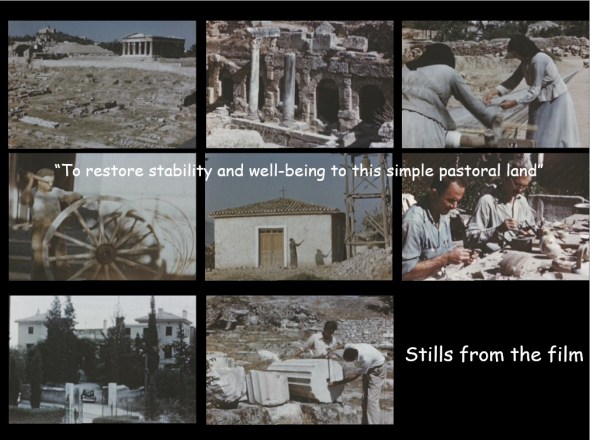
Stills from Triumph Over Time

 From the Archivist's Notebook