“All Aboard”: Cruising the Aegean in 1923
Posted: August 1, 2014 Filed under: Archaeology, Archival Research, History of Archaeology, Mediterranean Studies, Modern Greek History, Philhellenism | Tags: American Academy in Rome, American School of Classical Studies at Athens, Candia, Crete, Delos, Evelyn Waugh, George Dupont Pratt, Ida Thallon Hill, Melos, Natalie Murray Gifford, Santorini, Thomas Whittemore, Wilhelm Dörpfeld, yaght Zion 6 CommentsOn the morning of May 14, 1923, a private yacht approached the island of Santorini and cast anchor just outside the bay of Phira. The Zion carried twenty-five passengers and belonged to an American millionaire and philanthropist, George D. Pratt. Pratt, a recent widower, had come to Greece a few weeks earlier, and the cruise would allow him “to go about the islands taking photographs” as one of the Zion passengers –or so Natalie Murray Gifford wrote in her own account of the trip. There was, however, another, more practical, motivation that lay behind Zion’s Aegean course. At the end of the cruise, the yacht would sail to Mount Athos to deliver food and supplies to starving Bulgarian and Russian monks, who had lost vital support from home as a consequence of the Russian Revolution. Thomas Whittemore, one of Zion’s passengers, was monitoring this relief effort.
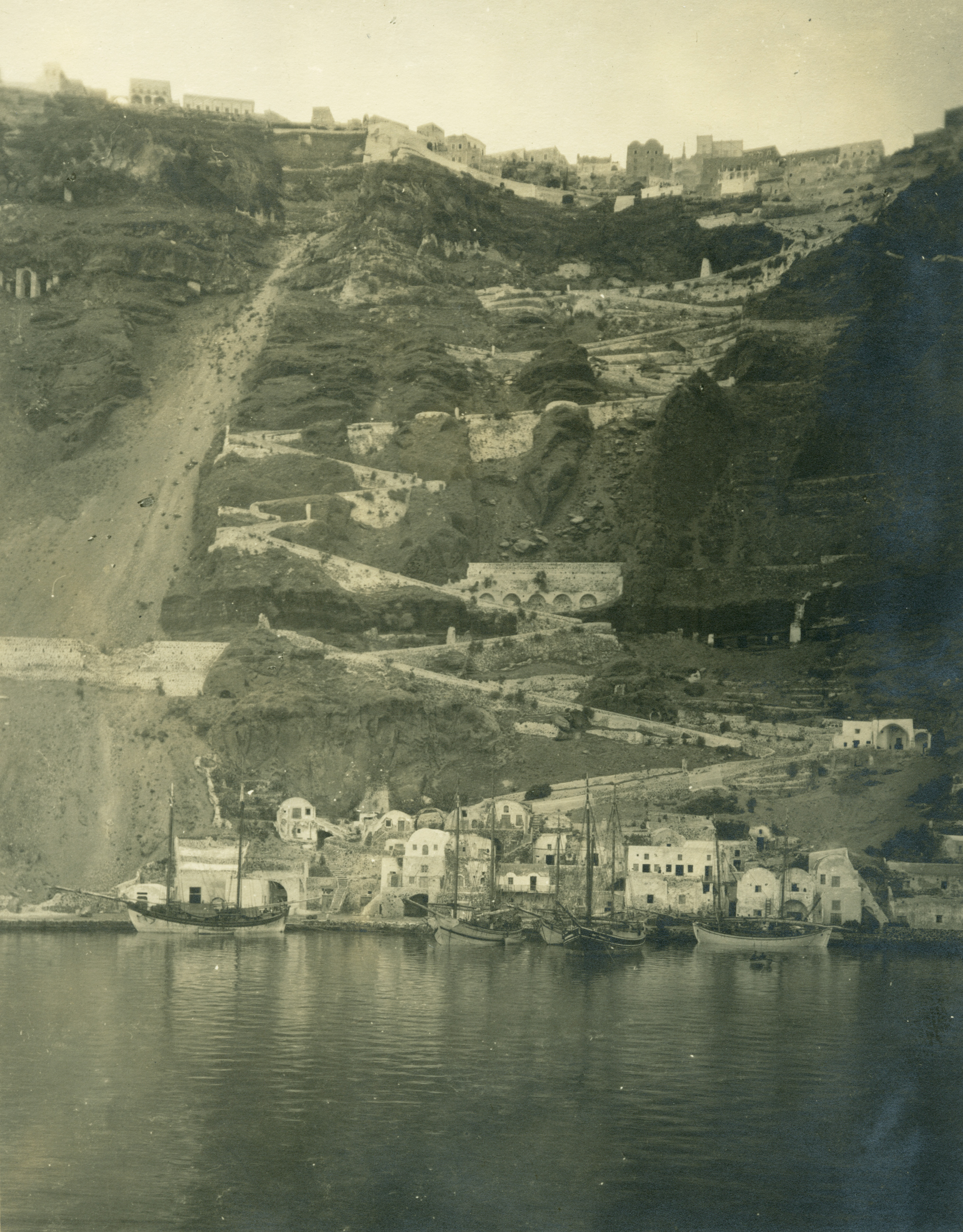
Santorini, 1923 (ASCSA Archives, Carl W. Blegen Papers)
Pratt’s guests on board the Zion were archaeologists or classicists affiliated with the American School of Classical Studies at Athens (ASCSA) or with the American Academy in Rome (AAR). All were advanced students and scholars, making the trip entirely unlike the contemporary commercial cruises to the renowned harbors of the Mediterranean that had become increasingly popular in the first decades of the 20th century. Evelyn Waugh describes such a trip aboard the Stella Polaris in Labels (1930), as well as how pleasure cruising had evolved by his time. “Before that only the very rich, who owned their own yachts, could afford this leisurely pottering from port to port,” and this is exactly what George Pratt’s Zion was tasked to do; to offer an exclusive, old-fashion cruise to the members of the School at Athens and the five “Romans” who had come from the Academy in Rome. Waugh also drew a colorful distinction between travelers and tourists, and Pratt’s guests were clearly members of the former club. Read the rest of this entry »
That Unspeakable Stoa
Posted: May 1, 2014 Filed under: Archaeology, Archival Research, Classics, History, History of Archaeology, Philhellenism, Women's Studies | Tags: American School of Classical Studies at Athens, Athenian Agora, Homer A. Thompson, Nancy Mitford, Stoa of Attalos 4 Comments
Posted by Lizabeth Ward Papageorgiou
Lizabeth Ward Papageorgiou here contributes to the Archivist’s Notebook an essay about Nancy Mitford’s visit to the Athenian Agora during the re-construction of the Stoa of Attalos in 1955. Unhappy with the building, Mitford, one of the famous Mitford sisters, wrote acidic comments about it in the press as well as to the Director of the Agora Excavations, Homer A. Thompson. Lizabeth (Liz), who studied Art History at the Institute of Fine Arts in New York University, found Mitford’s letters when she catalogued Thompson’s vast correspondence for the Archives of the American School of Classical Studies at Athens a few years ago. Her extensive catalogue of Homer Thompson’s papers is available at: http://www.ascsa.edu.gr/index.php/archives/thompson-finding-aid/
Over a decade ago, I archived the papers of Homer A. Thompson. Two of his letters are the subject of this article.
It [Athens] is probably the ugliest capital in Europe . . . [with] formless conglomerations of modern buildings overlooked by an immortal monument . . . . The traffic is noisier, wilder, and more evidently intent on homicide than that of Paris, and consists entirely of enormous pastel-colored American motor-cars.
Nancy Mitford, “Wicked Thoughts in Greece”, The Sunday Times, 24 July 1955.
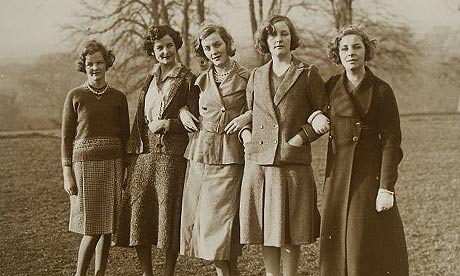
The Mitford sisters
Nancy Mitford (1904–1973), acclaimed author of comedies of English upper class manners (The Pursuit of Love), biographies (Madame de Pompadour), essays and reviews, was the eldest of six intelligent, beautiful and sometimes scandalous daughters of Lord and Lady Redesdale (Ben Macintyre described the sisters as Diana the Fascist, Jessica the Communist, Unity the Hitler-lover; Nancy the Novelist; Deborah the Duchess and Pamela the unobtrusive poultry connoisseur).1 In the summer of 1955, she traveled in Greece. She spent time with Patrick Leigh Fermor, who was living in Nikos Ghikas’s house on Hydra; went to Tatoi, the summer residence of King Paul; and visited friends in Spetses, Crete and the Peloponnese.2
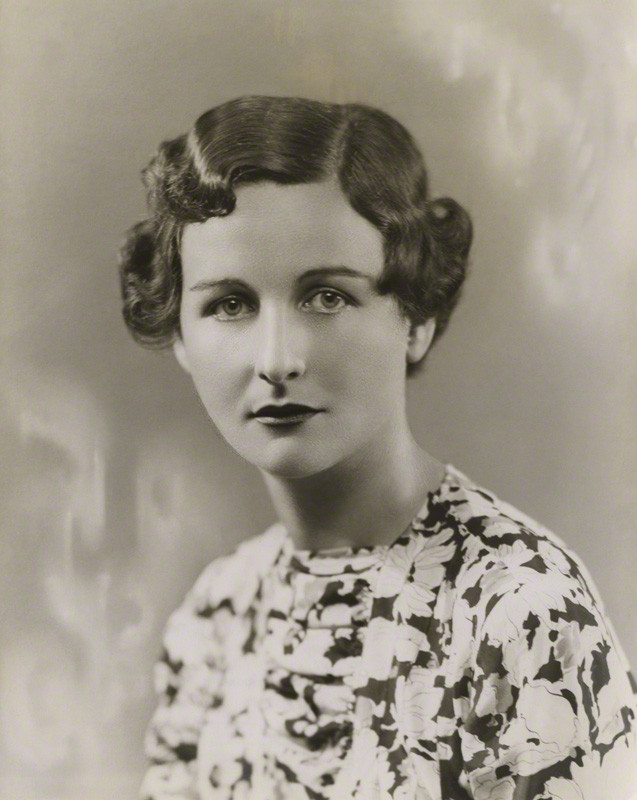
Nancy Mitford, 1932
When she was in Athens, she stayed at the Grand Bretagne and visited the ancient sites. One day she went to the Ancient Agora, but since the reconstruction of the Stoa of Attalos was not finished—it was covered with scaffolding and only the lower storey and colonnades had been reconstructed—Mitford must have needed permission to visit the site and one of the Agora staff to guide her. Homer A. Thompson, director of the Agora excavations from 1945 to 1967 and deeply involved with all aspects of the reconstruction of the Stoa, often mentioned visitors to the Agora in his letters to his wife, Dorothy Burr Thompson; but he made no mention of a visit by Nancy Mitford. Possibly Judith Perlzweig or C. W. J. Eliot, who bore the brunt of conducting visitors through the excavations and museum, served as her guide.3
Shortly after Mitford returned to her home in Paris, she wrote an article about her trip to Greece for The Sunday Times. Published on 24 July 1955, the title, “Wicked Thoughts in Greece”, gave readers a heads up that this was going to be another of her scathing attacks. Opening with the declaration that Athens is probably the ugliest capital in Europe, full of homicidal drivers and enormous pastel-colored American motor-cars, she continued to deplore the hideous newness of Athens, which from the air is a desert of khaki-coloured cement. But she did find an oasis in Plaka, where she delighted in the classical monuments, churches and old houses, until . . .
Alas! After ten minutes of happy wandering the dream is shattered and the dreadful wasteland of the Agora appears. Here the American School of Classical Studies seems to have torn down whole streets in order to search for a few pots. Here the Americans are building, in a ghastly graveyard marble, the Stoa, said to be ‘of Attalos’, but really of Mr. Homer A. Thompson. And here a gracious garden will be planted, complete, no doubt, with floral clock.

The Stoa of Attalos under construction, 1955. Photo: ASCSA, Agora Excavations
A few pages later, describing her visit to Knossos, she again attacked the reconstruction of the Stoa of Attalos:
. . . Knossos, a fraudulent reconstruction like the Stoa, English this time, alas, and built in an art nouveau style reminiscent of Paris metro stations. It is evident that Anglo-Saxons should be kept away from Mediterranean sites . . . . Knossos, however, matters less than the Stoa, because it is out in the country and does not spoil anything else. The Stoa in all its vileness hits the eye from the Acropolis and the Temple of Hephaestus. It is as though the French had allowed Frank Lloyd Wright to build his idea of a Petit Trianon at the bottom of the tapis vert at Versailles. Read the rest of this entry »
“I Once was Lost but Now I’m Found”: The Search for Missing Archives, Marion Rawson, and the Excavations of the Palace of Nestor at Pylos
Posted: March 1, 2014 Filed under: Archaeology, Archival Research | Tags: Carl W. Blegen, Marion Rawson, Patricia Neils Boulter, Prosymna, Pylos Excavations, University of Cincinnati Department of Classics, William Donovan 3 CommentsJack L. Davis, Professor of Greek Archaeology at the University of Cincinnati and former director of the American School of Classical Studies at Athens (2007-2012), here contributes to the Archivist’s Notebook an essay about his favorite topic, Carl Blegen and the Pylos excavations. He also describes the recent discovery of Marion Rawson’s personal diaries.
The spirit of Carl Blegen surrounds us. In 1972 I came to the University of Cincinnati to study Aegean Prehistory, the field that Blegen helped to create. (Curiously, Blegen himself objected to the term “prehistory” on the grounds that early humans had a history, preferring to call it “Preclassical archaeology”). I am the Carl W. Blegen Professor of Greek Archaeology at the University of Cincinnati. Our department is in Blegen Library. We use the Blegen Library of the American School of Classical Studies at Athens. But I never met Carl Blegen — and, in fact, until last May, when we discovered an old audio tape in a file cabinet at UC, I had never heard his voice. 
CWB, as he signed himself, died in 1971. In his final months he was nursed in Athens by his sister Martha, then buried in the First Cemetery beside his beloved wife, Libbie, Bert Hodge Hill, and Ida Thallon Hill. Of the quartet that lived at Plutarchou 9, he was last to depart.
The story of CWB and his world maps Greek prehistory over six decades, from its fumbling beginnings until its emergence as a modern scientific discipline. In May 2013 in Athens, my friends Vivian Florou and Natalia Vogeikoff organized a conference about the Blegens with me: “Carl and Elizabeth Blegen Remembered. Ploutarchou 9 Celebrated.” See http://www.ascsa.edu.gr/index.php/news/newsDetails/ascsa-co-organizes-colloquium-on-carl-and-elizabeth-blegen.

Carl Blegen in 1929
Chasing the spirit of CWB has been rewarding for us, particularly in that we have had the pleasure of making the acquaintance of several of his associates. One initial goal in so doing was to locate excavation records missing from the main Palace of Nestor archive. (It was transferred, after CWB’s death, from Ploutarchou 9 to ASCSA). Thus several years ago we contacted Bill Donovan, one of the authors of the third volume of The Palace of Nestor at Pylos, and Professor of Classics, emeritus, at MacAllister College. Bill still had in his hands his notebooks that recorded excavations of chamber tombs in the Tsakalis cemetery.
More recently, as planning for the May 2013 event progressed, we approached others, not to collect errant excavation records this time, but to cull reminiscences. George Papathanassopolos shared his at the workshop. See http://vimeo.com/68540982. Others wrote us: John Pedley, David French, and Kaddee Vitelli. John Camp gave us a transcription of his own diary from Pylos. Preparation also demanded a close reading of CWB’s personal daily diaries. These reside in the Archives of ASCSA. In composing my own project for the workshop, the “backstory” of the Pylos excavations, I, however, discovered a large archival gap. Where were Marion Rawson’s travel diaries? Rawson was, after all, Blegen’s principal collaborator. The diaries were not at Bryn Mawr College, her alma mater, nor at UC where she studied architecture, nor in Nantucket where she left only her summer diaries to the local historical society. Read the rest of this entry »
Two Academics “Ruin” the Spirit of Valentine’s Day: A Response to “My heart is beating.”
Posted: February 18, 2014 Filed under: Archaeology, Archival Research, History of Archaeology, Mediterranean Studies | Tags: American School of Classical Studies at Athens, Carl W. Blegen, Effie de Jong, Effie Skinner, Elizabeth Pierce Blegen, Mycenaean frescoes, Piet de Jong, Tiryns Leave a comment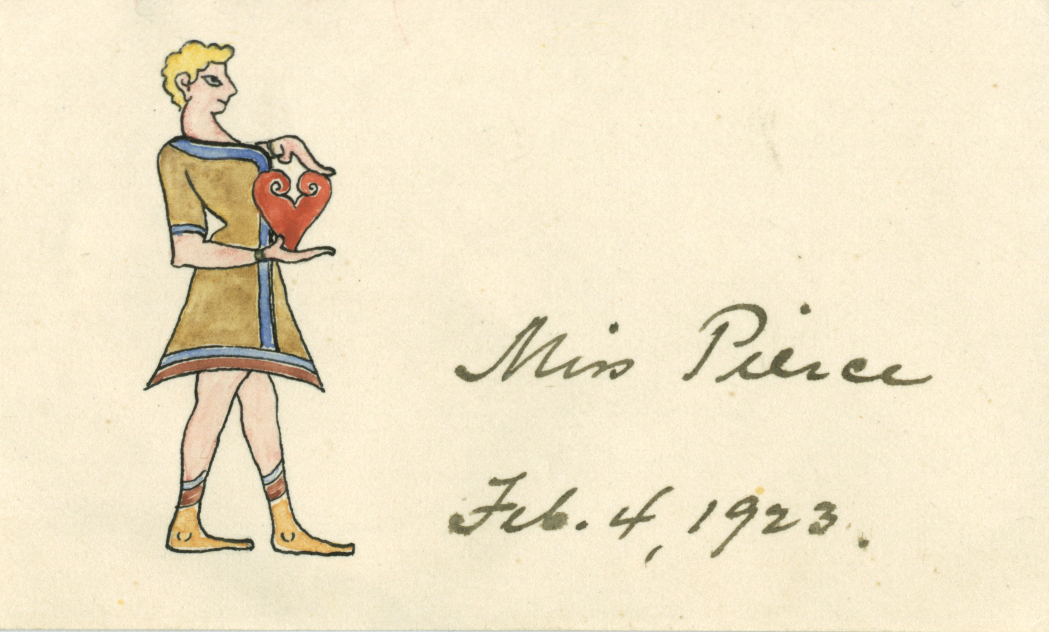 Emily Egan and Jack Davis, two “over-intellectuals” from the University of Cincinnati, could not resist the temptation to explore the Bronze Age antecedents of the Valentine card sent by Carl Blegen to Elizabeth Pierce in 1923. Check out their remarks below.
It is always dangerous to over-intellectualise love, particularly when expressed by a man to a woman on Love’s own holiday, but it is difficult, nonetheless, for scholars to avoid casting an academic eye on the caricature produced by Piet de Jong for Carl Blegen’s 1923 Valentine to his future wife, Elizabeth Pierce (see “My heart is beating: February 13, 1923”), as posted recently to this blog by Natalia Vogeikoff. For the drawing that de Jong produced must be a caricature of Blegen himself, one immediately recognizable from the distinctive blond hair. That makes this modest little drawing one of the very first in a series that de Jong famously executed in Greece during the 1920s and 1930s, and that were later collected and published by Rachel Hood in 1998. Read the rest of this entry »
“My heart is beating…”: February 13, 1923
Posted: February 14, 2014 Filed under: Archaeology, Archival Research, History of Archaeology | Tags: American School of Classical Studies at Athens, Carl W. Blegen, Elizabeth Pierce Blegen, Piet de Jong, Robert Pounder, Valentine's Day 9 Comments
This little Valentine was included in a letter mailed from Athens to Rome in early February 1923. Carl Blegen, Secretary of the American School of Classical Studies at Athens, asked his friend and artist Piet de Jong to draw the Valentine for his beloved Elizabeth Pierce. The Bronze Age figure on the card alluded to his recent work with Alan Wace which argued that the Mycenaean culture of mainland Greece had nothing to do with Minoan colonization, as Sir Arthur Evans had believed, and should instead be called “Helladic.” The image certainly hits the mark. Read the rest of this entry »

 From the Archivist's Notebook