Mycenaean Mementos and the Govs: The Materiality of the Wace-Blegen Friendship
Posted: September 1, 2019 Filed under: Archaeology, Archival Research, Biography, History of Archaeology, Philhellenism | Tags: Alan J. B. Wace, Émile Gilliéron, Carl W. Blegen, Kim Shelton, Rookwood Pottery Company 5 CommentsPosted by Jack L. Davis
Jack L. Davis, Carl W. Blegen Professor of Greek Archaeology at the University of Cincinnati and a former director of the American School of Classical Studies at Athens (2007-2012), here writes the biography of three objects, modern copies of Mycenaean originals, which once belonged to Carl W. Blegen and Alan Wace, the “Govs” of Mycenaean archaeology. These objects were once woven in some way into the personal relationship of these two individuals who shaped the field of Mycenaean studies.
They will honor him in their heart as if he were a god
And send him to his dear homeland in a ship
With gifts of bronze, gold, and fabrics in such abundance
As Odysseus would never had taken from Troy
If he had arrived home unscathed with his share of booty.
(Od. 5.36-40)
Such is Zeus’s prediction of Odysseus’s fate among the Phaeacians. And guest gifts are a phenomenon not only well-known to Classicists, but a concept that has had an impact on anthropological thought for nearly a century — at least since the publication in L’Année Sociologique of Marcel Mauss’s “Essai sur la donne” in 1925 — and, through it, on the interpretation of patterning in archaeological data. Mauss demonstrated that in pre-modern exchange systems there were obligations to give and receive, but especially to reciprocate in the presentation of gifts, practices deeply embedded in social systems. In the field of archaeology, gift exchange has been seen, prominently since the 1970s, as a mechanism that accounts for distributions of material goods (e.g., T.K. Earle and J.E. Ericson eds., Exchange Systems in Prehistory, New York 1977), and studies of the cultural biographies of exchanged artifacts have been popular (A. Appadurai, The Social Life of Things, Cambridge 2013).
This post is not, however, concerned with archaeological finds, but rather with the histories of a few mementos owned by two of the most famous Greek prehistorians of the 20th century, Alan Wace and Carl Blegen, best friends and colleagues,“the Govs” as they called themselves (see Y. Fappas, “The ‘Govs’ of Mycenaean Archaeology: The Friendship and Collaboration of Carl W. Blegen and Alan J. B. Wace as Seen through Their Correspondence,” in J.L. Davis and N. Vogeikoff, eds., Carl W. Blegen: Personal and Archaeological Narratives, Atlanta 2015, pp. 63-84). The copies of Mycenaean artifacts that I consider here have sometimes been thought to have been material manifestations of their friendships, mutually reciprocated gifts. But were they really? Read the rest of this entry »
Exploring the Relationship of the American School of Classical Studies at Athens with the Greek Omogeneia in the United States in the 1940s.
Posted: July 4, 2019 Filed under: Archaeology, Archival Research, Biography, History of Archaeology, Mediterranean Studies, Modern Greek History, Philhellenism | Tags: American School of Classical Studies at Athens, Greek War Relief Association, Nikolaos Mavris, Omogeneia, Oscar Broneer, Spyros Skouras, Theodore Leslie Shear, Triumph Over Time 7 CommentsIn 1947, the American School of Classical Studies at Athens (ASCSA or the School hereafter) produced a color movie titled Triumph over Time; it was directed by the archaeologist Oscar Broneer and produced by the numismatist Margaret E. Thompson with the aid of Spyros Skouras (1893-1971), the Greek American movie mogul and owner of Twentieth Century Fox (see Spyros Skouras Papers at Stanford University). Triumph over Time portrays Greece rebounding from World War II and the staff of the ASCSA preparing archaeological sites for presentation to postwar tourists. The film was made to promote the first postwar financial campaign of the ASCSA, the direct goal of which was to increase its capital and finance the continuation of the Athenian Agora Excavations. Indirectly, the ASCSA was hoping to contribute to the rehabilitation of Greece by providing employment for the Greek people and by promoting the economic self-sufficiency of Greece by developing the country’s tourist assets (Vogeikoff-Brogan 2007).

Oscar Broneer, ca. 1938. ASCSA Archives, Oscar Broneer Papers.
Triumph over Time begins with a brief overview of impressive Greek antiquities, such as the citadels of Mycenae and Tiryns and the Temple of Poseidon at Sounion, before continuing with rare ethnographic material capturing parts of rural Greece that no longer exist. It then moves from the Greek countryside to the buildings of the ASCSA, especially the Gennadius Library with its rare treasures. The story then covers the ASCSA’s two most important projects, the excavations at the Athenian Agora and at Ancient Corinth, explaining all stages of archaeological work. The documentary ends with a hopeful note that financial support of the ASCSA’s archaeological work will contribute to an increase in tourism so that this major source of revenue for Greece’s economy can “restore stability and well-being to this simple pastoral land.”
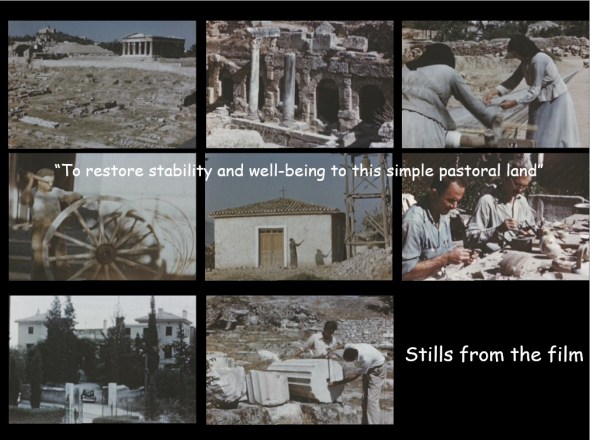
Stills from Triumph Over Time
Francis H. Bacon: Bearer of Precious Gifts from the Dardanelles
Posted: June 9, 2019 Filed under: Archaeology, Archival Research, Art History, Biography, History of Archaeology, Mediterranean Studies, Philhellenism | Tags: Assos Escavations, Francis H. Bacon, Frank Calvert, Stargazer 18 CommentsI first came to know Bacon’s name when, as a student of the American School of Classical Studies at Athens (ASCSA or the School hereafter) in 1989-1990, I was asked to report on the Assos Excavations during the School’s trip to Asia Minor. Assos, an affluent, ancient Greek city in the Çanakkale Province and a colony of Lesbos, is known for having erected the only Doric temple in Asia Minor, where the dominant style was Ionic. Francis Henry Bacon (1856-1940) was the architect of the excavations, which were funded by the Archaeological Institute of America (AIA) and took place from 1881 to 1883, as well as one of the three co-authors (with Clarke and Koldewey) of a final publication that was not completed until 1921. Although Bacon’s name appears second, the publication would not have appeared without his dedication and persistence. Joseph T. Clarke (1856-1920) had given up on it long before, and Robert J. Koldewey (1855-1925) had dedicated most of his life to uncovering Babylon.

In 1878, Francis H. Bacon and Joseph T. Clarke bought a sailboat, the “Dorian,” in London and sailed to Athens by way of Holland, the Rhine, the Danube, the Black Sea, and the Aegean. Here a self-sketch by Bacon while examining a marble lekythos at the National Archaeological Museum. Source: MIT Libraries, Institute Archives and Special Collections.
On Finding Inspiration in Small Things: The Story of a Pencil Portrait
Posted: April 2, 2019 Filed under: Archaeology, Archival Research, Art History, Biography, Classics, History of Archaeology, Philhellenism | Tags: American School of Classical Studies at Athens, Aristeides E. Phoutrides, Bert Hodge Hill, George Demetrios, John A. Huybers 14 CommentsMy story begins six years ago when we inventoried Bert H. Hill’s collection of photos at the item level. Among the images were early portraits of Hill when he was a little boy, and later, a handsome young man. A graduate of the University of Vermont (B.A. 1895) and Columbia University (M.A. 1900), Hill subsequently attended the American School of Classical Studies (ASCSA or the School hereafter) as a fellow for two years (1901-1903). He then secured a job as the Assistant Curator of Classical Antiquities at the Museum of Fine Arts in Boston (1903-1905) and lecturer at Wellesley College where he taught classes in sculpture. Bert Hodge Hill (1874-1958) was only 32 years old when he was appointed director of the ASCSA in 1906, a position he held until 1926.

Bert Hodge Hill, ca. 1910s. ASCSA Archives, Bert H. Hill Papers.
While processing the images my eye fell on a small portrait (12 x 9 cm) that was not a print but instead a well-executed drawing of Hill’s profile in pencil. On the back, Hill had scribbled “Huybers” and “BHH”. An initial web search for “Huybers artist” produced four of his pencil sketches in the Harvard Art Museums, a gift from George Demetrios in 1933 (keep the name in mind); the artist was identified as John A. Huybers.

Portrait of Bert Hodge Hill by John A. Huybers, ca. 1915-1920. ASCSA Archives, Bert H. Hill Papers.
Schliemann’s Culinary Adventures in Italy
Posted: March 3, 2019 Filed under: Archaeology, Archival Research, Biography, Book Reviews, Food and Travel, History of Archaeology | Tags: Caffè Greco, Heinrich Schliemann, Italian food, Massimo Cultraro, Umberto Pappalardo 4 Comments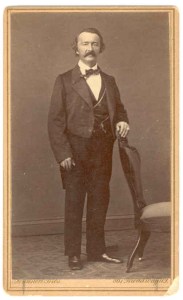
Heinrich Schliemann, a man of the world, ca. 1870. ASCSA Archives, Heinrich Schliemann Papers.
A day does not go by in the Archives of the American School of Classical Studies at Athens (ASCSA) without an inquiry about the Heinrich Schliemann Papers. More than one third of the collection has been digitized and made available for research online; still, these inquiries keep coming from all over the world, including destinations as remote as Japan and Cuba. Though unquestionably a legendary figure, Schliemann’s popularity is largely due to the richness of his personal archive, which remains an inexhaustible source of information for a wide range of audiences: historians, archaeologists, fiction and non-fiction writers, even film producers. (I have written about Schliemann before [Schliemann of Troy: The Story of a Linguistic Genius] and have hosted two posts by Curtis Runnels [Who Went to Schliemann’s Wedding? and, “All Americans Must Be Trojans at Heart”: A Volunteer at Assos in 1881 Meets Heinrich Schliemann], the author of The Archaeology of Heinrich Schliemann: An Annotated Bibliographic Handlist [2007].)
To the rich list of books and articles that have been written about Schliemann I would like to add the recent publications by Umberto Pappalardo, who has been studying Schliemann’s activities in Napoli and on the island of Motya, and Massimo Cultraro’s new book with the sibylline title L’ ultimo sogno dello scopritore di Troia: Heinrich Schliemann e l’ Italia (1858-1890). Before them, in 2012, Elizabeth Shepherd published a comprehensive article about Schliemann’s wanderings in Italy in the fall/winter of 1875, especially his interest in the site of Populonia. Schliemann travelled to Italy seven times, first as a tourist (1858), and later, especially after the discovery of Troy (1871-1873), as a celebrity and potential excavator. He even drew his last breath in the streets of Naples one morning in December 1890. Yet, until recently, Schliemann’s Italian days remained understudied. Read the rest of this entry »

 From the Archivist's Notebook