Financing the Reconstruction of the Stoa of Attalos
Posted: March 20, 2021 Filed under: Archaeology, Archival Research, Biography, Classics, Education, History of Archaeology, Philhellenism | Tags: Carl W. Blegen, Charles H. Morgan, Homer A. Thompson, John L. Caskey, Stoa of Attalos, Ward Canaday 4 Comments1946 marked the re-opening of the American School of Classical Studies at Athens (ASCSA or School hereafter) in a country that had been devastated by war. In reading the official correspondence between the Greek Ministry of Education and the ASCSA, it becomes obvious that opening museums and the preservation of archaeological sites ranked highly on Greece’s list of priorities. With the launch of the Marshall Plan in 1947, Greece’s chances of success were also tightly connected with the development of tourism, and a large part of U.S. aid was streamlined in this direction.
“It is well known that travelers come to Greece chiefly for the purpose of seeing the ancient sites and visiting the museums of the country. In other words, the antiquities of Greece constitute a productive source of revenue capable of adding to the national treasury some 30 million dollars in the course of three years… No investment in the economy of Greece can match this for returns” wrote Oscar Broneer, Acting Director of the American School, on June 29th of 1948, in a petition of the School to the Industry Division of the Marshall plan for a $1,149,000 grant that would re-establish the Greek Archaeological Service.
ASCSA AdmRec 804/6, folder 4
Carl W. Blegen, the excavator of many prehistoric sites in Greece who succeeded Broneer in the Directorship of the American School (1948-1949) and had served as Cultural Relations Attaché at the U.S. Embassy in Athens in 1945-1946, also thought along the same lines. In an additional memorandum to the U.S. Ambassador in Athens, in August of 1948, Blegen underlined “the lamentable state of disrepair of the Greek museums,” which looked like empty shells (ASCSA AdmRec 804/6, folder 11). Blegen participated actively in meetings between the Economic Cooperation Administration (ECA) representatives and the Archaeological Service and helped with writing proposals. (The ECA was a U.S. government agency set up in 1948 to administer the Marshall Plan.) Since the American School could not receive direct funding from the Marshall plan, the only way to benefit from it was through collaboration with the Greek Government. The School hoped in this way to secure about $100,000 from the ECA through the Greek Government to supplement the cost of the construction of a museum that would store and display the growing number of finds from the Athenian Agora Excavations that had been accumulated since 1931. Before WW II, the School already had secured a grant of $150,000 from the Rockefeller Foundation to build a museum on the west side of the Agora.
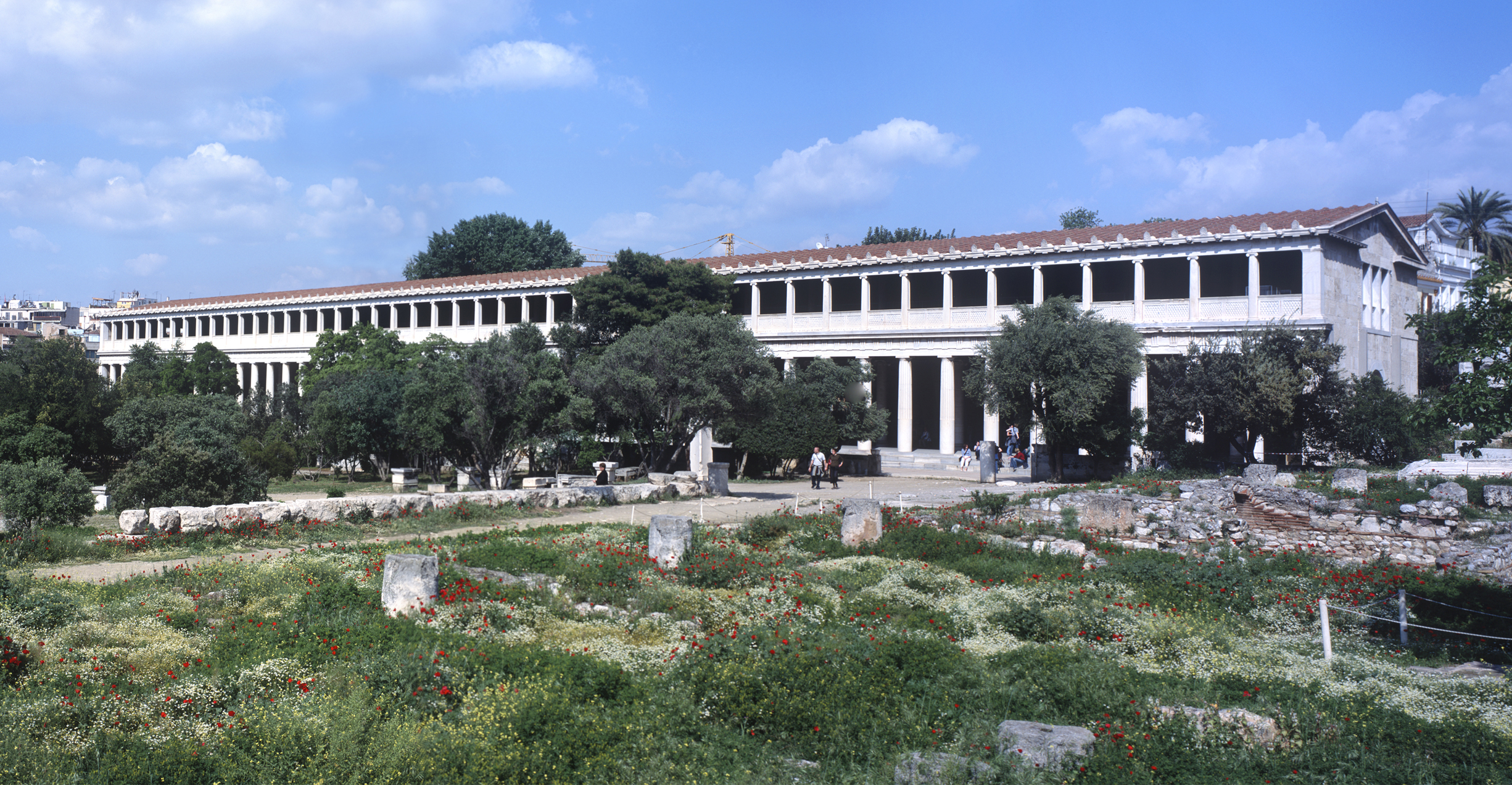
Forced by the War to abandon their plans for an Agora Museum, the Americans resumed work at the Athenian Agora in 1947, conducting excavations at the proposed site, in order to begin construction. The 5th and 4th century B.C. houses and industrial workshops that they found were considered too important to be covered up, and a new site for the museum had to be found. After considering every possible location in the Athenian Agora for the museum, the Americans, following Homer Thompson’s suggestion, came to the conclusion that “another and in many ways preferable alternative would be to restore the Stoa of Attalos and install in it the museum, workrooms, and offices…” (ASCSA Annual Report 1947-1948, p. 29).
The draft of a program agreement between the ECA and the Greek Ministries of Coordination and Education included figures for the preservation of 34 monuments, and the reconstruction of the Stoa of Attalos was first on the list.
Read the rest of this entry »Where There’s Smoke There’s Fire: De Waele’s Story
Posted: February 7, 2021 Filed under: Archaeology, Archival Research, Biography, Classics, History of Archaeology | Tags: Ferdinand Joseph Maria de Waele, Louis E. Lord, Oscar Broneer, Richard Stillwell 14 CommentsThe jumping-off point for this story was an odd comment that Louis E. Lord made in his History of the American School of Classical Studies at Athens about a Belgian archaeologist who was active at the School from 1927 until 1934. “Ferdinand Joseph Maria de Waele, Assistant in Archaeology for six years (1929-1934) was not reappointed. He had served well as an excavator, his work at the Asklepieion had been competent. But he never made a final report for publication, and the manner of his departure left behind him an odor of unsanctity highly offensive to the School” (Lord 1947, p. 246). Lord was referring to an accusation of smuggling antiquities made against de Waele. But was it true? A simple Google search showed that Ferdinand Joseph Maria De Waele (1896-1977), after leaving the American School, went on to have a distinguished career as a professor of archaeology at the Catholic University of Nijmegen in the Netherlands and, later, at the University of Ghent.

“Mr. Lo”: The First Chinese Student at the American School of Classical Studies at Athens, 1933.
Posted: October 4, 2020 Filed under: Archaeology, Archival Research, Biography, Classics, History of Archaeology, Philhellenism | Tags: Edward D. Perry, Luo Niansheng, Mao-Te Lo, Richard H. Howland, Thomas Means 5 CommentsIn the late 1990s, a few years after I was appointed Archivist of the American School of Classical Studies at Athens (ASCSA or the School), Robert (Bob) A. Bridges, the Secretary of the School, brought to the Archives a Chinese metallic vase to be saved because it was part of our institutional history. Bob said that the bearer of the gift was a former student of the School from the 1930s, who had visited Greece and the School in the 1980s. Underneath the vase, Bob had pasted the donor’s professional card to make sure that his identity was not lost. The print on the card read: Luo Niansheng, Professor [and] Research Fellow of the Chinese Academy of Social Sciences; and scribbled on it: Lo Maote student of the American School in the academic year of 1933-1934.


The School’s Directory in Louis E. Lord’s History of the American School of Classical Studies (1947) lists the following information for “Mr. Lo”:
LO, MAO TE 1933-1934 – Tern., Chinese Educational Mission, 1360 Madison Street, Washington, D. C, or 317 College Avenue, Ithaca, New York; Per., Yu-Tai-Huan Company, Lo-Chwan-Tsing, Ese-Chung-Hsien, Sze-Chuan, China. A.B., Ohio State University, 1931.
Forgotten Friend of Skyros: Hazel D. Hansen (Part II)
Posted: May 14, 2020 Filed under: Archaeology, Archival Research, Biography, Classics, Greek Folklore, History of Archaeology, Philhellenism, Women's Studies | Tags: Brunilde Sismondo Ridgway, Francis Bertram Welch, Hazel D. Hansen, Oscar Broneer, Stanford University 2 CommentsAs a young woman, Hazel Dorothy Hansen broke several glass ceilings. From a humble background –her father was a foundryman—she was admitted to Stanford University in 1916, at a time when the institution had severely limited the admission of women. In 1904, Mrs. Stanford became afraid of the increasing number of women enrolling at Stanford (by 1899 reaching almost 40% of the student population) and implemented a quota that restricted their numbers at the undergraduate level: for every woman at Stanford, there had to be three men. (See Sam Scott, “Why Jane Stanford Limited Women’s Enrollment to 500,” Stanford Magazine, Aug. 22, 2018.). Fortunately for a girl of modest means, Stanford remained tuition-free until 1920.
She broke the glass ceiling again when she chose a prehistoric topic for her dissertation (“Early Civilization in Thessaly”) that also required extensive surveying for sites on the Greek periphery. In the 1920’s female graduate students at the American School had limited options when it came to field research. Apart from Alice Leslie Walker, who had been entrusted with the publication of its Neolithic pottery, Corinth remained a male domain, with Bert Hodge Hill and Carl W. Blegen controlling access to, and publication of, archaeological material. Hazel would have needed either to finance her own excavation, as Hetty Goldman and Walker had done in the 1910s, or to write an art history thesis based on material in museums. It was not until David R. Robinson began excavations at Olynthus and Edward Capps spearheaded the Athenian Agora Excavations that women were allowed to participate in the publication of (secondary) excavation material.
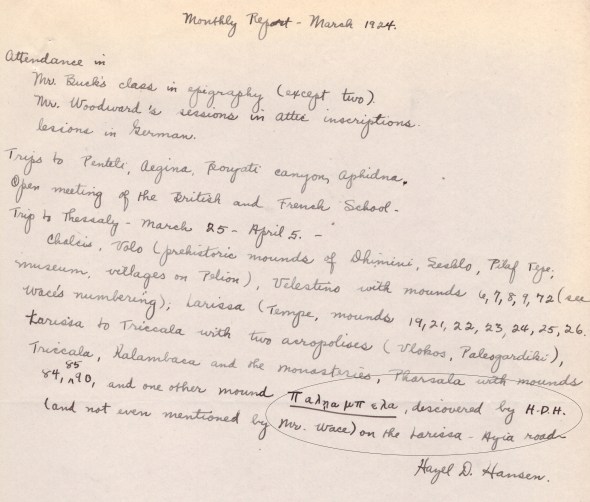
Hansen’s monthly report (March 1924) to the School’s Director, where she lists her trips, and also proudly claims that she discovered the prehistoric site of Μαγούλα Παλιάμπελα (“and not even mentioned by Mr. Wace”). ASCSA Archives, AdmRec 108/1, folder 5.
Forgotten Friend of Skyros: Hazel Dorothy Hansen (Part I)
Posted: April 19, 2020 Filed under: Archaeology, Archival Research, Biography, Classics, Greek Folklore, History of Archaeology, Women's Studies | Tags: American School of Classical Studies at Athens, David M. Robinson, Dorothy Burr Thompson, George Mylonas, Hazel D. Hansen, Natalie Murray Gifford, Stanford University 12 Comments“Her main contribution was not destined to be in the field of excavation, but in discovering in dark cellars a good number of broken vases still covered with earth, discovered by others over the years in the island of Skyros. There she collected, cleaned, patched, and provided with a shelter transforming into a small Museum a room in the City Hall of Skyros. For this service to archaeology and the island she was made Honorary Citizen of Skyros,” wrote archaeologist George Mylonas about Hazel Hansen in early 1963, a few months after her death, in the Annual Report of the American School of Classical Studies at Athens (ASCSA or the School hereafter).
I asked several archaeologists of my generation and slightly older if her name or her association with the island of Skyros rang a bell. It did not, although she was known well enough in Greece, for her death to be noted at length in Kathimerini (December 22, 1962), one of the most respected Greek newspapers. «Ηγγέλθη χθες στην Αθήνα ο θάνατος της φιλέλληνος αρχαιολόγου καθηγητρίας του Πανεπιστημίου Στάνφορδ, Χέιζελ Χάνσεν, η οποία είναι ιδιαιτέρως γνωστή δια το σύγγραμμά της περί του αρχαιοτέρου πολιτισμού της Θεσσαλίας…”. In addition to her work in Thessaly and Skyros, the note referred to her participation in the excavations at Olynthus and on the North Slope of the Acropolis. The author of Hansen’s Greek obituary knew her well and wanted to capture the accomplishments of a friend and able colleague. It must have been (again) George Mylonas, whose friendship with Hazel started in the 1920s when they were both at the American School.

Hazel D. Hansen, 1923. ASCSA Archives, Carl W. Blegen Papers.

 From the Archivist's Notebook