Athens 1918: “In Every Way a Much More Attractive City than Rome”
Posted: December 1, 2015 Filed under: Archival Research, History of Archaeology, Modern Greek History | Tags: 1918-1919, A. Winsor Weld, American Red Cross Greek Commission, American School of Classical Studies at Athens, Aspasia Manou, Athens, Edward Capps, Great War, Greek Cuisine, Josephine Kelly, Kephissias Street, King Alexander of Greece 4 Comments
The headquarters of the American Red Cross in Athens, 1918-1920. Source: Horace S. Oakley Papers, Newberry Library, Chicago.
This description of Athens was penned by A. Winsor Weld (1869-1956), one of the deputy commissioners of the American Red Cross Commission to Greece, a few days after his arrival in October 1918. Weld, an investment broker from Boston and a graduate of Harvard University (B.A. 1891), was one of a million Americans who responded to President Wilson’s call to provide military and civilian aid to many European countries at the end of WW I. The mission to Greece was organized in June and July of 1918 in response to an appeal from the Greek Red Cross (Capps 1919, 9).
There came from America to do the work 103 persons (60 men and 43 women), and several others were recruited in Europe. They enlisted in the service of the American Red Cross from all parts of the United States, and represented all manner of occupations and professions. There were business men, lawyers, bankers, physicians, preachers, teachers, farmers and mechanics, and among the women, trained nurses, stenographers and social workers. The authority of the Commission was vested in the Commissioner, who held the rank of Lieutenant-Colonel, and seven Deputy Commissioners with the rank of Major.
Living Like Kings: When the Palace of Prince George Was the Annex of the American School of Classical Studies at Athens
Posted: September 1, 2015 Filed under: Archaeology, Archival Research, History of Archaeology, Modern Greek History, Women's Studies | Tags: Academy Street, American School of Classical Studies at Athens, Caroline Morris Galt, George Mylonas, Marie Bonaparte, Oscar Broneer, Palace of Prince George, Prince George, Priscilla Capps 8 CommentsImmediately after the destruction of Smyrna in 1922, a sudden influx of hundreds of thousands of Asia Minor refugees created severe housing problems for all those arriving in Athens, including the incoming students of the American School of Classical Studies at Athens (hereafter ASCSA or the School). Its female members could not find any accommodations, whether rooms in a boarding house or a hotel. Until then, only the male students were allowed to board in the School’s facilities. Plans for a female dormitory on a plot of land on the other side of Speusippou Street had been in place since 1916, but construction delays sprang up after communication problems between the School’s Managing Committee, headed by the mighty Edward Capps, and the Women’s Hostel Committee, led by M. Carey Thomas, the dynamic president of Bryn Mawr College.
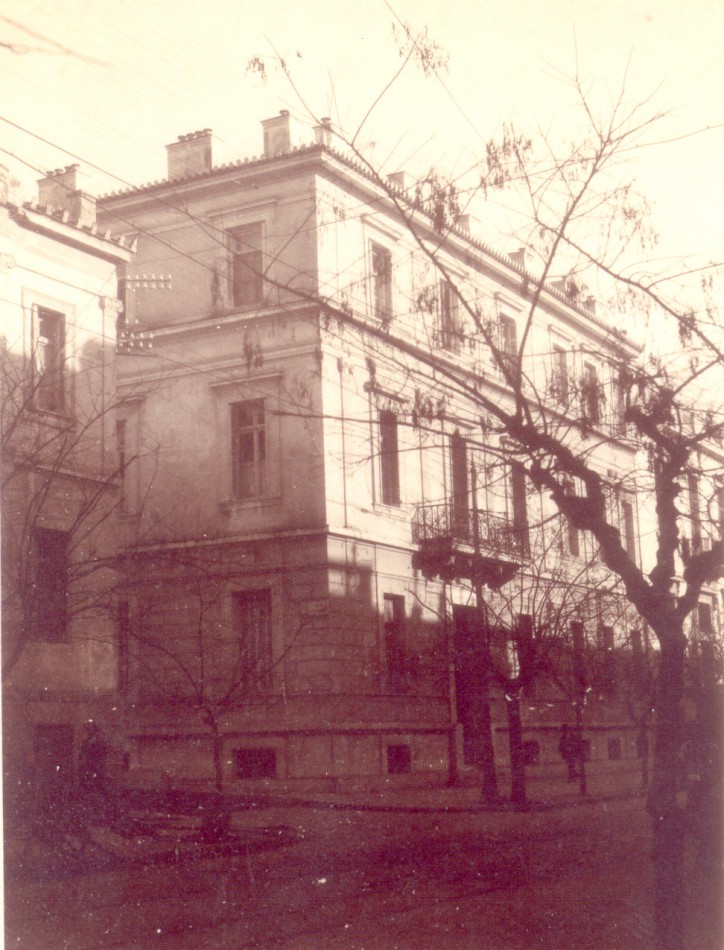
The palace of Prince George on Academias Street as Annex of the ASCSA, 1926 (American School of Classical Studies at Athens)
To cope with the situation, the School allowed women to live “on campus” for the first time since its establishment in 1881. Elizabeth Pierce (Blegen), Natalie Gifford (Wyatt), and Dorothy Cox were among the female students to stay in the School’s bedrooms in 1922-23 and share bathroom facilities with the male occupants of the building. Not surprisingly, the Managing Committee, unhappy with the solution, expressed its “earnest hope that the emergency arrangements of the year 1922-1923 might not recur….” It was suggested “that an annex might be rented which could be used for the accommodation of the women” (Louis Lord, History of the American School of Classical Studies at Athens, Cambridge, Mass. 1947, 163). Read the rest of this entry »
Archives from the Trash: The Multidimensional Annie Smith Peck—Mountaineer, Suffragette, Classicist
Posted: May 1, 2015 Filed under: Archaeology, Archival Research, Classics, History of Archaeology, Modern Greek History, Mountaineering, Women's Studies | Tags: American School of Classical Studies at Athens, Annie S. Peck, Demetrios Kalopothakes, Frederic de Forest Allen, Martin D'Ooge, Walter Miller 9 CommentsJack L. Davis, Carl W. Blegen Professor of Greek Archaeology at the University of Cincinnati and a former director of the American School of Classical Studies at Athens (2007-2012), here contributes to The Archivist’s Notebook a story about Annie S. Peck, famous mountaineer and the first woman student at the American School of Classical Studies at Athens.

Annie Smith Pack (1850-1935): scholar, teacher, university professor, lecturer, popular author, advocate for women’s rights and pan-Americanism, the leading woman mountain climber of her generation — and first woman member of the American School of Classical Studies at Athens (ASCSA). Much of her story would have been lost forever, but for the grace of God. Read the rest of this entry »
Of Job Security, Personal Dignity, and Efficiency Wages: ASCSA Trustee Fred Crawford and his Corporate Philosophy
Posted: March 2, 2015 Filed under: American Studies, Archival Research, Corporate History | Tags: American School of Classical Studies at Athens, Frederic C. Crawford, John Elton Mayo, John McCloy, Mark Bertolini, Thompson Products, TWR (Thompson Ramo Wooldridge), Ward Canaday, welfare capitalism, Yannis Varoufakis Leave a comment
Excerpt from “The Financial Page,” The New Yorker, Feb. 9, 2015.
Recently on the financial page of The New Yorker (February 9, 2015) staff writer James Surowiecki published “A Fair Day’s Wage,” an article about the decision by Aetna, one of the largest U.S. companies, to increase its lowest wage from twelve to sixteen dollars an hour and offer an improved package of medical coverage. In an era plagued by high unemployment and few raises for the majority of the nation’s workforce, Mark Bertolini, the idiosyncratic C.E.O. of Aetna, made the bold decision to increase the lowest salaries at his company by 33%. “It is not fair for employees of a Fortune 50 company to be struggling to make ends meet” said Bertolini. In addition to a near-to-death personal experience, Bertolini claims that reading Thomas Piketty’s influential Capital in the Twenty-First Century (which he also gave to all of his top-executives) made him realize how income inequality had increased significantly since 2000. Surowiecki, moreover, reminds readers that the benefits of US economic growth in the post-war era prior to 2000 had generally been shared broadly, and that “US companies were responsible not only to their shareholders but also to their workers.” Recent studies have, in fact, shown that companies that invest in workers’ training, reward them with “efficiency wages,” and care about their mental well-being also end up flourishing through the efforts of dedicated employees. “It’s hard for people to be fully engaged with customers when they’re worrying about how to put food on the table,” Bertolini told Surowiecki. (For a more recent interview with Bertolini in The New York Times, see David Gelles, “At Aetna, a C.E.O.’s Management by Mantra,” Feb. 27, 2015). Read the rest of this entry »
A Mycenaean “Matter of Fact”: Part I, Joe Alsop Reports on the Greek Bronze Age
Posted: February 1, 2015 Filed under: American Studies, Archaeology, Archival Research, History of Archaeology, Mediterranean Studies | Tags: American School of Classical Studies at Athens, Carl W. Blegen, From the Silent Earth, Joseph W. Alsop, Maurice Bowra, Pylos Excavations, Susan Mary Alsop Leave a commentJack L. Davis, Carl W. Blegen Professor of Greek Archaeology at the University of Cincinnati and a former director of the American School of Classical Studies at Athens (2007-2012), here contributes to The Archivist’s Notebook an essay about political columnist Joseph Alsop and his passion for the prehistoric archaeology of Greece.
Several months ago Louis Menand’s New Yorker review (Nov. 10, 2014) of Gregg Herken’s The Georgetown Set: Friends and Rivals in Cold War Washington kindled my interest in Joseph W. Alsop (1910-1989), influential journalist, syndicated newspaper columnist, and trustee (1965-1985) of the American School of Classical Studies at Athens. A bit of archival sleuthing at the University of Cincinnati (see below) led to the discovery that on Saturday, December 14, 1963, Alsop had summoned an A-list of Classical archaeologists and art historians to dine with him and his wife, Susan Mary, in their Georgetown, Washington, D.C., home — a strange flock for this longtime Washington insider to host.

On the cover, Joseph and Stewart Alsop (photo by Henri Cartier-Bresson)
Guests included Jack and Betty Caskey, professors at the University of Cincinnati, Emmett Bennett, professor at the University of Wisconsin, Emily Vermeule, then professor at Boston University, Cornelius Vermeule, curator of Classical art at the Boston Museum of Fine Arts, and Sterling Dow, professor at Harvard. Read the rest of this entry »

 From the Archivist's Notebook