A Preamble to the Nazi Holocaust in Greece: Two Micro-Histories from the American School of Classical Studies at Athens
Posted: November 1, 2014 Filed under: Archaeology, Archival Research, Classics, History, History of Archaeology, Jewish Studies | Tags: American School of Classical Studies at Athens, Georg Karo, Henry Immerwahr, Holocaust, Israel Walker, Martin Amis, The Zone of Interest 9 CommentsJack L. Davis, Carl W. Blegen Professor of Greek Archaeology at the University of Cincinnati and a former director of the American School of Classical Studies at Athens (2007-2012), here contributes to The Archivist’s Notebook an essay about Jewish academics in Athens in the 1930s and anti-semitism at the ASCSA.
A recent comment by Barbara McManus on a older post to this blog makes it clear that leaders of the American School of Classical Studies at Athens (ASCSA) factored religion into decision-making about student applications for fellowships (https://nataliavogeikoff.com/2013/10/01/the-modern-greek-exam-professor-blanks-method-and-other-stories-from-the-1930s/). Natalia Vogeikoff-Brogan had observed that fellowship procedures in the 1930s were weighted against women, the handicapped, and even Canadians! McManus remarked:
“Besides being female, handicapped, or Canadian, if you were a Jew it was also difficult to win an ASCSA fellowship in the 1930s. Letters in the Samuel E. Bassett papers in Yale’s manuscript and archives library show that the Fellowship Committee gave Israel Walker the 1930-31 Fellowship in Greek Language, Literature and History only with great reluctance. In an undated letter to Edward Capps about the results of the 1930 fellowship examinations, Bassett lamented that John F. Latimer, “a very attractive young man and an excellent teacher,” fell down badly on the history and literature exams, while Walker placed 6 or 7 points ahead of his nearest competitor. The committee agreed to award the fellowship to Walker since he was ‘vouched for as personally acceptable’ by LaRue Van Hook, Walker’s Columbia professor, who wrote that ‘his semitic blood does not make him objectionable.’ Van Hook’s letter (5 March 1930) actually said, ‘He is of Semitic extraction, but a quiet, modest, and unassuming fellow, very presentable.’ When Bassett had asked David Robinson’s opinion about giving the fellowship to Walker (Robinson was a member of the Fellowship Committee), Robinson had replied (29 March 1930), ‘I am a firm believer in examinations and if Walker comes out far ahead in general average I should hesitate not to give him the fellowship, especially as he can work under his own instructor, Van Hook [Annual Professor for 1930-31]… Personality is an important thing and I hate the Jews with a few exceptions, but these fellowships are given for scholarship and ability to do research work and not merely on the grounds of personality.’” Read the rest of this entry »
The American Dream to Excavate Delphi or How the Oracle Vexed the Americans (1879-1891)
Posted: October 2, 2014 Filed under: Archaeology, Archival Research, Classics, History of Archaeology, Modern Greek History | Tags: American School of Classical Studies at Athens, Archaeological Institute of America, École française d’Athènes, Charilaos Trikoupis, Charles Eliot Norton, Charles Jean Tristan de Montholon, Charles Waldstein, Delphi, Paul Foucart, Pierre Amandry, Stephanos Dragoumis, Walker Fearn, Zante currants 5 Comments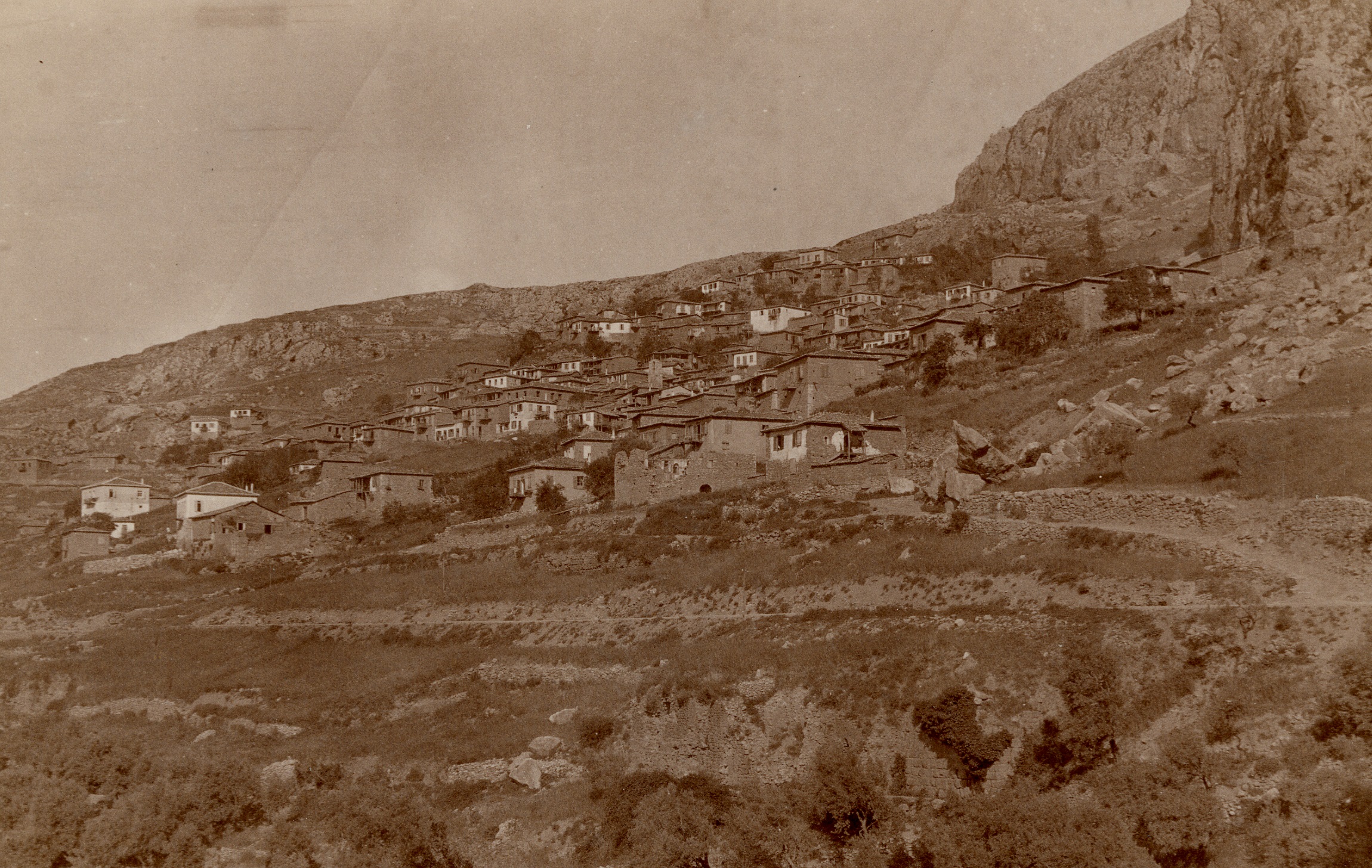
Delphi before the excavations, April 1891. Photo ASCSA Archives. Click to enlarge.
The story of how the French secured the excavation of Delphi has been told before. Pierre Amandry published an exemplary account (“Fouilles de Delphes et raisins de Corinthe”) of the negotiations between the French, Greeks, and Americans in La redécouverte de Delphes (1992). His work drew heavily on material in the archives of the French ministries of Public Instruction and Foreign Affairs and L’ Academie des Inscriptions et Belles Lettres to paint a detailed picture of the French side of the story. His account of the American side is much shorter because Amandry only had access to a handful of documents published in the History of the American School of Classical Studies at Athens, 1882-1942 (1947, pp. 58-62). The author of that volume, Louis Lord, included four letters either addressed to or written by Charles Eliot Norton, the President of the Archaeological Institute of America (AIA). Norton was not only the founding spirit of the American School of Classical Studies at Athens (ASCSA) but also the driving force behind the Institute’s unsuccessful campaign to dig at Delphi. In a brief essay from Excavating Our Past (2002), Phoebe Sheftel presented more records from the archives of the AIA that shed further light on the American side of the Delphi story without, however, making reference to the rich archival resources that Amandry had published in his long article. Sheftel’s story about Delphi is “the story that Norton wanted told” (Sheftel 2002, p. 106). Read the rest of this entry »
The Pride of Amphipolis
Posted: September 15, 2014 Filed under: Archaeology, Archival Research, History, History of Archaeology | Tags: American School of Classical Studies at Athens, Αμφίπολις, Λόφος Καστά, Jacques Roger, John Monks & Sons, Lincoln MacVeagh, Lion of Amphipolis, Oscar Broneer, Roy W. Gausmann, Stella Miller-Collett, Steve Miller, Ulen & Company 14 CommentsPosted by Betsey Robinson
Betsey A. Robinson, Professor of History of Art at Vanderbilt University, here contributes to The Archivist’s Notebook an essay about the history of the reconstruction of the Lion of Amphipolis in the 1930s and the people who spearheaded it; she also reminds us of recent work by the American School in the area in 1970. Her current essay is based on extensive archival research she conducted in the Archives of the American School of Classical Studies at Athens a few years ago, which resulted in an article entitled “Hydraulic Euergetism: American Archaeology and Waterworks in Early-20th-Century Greece,” in Philhellenism, Philanthropy or Political Convenience? American Archaeology in Greece, ed. Jack L. Davis and Natalia Vogeikoff-Brogan (Hesperia 82: 1, special issue), Princeton 2013, pp. 101-130.

The Lion of Amphipolis, 1962. Photo ASCSA Archaeological Photographic Collection. Click to enlarge.
Εἰπέ, λέον, φθιμένοιο τίνος τάφον ἀμφιβέβηκας, βουφάγε; τίς τᾶς σᾶς ἄξιος ἦν ἀρετᾶς;
Tell, lion, whose tomb do you guard, you slayer of cattle? And who was worthy of your valour?
Anthologia Palatina 7.426.1-2 (Trans. M. Fantuzzi & R. Hunter)
The lines above, by Hellenistic poet Antipater of Sidon, are as much of a tease today as they were when Oscar Broneer quoted them in The Lion Monument at Amphipolis in 1941. As I write, each day brings tantalizing new discoveries at Amphipolis where the Kasta Hill is being excavated by the 28th Ephorate of Prehistoric and Classical Antiquities. Less than 5 km to the south, the colossal marble lion that was reconstructed in 1937 has attracted renewed attention since archaeologist Katerina Peristeri and architect Michalis Lefantzis reported evidence connecting it to the mysterious tumulus (http://www.archaiologia.gr/en/blog/2013/04/01/the-lion-of-amphipolis/). Nearly a century after the lion’s discovery, as we await the excavators’ next revelations, it seems a good time to reflect on the lion and its modern history. Read the rest of this entry »
“All Aboard”: Cruising the Aegean in 1923
Posted: August 1, 2014 Filed under: Archaeology, Archival Research, History of Archaeology, Mediterranean Studies, Modern Greek History, Philhellenism | Tags: American Academy in Rome, American School of Classical Studies at Athens, Candia, Crete, Delos, Evelyn Waugh, George Dupont Pratt, Ida Thallon Hill, Melos, Natalie Murray Gifford, Santorini, Thomas Whittemore, Wilhelm Dörpfeld, yaght Zion 6 CommentsOn the morning of May 14, 1923, a private yacht approached the island of Santorini and cast anchor just outside the bay of Phira. The Zion carried twenty-five passengers and belonged to an American millionaire and philanthropist, George D. Pratt. Pratt, a recent widower, had come to Greece a few weeks earlier, and the cruise would allow him “to go about the islands taking photographs” as one of the Zion passengers –or so Natalie Murray Gifford wrote in her own account of the trip. There was, however, another, more practical, motivation that lay behind Zion’s Aegean course. At the end of the cruise, the yacht would sail to Mount Athos to deliver food and supplies to starving Bulgarian and Russian monks, who had lost vital support from home as a consequence of the Russian Revolution. Thomas Whittemore, one of Zion’s passengers, was monitoring this relief effort.
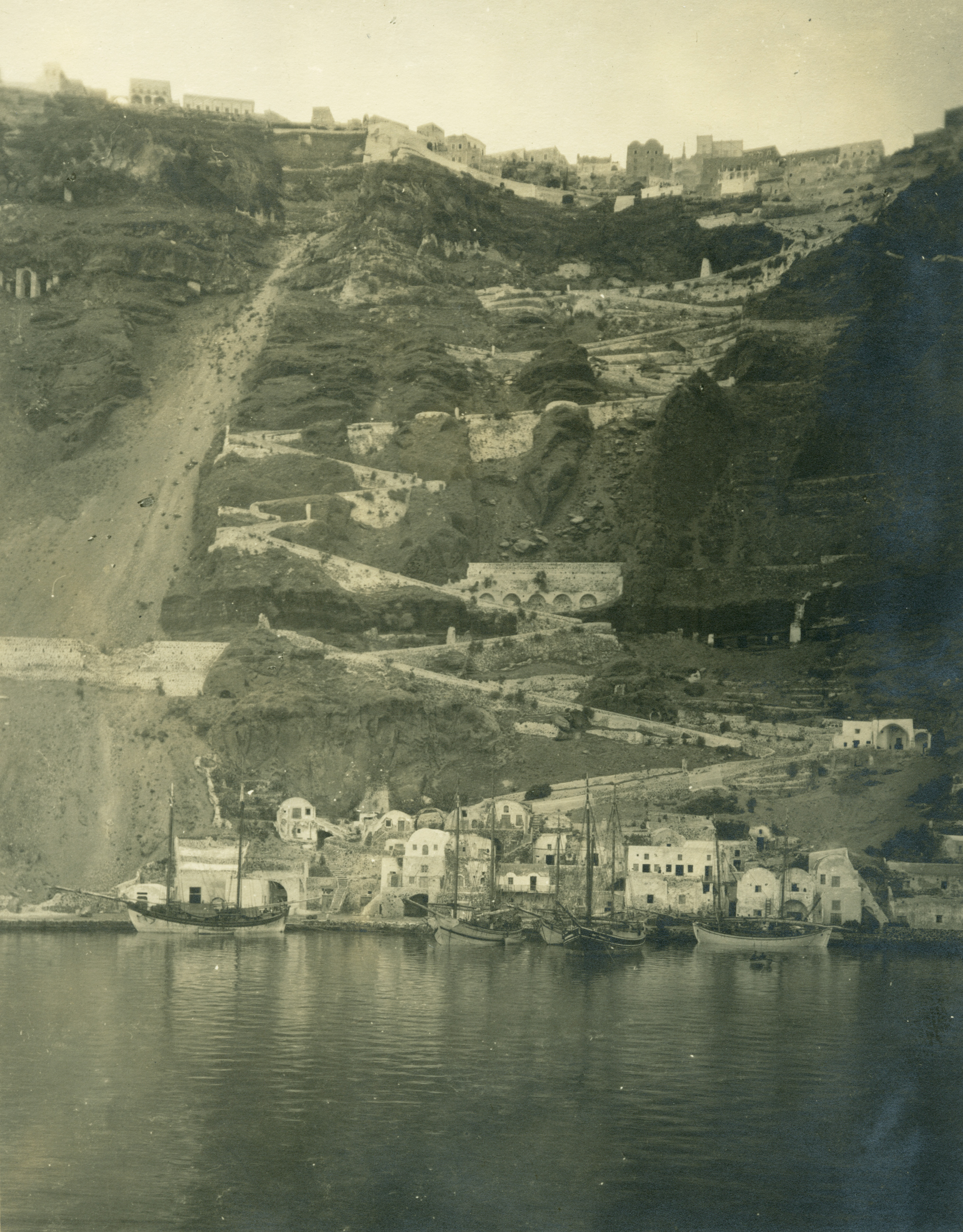
Santorini, 1923 (ASCSA Archives, Carl W. Blegen Papers)
Pratt’s guests on board the Zion were archaeologists or classicists affiliated with the American School of Classical Studies at Athens (ASCSA) or with the American Academy in Rome (AAR). All were advanced students and scholars, making the trip entirely unlike the contemporary commercial cruises to the renowned harbors of the Mediterranean that had become increasingly popular in the first decades of the 20th century. Evelyn Waugh describes such a trip aboard the Stella Polaris in Labels (1930), as well as how pleasure cruising had evolved by his time. “Before that only the very rich, who owned their own yachts, could afford this leisurely pottering from port to port,” and this is exactly what George Pratt’s Zion was tasked to do; to offer an exclusive, old-fashion cruise to the members of the School at Athens and the five “Romans” who had come from the Academy in Rome. Waugh also drew a colorful distinction between travelers and tourists, and Pratt’s guests were clearly members of the former club. Read the rest of this entry »
“To deaccession, or not to deaccession?” Paul Manship’s Actaeon and the American School of Classical Studies at Athens
Posted: June 1, 2014 Filed under: Art History, History of Archaeology | Tags: Actaeon, American School of Classical Studies at Athens, Diana, Doreen Canaday Spitzer, Paul Manship 2 CommentsRevised on August 3, 2022, after it was discovered that the bronze carries Manship’s signature. New photos were added.
This is the question that Doreen Canaday Spitzer, President of the Board of Trustees of the American School of Classical Studies at Athens (1983-1988), posed in a memo to board members on January 25th, 1988. But why would the School ever consider putting up its valuable possessions on the market (the others mooted for sale included Amory Gardner’s portrait by Anders Zorn and a Tiffany lamp once owned by Carl and Elizabeth Blegen)? Because there was immediate pressure to secure funding for the construction of the New Extension of the Blegen Library. It was Richard H. Howland, former chairman of the Managing Committee and Trustee of the American School, who brought Doreen’s attention to the significant value of Paul Manship’s bronze Actaeon and the financial benefits the School would gain from its sale.
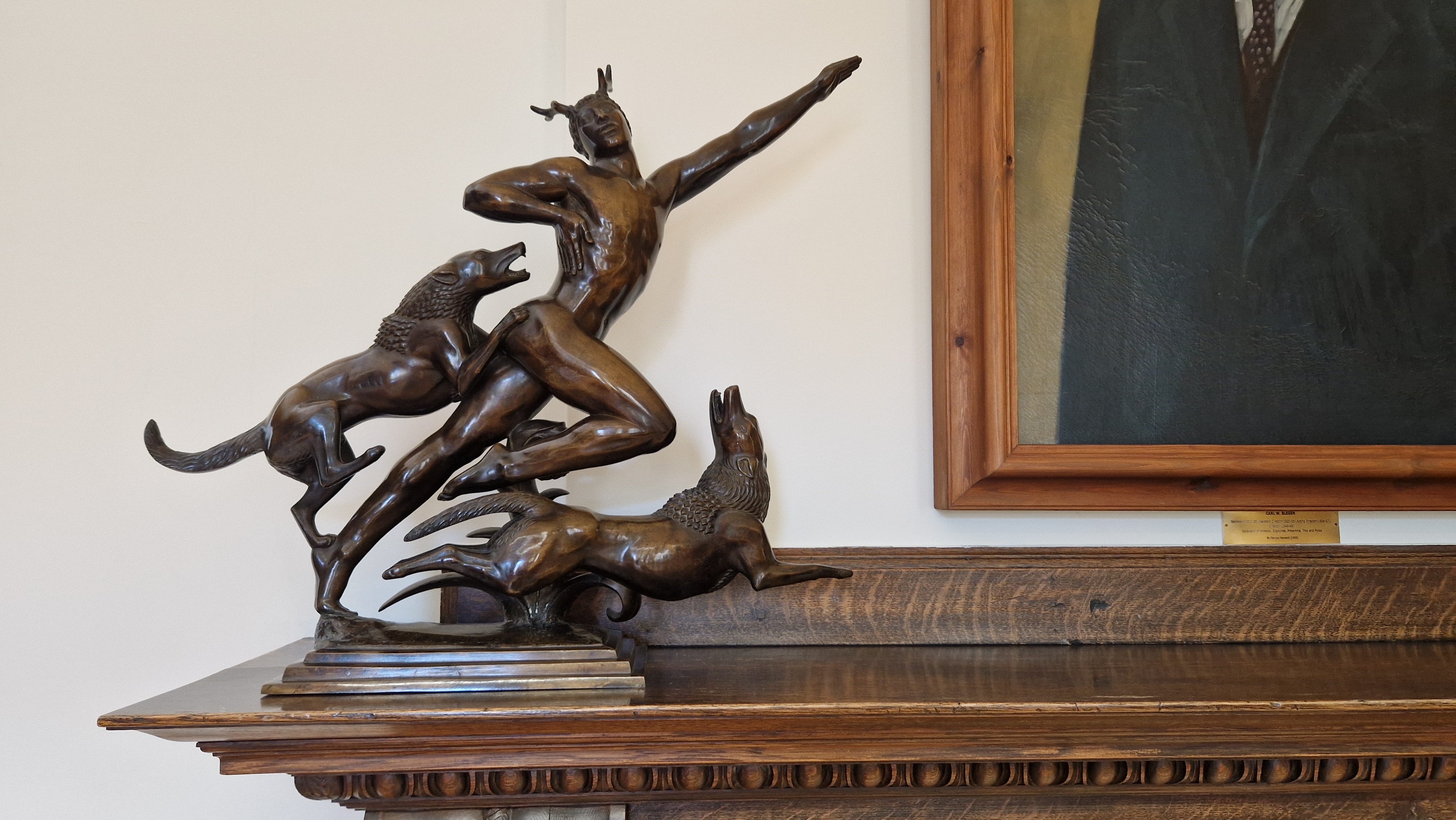


Paul Manship (1885-1966) was an American sculptor from Minnesota whose work can be seen in several public buildings and museums; he is also known for his low relief work on coins and medals, including the John F. Kennedy inaugural medal. His small bronzes are auctioned for several hundred thousands of dollars. The Dancer and the Gazelles (1916) was sold for $434,000 in a Bonhams’ auction in 2009, while the group of Diana and Actaeon was sold for more than a million at Christies in 2015. It is certain that the sale of the single Actaeon in the late 1980s could have brought two or three hundred thousand dollars to the School. Prudence, however, prevailed because a few months later, in May of 1988, Spitzer stated “I believe the [Manship] bronze should not be considered as a source of funds for the Blegen [Library], or any other expansion. We are obliged to raise much more, in any case, than it should bring…” Doreen, with typical frankness, further admitted that “Yes, I argued for selling it, but I did not succeed in convincing myself! Yes, ‘the School is not a Museum,’ but neither is it a factory. It is a cultural institution. We appreciate nice furniture; handsome green and gold china from 9 Plutarch St. [she refers to the house where Carl and Elizabeth Blegen lived] is preferable to cafeteria crockery.” By November of 1988, the Trustees had voted to have the Manship bronze insured together with the portrait of Amory Gardner by Anders Zorn) and the Tiffany lamp that once belonged to the Blegens (for the Zorn portrait see an earlier post).
Read the rest of this entry »
 From the Archivist's Notebook