Glass “Eye Candy”: A Decorated Window at the American School of Classical Studies at Athens
Posted: January 1, 2014 Filed under: Art History, Arts and Crafts Movement, Stained Glass | Tags: American School of Classical Studies at Athens, Belcher Mosaic Glass Co., Stained Glass, William J. McPherson, William Robert Ware 5 CommentsHAPPY NEW YEAR!
“In the effort to make this building a credit to American architecture, many well-known American makers and designers took the most lively and liberal interest. Thus, Messrs. J.B. & J.M. Cornell presented the iron staircase extending from cellar to roof… the Belcher Mosaic Glass Company and Mr. W. J. McPherson decorative panels for the outer door, and a beautiful window for the staircase…”
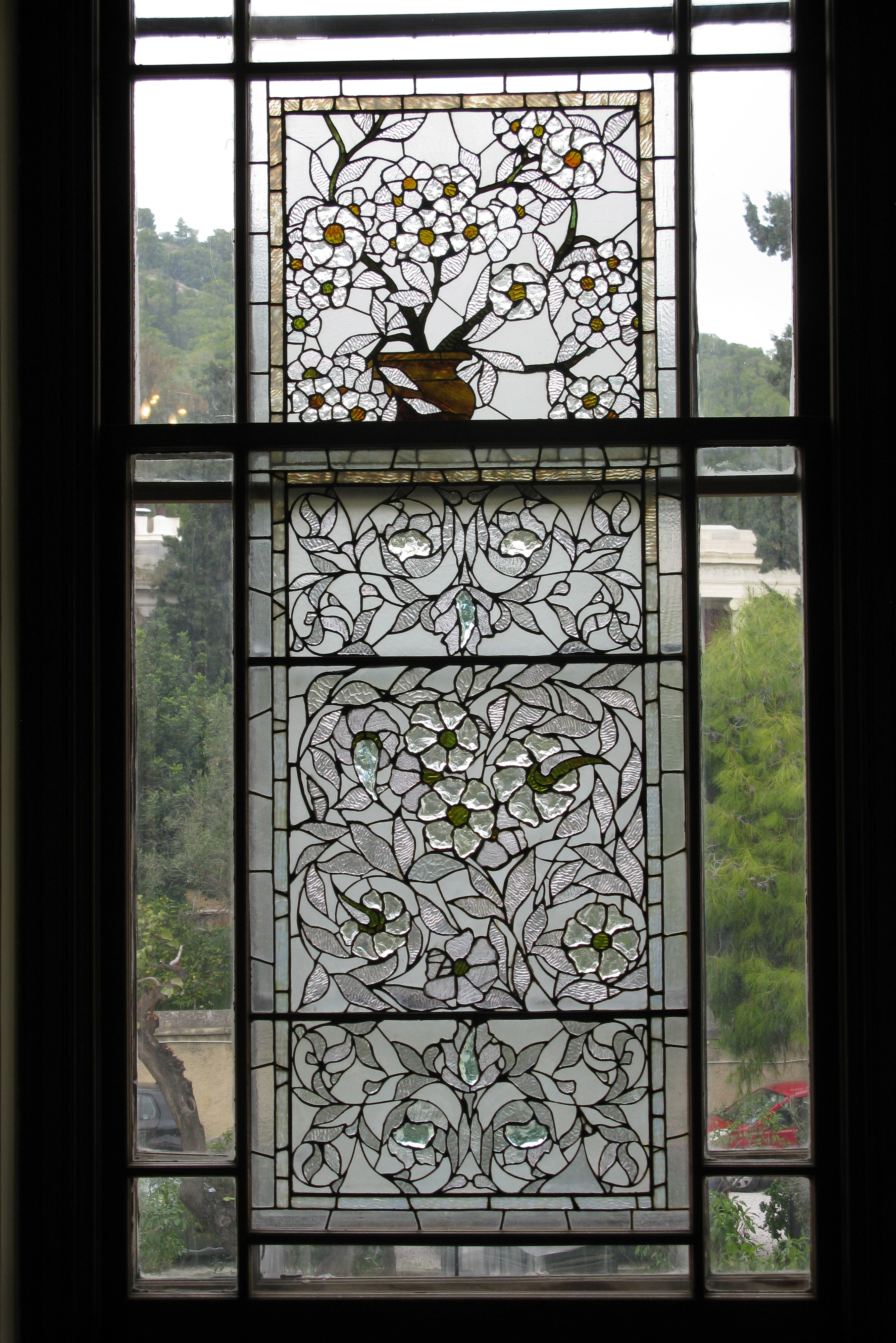
The decorated window at the ASCSA Director’s residence. Click to enlarge
This description is taken from an article published in The American Architect and Building News (AABN) in December of 1889 (no. 728, p. 263), a year after completion of the building destined to house the newly founded (1881) American School of Classical Studies at Athens (ASCSA). In addition to describing the mission and goals of the School, the author drew attention to all the American firms and designers who contributed to the building’s furnishings. One comes away with the impression that everything but the stone walls was imported from America. J.B. & J.M. Cornell presented an iron staircase that still climbs from cellar to roof; the Hopkins & Dickinson Manufacturing Company gave all the necessary hardware; the Sanitas Company contributed plumbing fittings; A.H. Davenport & Company and Norcross Brothers, handsome mantelpieces for the library and the dining room, respectively… and the list goes on.
I have always been fascinated by the tall, exquisite window that looms over the first landing in the white marble staircase that leads from the ground floor to the first floor of the Director’s residence. It was once rumored to be a Tiffany creation, but in Louis Lord’s History of the American School, written more than fifty years after the construction of the building, McPherson was credited as the donor–“…and from Mr. W. J. Macpherson a fine decorated window for the main staircase” (1947, p. 29). One suspects that Lord was drawing his information from the AABN article, but it puzzles me why he did not also credit the Belcher Glass Mosaic Company, since in that place the decorated glassworks of the School’s building had been attributed to both Belcher and McPherson. Read the rest of this entry »
Le Noir et le Bleu: An Exhibit about the Mediterranean in Marseilles
Posted: November 1, 2013 Filed under: Art History, Exhibits, History, Mediterranean Studies | Tags: American School of Classical Studies at Athens, Cyprian Broodbank, Fernand Braudel, Gennadius Library, Le musée des Civilisations de l’ Europe et de la Méditerranée (MuCEM), Le Noir et le Bleu, Marseilles, Mediterranean, Middle Sea, Nicholas Purcell, Odysseus Elytis, Peregrine Horden, Thierry Fabre 1 Comment
The exhibit’s catalog
Fernand Braudel (1902-1985) declared “J’ ai passionément aimé la Méditerranée” in the preface of the first edition of La Méditerranée et le monde méditerranéen a l’ époque de Philippe II (1949). Archaeologists of my generation had to read or at least leaf through this three volume magnum opus written during Braudel’s captivity in concentration camps in Mainz and Lübeck during WWII (and delivered in lectures to fellow prisoners). “Had it not been for my imprisonment, I would surely have written a much different book…” wrote Braudel in his “Personal Testimony.” Much more about Braudel’s life and work can be found in the excellent biographical essay by historian William McNeill (Journal of Modern History 73:1, 2001, pp. 133-147); McNeill himself was awarded the National Humanities Medal by President Barack Obama on February 25, 2010.
Braudel belongs to the first generation of post war “savants” who tried to reconfigure the Mediterranean world after the destruction and the division that WWII brought to the shores of the “Middle Sea.” This new “mediterraneité” would be inclusive and post-colonial –at least in the erudite world of scholarship. Although Braudel’s approach has been criticized for overlooking certain fundamental conflicts (e.g., the clash of Islam and Christianity and the clash between Catholics and Protestants), it has cast a long shadow over subsequent study of the Mediterranean. More than three decades would separate Braudel’s last revision in 1966 (and translation into English in 1972) from the next major tome written about the Mediterranean by an ancient historian (Nicholas Purcell) and a medievalist (Peregrine Horden). Published in 2000, their study (The Corrupting Sea: A Study of Mediterranean History) is Braudelian both in size and depth and covers the period from about 800 B.C. through medieval times. While receiving both praise and criticism, Purcell and Horden’s book has rightly become a classic. Read the rest of this entry »
Revisiting George Cram Cook and Other Delphic Surprises
Posted: October 15, 2013 Filed under: Archaeology, Classics | Tags: American School of Classical Studies at Athens, Delphi, Elias Venezis, George Cram Cook, Judith Binder, Nilla Cook, Richard Mark Hillary, Susan Glaspell, Wolfgang Binder 8 Comments
George Cram Cook’s grave. Click to enlarge photo
Back in August, when I wrote about the unusual life of George Cram Cook and his death and burial at Delphi, I promised to add a photo of his grave. Artemis Leontis of Michigan University kindly sent me her own photos of Cook’s and Eva Palmer’s tombs at Delphi, but I hesitated to post them because I felt that I had to visit Cook’s grave myself. Moreover, as an archaeologist, I was curious to examine the ancient block that had been used for his headstone. Susan Glaspell in The Road to the Temple described it as “one of the great fallen stones from the Temple of Apollo” (1926, p. 343). But by the time Elias Venezis referred to Cook’s grave in his American Earth, the block had assumed the shape of a column “συντροφευμένος από μια κολόνα του Ιερού των Δελφών” (1955 [1977], 301). Was it a block or a column drum?
On September 24, Tom Brogan and I drove to Delphi to hear the papers of Tom Levy and his team at a conference on virtual reality in archaeology. Before going to the conference center, we made a brief stop at the local cemetery, which is located above modern village near the southwest edge of the ancient site. Several foreigners are buried in the northwest corner of the cemetery. It wasn’t hard to locate Cook’s grave, two burials to the right of Eva Palmer Sikelianou’s. With a broom that I borrowed from a nearby grave, I cleaned the surface of the marble plaque and revealed this inscription: Read the rest of this entry »
The Modern Greek Exam, “Professor Blank’s” Method, and Other Stories from the 1930s
Posted: October 1, 2013 Filed under: Archaeology, Classics, Education, Women's Studies | Tags: American School of Classical Studies at Athens, David M. Robinson, Edward Capps, LaRue Van Hook, Lawrence Durrell, Marian Welker, Richard Stillwell, Samuel E. Bassett 9 CommentsAfter publishing Jack Davis’ essay about the recent history of the ASCSA admission exams and while I was reflecting on Donald Haggis’ reference to the Modern Greek exam, defunct since WW II, I recalled a passage in Lawrence Durrell’s Prospero’s Cell (1947). While writing about his life in pre-WWII Corfu, Durrell painted a perceptive, if not-so-flattering, image of the foreign archaeologist in Greece: “Like earnest mastodons petrified in the forests of their own apparatus, the archaeologists come and go, each with his pocket Odyssey and his lack of Modern Greek. Diligently working on the refuse heaps of some township they erect on the basis of a few sherds or a piece of dramatic drainage, a sickly and enfeebled portrait of a way of life.”
Durrell’s criticism and the recent discussion of exams in this blog enticed me look more carefully than I had ever previously done at the pre-WWII fellowship exams. Here, I should emphasize that these were FELLOWSHIP exams. Before WW II there were no admission exams. Candidates sat competitive examinations only for fellowships. Harold Fowler (1904-1917), Samuel Bassett (1917-1936), Benjamin Meritt (1931-1932), and others served as Chairmen of the Committee on Fellowships (only in 1950 was its name changed to the Committee on Admissions and Fellowships). Students were admitted on the basis of their credentials; although a knowledge of Classical Greek “was expected and assumed…in exceptional cases, a student ignorant of the Greek language [was] accepted as regular member of the School if he [was] qualified to pursue special studies in some field (e.g., architecture or art) where a knowledge of the Greek language [was] not absolutely necessary (ASCSA Handbook of Information, 1932, p. 16). Those competing for fellowships in Archaeology were examined in Modern Greek, but not in Ancient.
What were these exams like? Below I reproduce, as an example, the Modern Greek exam of 1936, which to my surprise also included a passage to be translated from English to Greek, as well as the requirement to translate an essay by poet Kostis Palamas from Greek to English. The passage for translation from English is amusing and imagines a conversation between an American archaeologist and a Greek boatman, the latter complaining about Edmond About’s unflattering portrayal of Greece (La Grèce contemporaine, 1858) and hoping that his American passenger will steer a different course! Read the rest of this entry »
Barbarians at the Gate
Posted: September 1, 2013 Filed under: Archaeology, Classics, Education | Tags: American School of Classical Studies at Athens, Charles H. Morgan, Emily Vermeule, Fulbright Foundation, Gertrude Smith, John L. Caskey 7 CommentsJack L. Davis, Carl W. Blegen professor of Greek Archaeology at the University of Cincinnati and former director of the American School of Classical Studies at Athens (2007-2012), here contributes to the Archivist’s Notebook an essay about the history of the School’s admission exams.

ASCSA Gate, 1900s
Είναι οι βάρβαροι να φθάσουν σήμερα.
…
Και τώρα τι θα γένουμε χωρίς βαρβάρους.
Οι άνθρωποι αυτοί ήσαν μια κάποια λύσις.
The barbarians are coming today.
…
What will become of us without barbarians.
They were in themselves a kind of solution for us.
Constantine Cavafy, 1908
Are Greek-less barbarians knocking at the gate of the American School of Classical Studies at Athens?
Louis Menand (The Marketplace of Ideas, 2010), has written that there “are things that academics should probably not be afraid to do differently — their world will not come to an end…”. Yet institutions of higher learning are notorious for the “gate-keeping” mechanisms, procedures, and policies they employ to preserve the status quo. Central to the process of academic reproduction are examinations.
Exams have long puzzled me, particularly those administered by the American School of Classical Studies (ASCSA or “the School”). Forty years ago when I arrived as a student, I found in place a system that remains largely the same today. Candidates for the following academic year sit for admission exams. Of the 16 foreign schools in Athens that are recognized by the Ministry of Culture, ASCSA is, I think, the only one that controls membership in this way.
Members of the Managing Committee of the School, representing mostly Classics departments in nearly 200 universities and colleges in the United States and Canada, set the exams. There is one in Ancient History and another in Ancient Greek that all applicants must take, while students may choose between a third in Ancient Greek Literature or in (pre-Byzantine) Greek Archaeology. The prize is a yearlong fellowship in Athens that includes room and board. Read the rest of this entry »

 From the Archivist's Notebook