Prevailing: Bert Hodge Hill (1910-1915)
Posted: May 4, 2024 Filed under: Archaeology, Archival Research, Biography, Classics, History of Archaeology, Uncategorized | Tags: art, Athens, Bert Hodge Hill, Edward D. Perry, Elizabeth Manning Gardiner, first-world-war, George W. Elderkin, greece, James R. Wheeler, Kendall K. Smith, women 2 CommentsIn my January post I explored the first term of Bert Hodge Hill’s long directorship (1906-1926) at the American School of Classical Studies at Athens (ASCSA or the School hereafter), which was the longest of any director. After a trial period with annual directors, the School introduced the five-year term with the possibility of one renewal. Rufus B. Richardson (1845-1914), Professor of Greek at Dartmouth, was the first director to serve two terms. He moved to Greece with his wife Alice Linden Bowen (1854-1948) and their two daughters, Lucy and Dorothy, setting up a bustling household and mingling with the local high society. The wedding of his oldest daughter Lucy to Arthur Morton Lythgoe (1868-1934), an American archaeologist working in Egypt, was the event of the year (1902) in Athens, attended by the Crown Prince and Crown Princess of Greece.
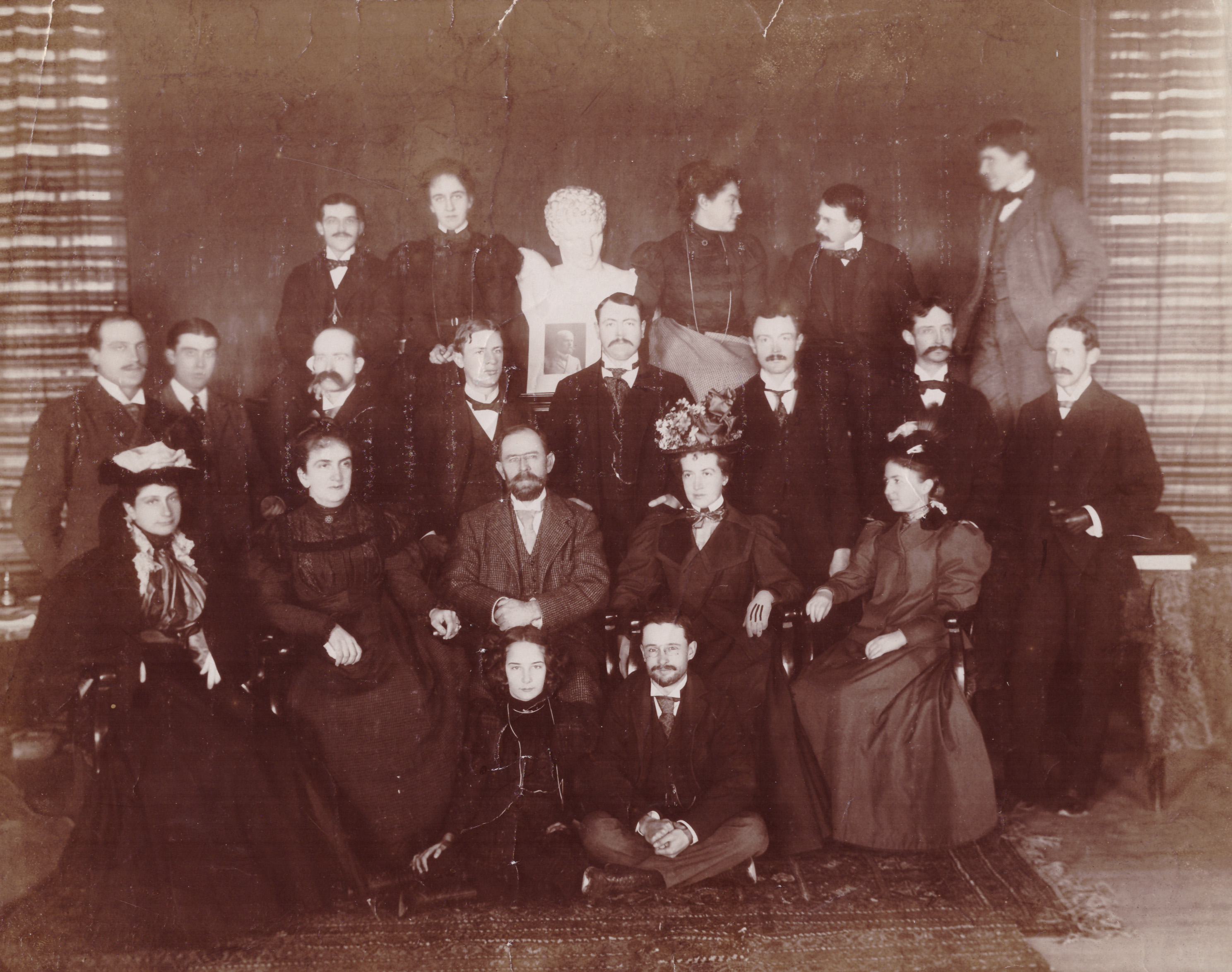
For Richardson’s successor the School appointed a young, highly promising scholar, Theodore W. Heermance, whose untimely death two years later (1905) from typhoid fever left the School in shock. One wonders what would have been the course of the School had Heermance lived longer. His successor Bert Hodge Hill was the first director at the School who was not a professor or held a Ph.D. Hill’s first term (1906-1911) was a trying experience, but he seemed to be able to deal with the challenges of an overseas post. Knowing some of Hill’s weak points –the most conspicuous being his inability to turn in anything in time– James R. Wheeler (1859-1918), the Chair of the School’s Managing Committee and Professor of Greek Archaeology and Art at Columbia University, kept a close eye on him during this first term.
Read the rest of this entry »Becoming: Bert Hodge Hill, 1906-1910 (Part I)
Posted: January 1, 2024 Filed under: Archaeology, Archival Research, Biography, Crete, History of Archaeology, Mediterranean Studies, Modern Greek History, Uncategorized | Tags: Archaeology, Athens, Bert Hodge Hill, europe, George W. Elderkin, greece, James R. Wheeler, Kendall K. Smith, Mochlos, Richard Berry Seager, Theodore W. Heermance, travel 10 Comments
The re-discovery of a small cache of old photos depicting students at the American School of Classical Studies at Athens (ASCSA or School hereafter) from 1907-08 inspired me to write about the first years of Bert Hodge Hill’s directorship at the School. [1]
The photos depict four men and one woman: George Wicker Elderkin (1879-1965), Kendall Kerfoot Smith (1882-1929), Charles Edward Whitmore (1887-1970), Henry Dunn Wood (1882-1940), and Elizabeth Manning Gardiner (1879-1958). Of the five, Elderkin, Smith, and Wood were second year students at the School. In 1908, Elderkin, who already held a PhD from Johns Hopkins (1906), succeeded Lacey D. Caskey as Secretary of the School, a position he held for two years (1908-10). Smith came to the School in 1906 holding the Charles Eliot Norton Fellowship, established by James Loeb in 1901 for Harvard or Radcliffe students. Wood, a trained architect with a BS in Architecture from the University of Pennsylvania, was the second recipient of the Fellowship in Architecture (1906-08) that was funded by the Carnegie Institution in Washington.
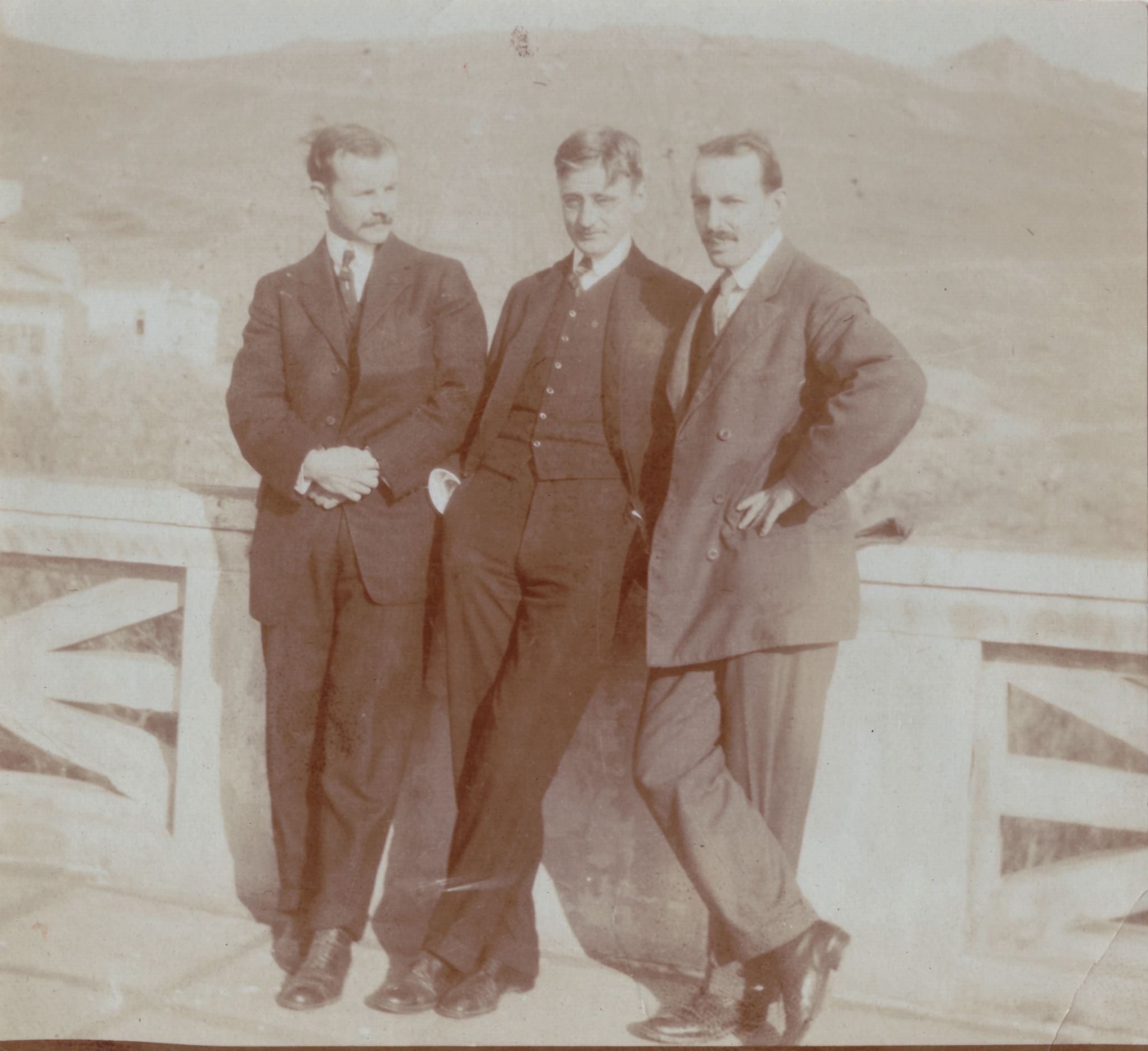
Of the new students, Whitmore, another Harvard man, was the Charles Eliot Norton Fellow for 1907, and Gardiner, the only woman in the photos, was a graduate of Radcliffe College (1901), with an MA from Wellesley (1906), and a recipient of the Alice Palmer Fellowship that supported female students.
Read the rest of this entry »“Metropolitan Transportation”: Sardis, Colophon, and the Asia Minor Disaster of 1922
Posted: July 3, 2021 Filed under: Archaeology, Archival Research, Biography, History of Archaeology, Mediterranean Studies | Tags: Aristides Stergiadis, Bert Hodge Hill, Colophon Excavations, Edward Capps, George Horton, Αριστείδης Στεργιάδης, Sardis Excavations 6 CommentsBY JACK L. DAVIS
Jack L. Davis, Carl W. Blegen Professor of Greek Archaeology at the University of Cincinnati and a former director of the American School of Classical Studies at Athens (2007-2012), here writes about the politics behind two American excavations in Asia Minor during the tumultuous years of the Greek-Turkish War of 1919-1922, and their connection to the acquisition of Greek antiquities by American museums.
For the paltry sum of $125, anyone can buy a pair of graceful bookends modeled on a column of the Temple of Artemis at Sardis from the gift shop of the Metropolitan Museum (Met) of New York. The Met describes them as follows:

An eye-catching pair for home or office, our bookends celebrate the magnificent Sardis column in The Met. The capital, base, and portions of the shaft of this great Ionic column come from a monumental temple constructed at Sardis (in today’s Turkey) and dedicated to Artemis, the Greek goddess of the hunt and the moon. Shortened from its original height of 56 feet, The Met’s massive column on display in the Greek and Roman galleries lets viewers admire the fine carving of the foliate ornaments on the capital and the fish-scale pattern on the molding at its base. These same decorative details appear on our handsome bookends.
The story of how this column ended up in the Met (and why it is shortened!) is more interesting than the bookends themselves, however worthy of admiration they may be. And it will cost you nothing to learn it here. Hint: the column was not shortened so that visitors could view its fine carving. (It is also important to note immediately that the Temple of Artemis is not only in “today’s Turkey,” but was already in Turkey when the Met’s column left Sardis.)
Read the rest of this entry »On Finding Inspiration in Small Things: The Story of a Pencil Portrait
Posted: April 2, 2019 Filed under: Archaeology, Archival Research, Art History, Biography, Classics, History of Archaeology, Philhellenism | Tags: American School of Classical Studies at Athens, Aristeides E. Phoutrides, Bert Hodge Hill, George Demetrios, John A. Huybers 14 CommentsMy story begins six years ago when we inventoried Bert H. Hill’s collection of photos at the item level. Among the images were early portraits of Hill when he was a little boy, and later, a handsome young man. A graduate of the University of Vermont (B.A. 1895) and Columbia University (M.A. 1900), Hill subsequently attended the American School of Classical Studies (ASCSA or the School hereafter) as a fellow for two years (1901-1903). He then secured a job as the Assistant Curator of Classical Antiquities at the Museum of Fine Arts in Boston (1903-1905) and lecturer at Wellesley College where he taught classes in sculpture. Bert Hodge Hill (1874-1958) was only 32 years old when he was appointed director of the ASCSA in 1906, a position he held until 1926.

Bert Hodge Hill, ca. 1910s. ASCSA Archives, Bert H. Hill Papers.
While processing the images my eye fell on a small portrait (12 x 9 cm) that was not a print but instead a well-executed drawing of Hill’s profile in pencil. On the back, Hill had scribbled “Huybers” and “BHH”. An initial web search for “Huybers artist” produced four of his pencil sketches in the Harvard Art Museums, a gift from George Demetrios in 1933 (keep the name in mind); the artist was identified as John A. Huybers.

Portrait of Bert Hodge Hill by John A. Huybers, ca. 1915-1920. ASCSA Archives, Bert H. Hill Papers.
Hetty Goldman: The Potentate of American Archaeology in Greece
Posted: July 3, 2018 Filed under: Archaeology, Archival Research, Biography, History of Archaeology, Mediterranean Studies, Women's Studies | Tags: Alice Leslie Walker Cosmopoulos, Bert Hodge Hill, Eutresis Excavation, Halae Excavations, Hetty Goldman, Piet de Jong 13 CommentsIn 1924, Hetty Goldman (1881-1972), who was directing an excavation at the site of Eutresis in Boeotia, hired architect Piet de Jong to draw some of the finds she had unearthed during the season. To beat the dullness of the evenings, De Jong, who worked for American and British excavations in Greece, made pencil caricatures of his fellow archaeologists which he later turned into striking Art Deco watercolors. The majority of these caricatures once in the possession of Sinclair and Rachel Hood, are now in the care of the Ashmolean Museum. Published by Rachel in Faces of Archaeology in 1998, they constitute visual biographies of American and British archaeologists working in Greece in the 1920s and 1930s.
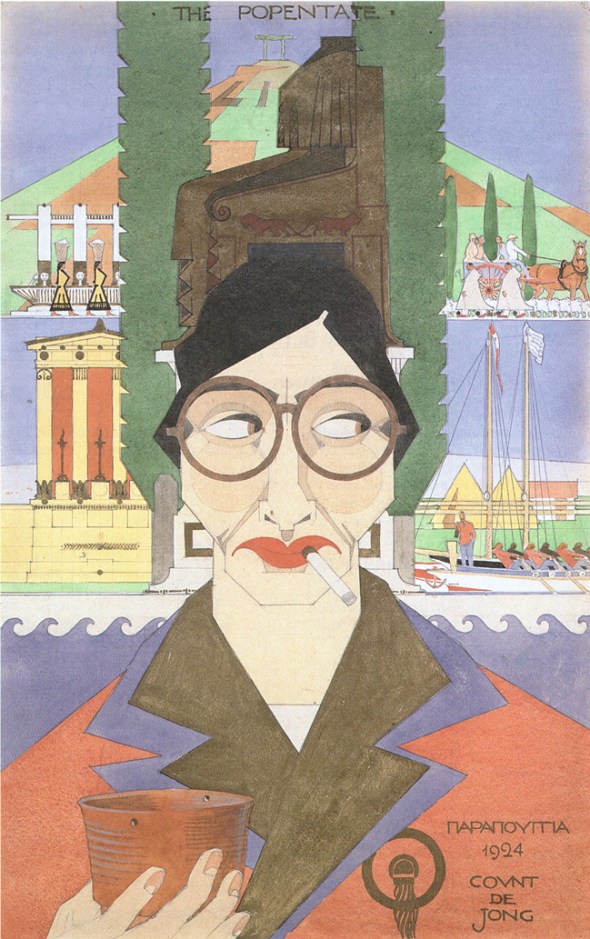
Hetty Goldman’s caricature by Piet de Jong, 1924. Image reproduced with kind permission of Ashmolean Museum, University of Oxford.
De Jong’s caricature of Goldman depicts her “holding a Neolithic pot of which she was particularly proud. The object behind Hetty’s head is a seated archaic statue found up in a Roman villa which was excavated at some distance from the mound [of Eutresis]… There is the mound itself surmounted by the shelter to protect the diggers from the heat of the sun… The horse, Kappa, on the road below the hill to the right draws the cart containing Hetty herself, Hazel [Hansen], Dorothy [Thompson] and Mitso the driver, on their way to work… a sailing boat or caique refers to the expedition organized by the foreman, George Deleas, to try and row across the Gulf of Corinth from Creusis, the harbor settlement of Eutresis. On the left of the picture at the foot of the mound two village girls with long plaits carry on their heads baskets of washing… Below them is a temple which probably refers to classical architectural findings at Hetty’s previous dig at Halae…” (Hood 1998, p.51). Read the rest of this entry »

 From the Archivist's Notebook