Communism In and Out of Fashion: The American School of Classical Studies at Athens and the Cold War
Posted: September 1, 2016 Filed under: American Studies, Archaeology, Archival Research, Biography, History of Archaeology, Modern Greek History, Philhellenism, Women's Studies | Tags: American School of Classical Studies at Athens, Emily Grace Kazakevich, Homer A. Thompson, Ida Thallon Hill, Jane Harrison, Kevin Andrews, Robert Oppenheimer, Robert Scranton 4 CommentsPosted by Jack L. Davis
Jack L. Davis, Carl W. Blegen Professor of Greek Archaeology at the University of Cincinnati and a former director of the American School of Classical Studies at Athens (2007-2012), here contributes an essay about attitudes of the ASCSA and its members toward Communists and Communism in the 20th century.
“Feeling they were witnessing the demise of capitalism, many writers moved left, some because their working class origins helped them identify with the dispossessed, others because they saw socialism or Communism as the only serious force for radical change, still others because it was the fashionable thing to do; they went where the action was.”
Morris Dickstein, Dancing in the Dark (2009), pp. 16-17.
 In 1974, when I first arrived at the American School of Classical Studies at Athens (ASCSA or the School hereafter), we youngsters were told that we should not express our political views in public. The ASCSA’s institutional mission might be hurt, were it perceived not to be neutral. In September 1974 that was certainly a reasonable position for the ASCSA to assume. Yet I was curious. In 1974, I was myself radicalized, and had definitely headed left. I could not condone U.S. policy in respect to the Junta, or the suppression of the Left in Greece. Could I say nothing? Had the ASCSA always maintained a position of strict neutrality? Or were its postures more convenient than sincere? Read the rest of this entry »
Gertrude Smith: A Classic American Philhellene
Posted: August 1, 2016 Filed under: Archaeology, Archival Research, Classics, History of Archaeology, Philhellenism, Women's Studies | Tags: American School of Classical Studies at Athens, Gertrude E. Smith, Henry S. Robinson, University of Chicago 9 CommentsPosted by Dylan Rogers
Dylan Rogers holds a PhD from the University of Virginia, and he has been Assistant Director at the American School of Classical Studies at Athens since 2015. The essay he contributes to “From the Archivist’s Notebook” was inspired by his summer experience at the School.
“Summers at the ASCSA are a vibrant time for the School, full of students and scholars, with the buzz of activity and chats at Ouzo Hour. Taking on the role of the Assistant Director of the School last year, I was intrigued to learn that each Summer Session Director is given the title, “Gertrude Smith Professor.” At first, I was only vaguely familiar with Smith’s scholarship on Greek law. So, why would the School associate SS Directors with her? This led me on a quest to find out more about Smith—and to find out what her story exactly was. She must have had a passion for Greece, but why? And in what ways did she spread this love to others?”

Gertrude E. Smith in her office at the University of Chicago, ca. 1950. Photo: University of Chicago Library, Special Collections Research Center.
Gertrude Elizabeth Smith (1894-1985) spent most of her adult life in Illinois. Born and raised in Peoria, Smith would later go on to receive her education at the University of Chicago, writing a PhD dissertation on Greek law– after which Smith would begin teaching at the university, eventually becoming the Edwin Olson Professor of Greek in 1933. From 1934 until her retirement in 1961, Smith was the Chairman of the Department of Classics at Chicago, making her a prominent female figure in the field of Classics in America in the 20th century. Smith also served as a founder of Eta Sigma Phi, the national Classics honor society, was the first woman to serve as the president of both the Classical Association of the Middle West and South (CAMWS, 1933-1934) and the American Philological Association (1958), and was a long serving member of the editorial board of the journal, Classical Philology (1925-1965). After her retirement from Chicago, Smith would go on to teach briefly at the University of Illinois, Loyola University in Chicago, and Vanderbilt University (Gagarin 1996-1997). Read the rest of this entry »
Skyromania? American Archaeologists in 1930s Skyros
Posted: June 1, 2016 Filed under: Archaeology, Archival Research, Greek Folk Art, History of Archaeology, Mediterranean Studies, Modern Greek History | Tags: Carol Bullard, Doreen Canaday Spitzer, Dorothy Burr Thompson, Faltaina Kalimeri Peschke, Georg von Peschke, Αngeliki Hatzimichali, Σκύρος, Richard H. Howland, Skyros 9 Comments
Skyros, house interior, 1931. ASCSA Archives, Dorothy Burr Thompson Photographic Collection
“The island of Skyros is fairly remote and inaccessible, on account of the winds. One consequence of its geographical location is that there is very little information about the island in the ancient authors, and the picture also given by the travelers is also fragmentary,” archaeologist Efi Sapouna-Sakellaraki could write in her archaeological guide to Skyros, as recently as 1998. Before her, American archaeologist Hazel Hansen, in writing about prehistoric Skyros in 1951, similarly described the island as “one of the most solitary islands in the Aegean for nearly all the other islands are nearer to one another or to the mainland.” Its isolation and the capricious sea between it and the mainland and Euboea are the reasons why Skyros is far less frequently visited…”.
Dorothy Burr Thompson’s Love for the Spirit of the Primitive
Posted: May 1, 2016 Filed under: Archaeology, Archival Research, Biography, Greek Folk Art, History of Archaeology, Mediterranean Studies, Women's Studies | Tags: American School of Classical Studies at Athens, Boeotia, Bryn Mawr College, Dorothy Burr Thompson, Eutresis Excavation, George Cram Cook, Parapoungia (Leuctra), Susan Glaspell 6 Comments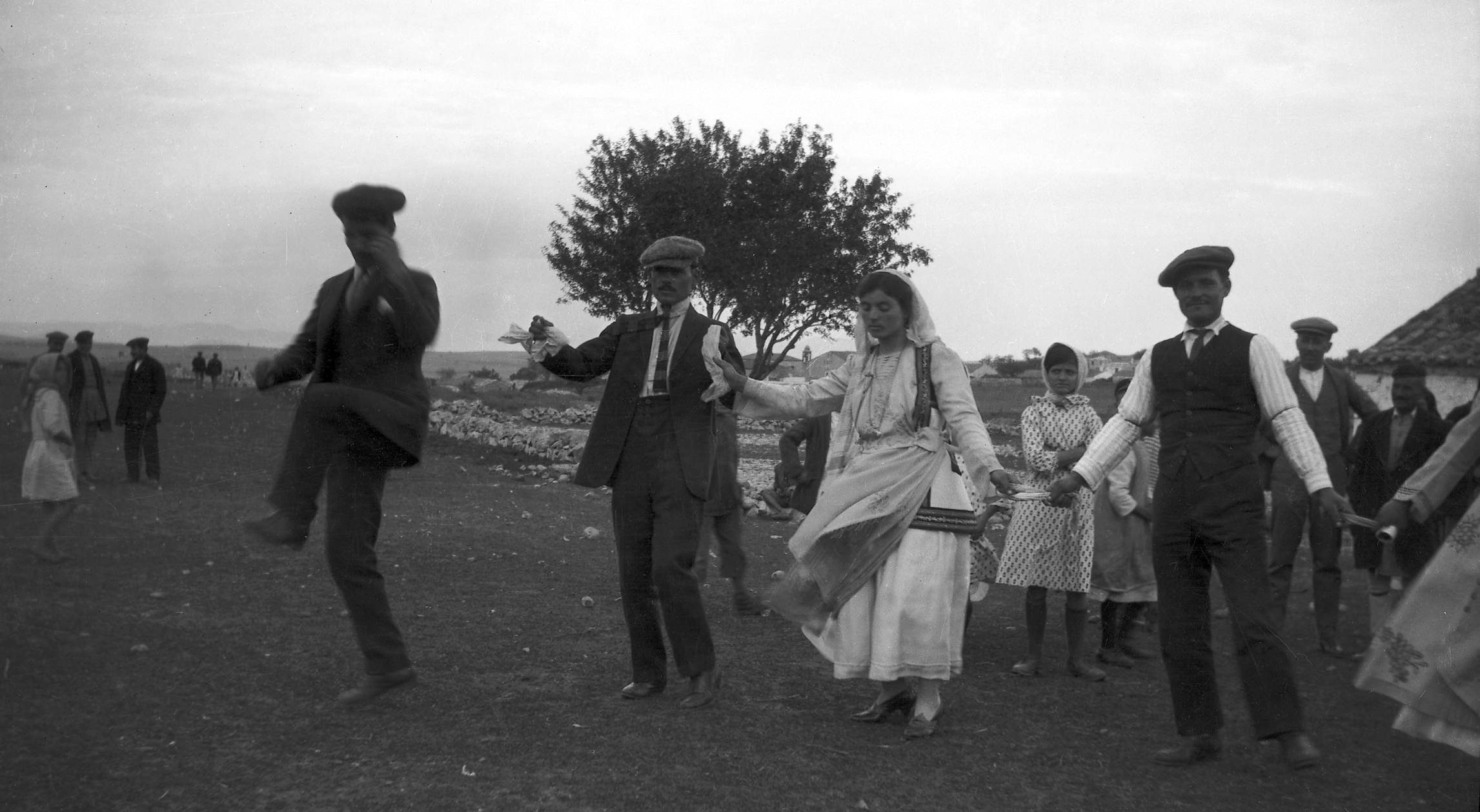
Dorothy Burr photographing wedding dance at Parapoungia 1924. ASCSA Archives, Dorothy Burr Thompson Photographic Collection.
“By myself in a Boeotian village, with the cry of the wind and drunken men in my ears! I love this place; it is so full of interest and a sense of real thing – seeing weddings whereat one reddens a finger… plodding one’s weary way homeward over purple fields to the din of bells like an organ cadence, knowing villagers… Oh, it is so full of life…” scribbled Dorothy Burr in her personal diary on November 9, 1924.
She was twenty-four years old and had come to Greece the year before, to study at the American School of Classical Studies at Athens (ASCSA or the School hereafter). Before that, she had lived in Philadelphia and studied at Bryn Mawr College. After attending the year-long program of the ASCSA, she and Hazel Hansen, another student of the School, were invited by archaeologist Hetty Goldman to dig at the Neolithic site of Eutresis, not far from Thebes, in Boeotia. Read the rest of this entry »
Clash of the Titans: The Controversy Behind Loring Hall
Posted: April 1, 2016 Filed under: Archaeology, Archival Research, Biography, History of Archaeology, Women's Studies | Tags: American School of Classical Studies at Athens, British School of Athens, Edward Capps, Loring Hall, Lucy Shoe Meritt, M. Carey Thomas, Ruth Emerson Fletcher, Thomas H. Mawson, William Caleb Loring 10 Comments
Loring Hall at 61 Speusippou (Souidias today), 1929. Source: ASCSA Archives
Reading Louis Lord’s History of the early years of the American School of Classical Studies at Athens (hereafter ASCSA or School), one gets a sanitized and condensed account of the building’s history (Lord 1947, 203-204). From his description, which largely concentrates on the final phase of the project, one could hardly imagine that 16 years of complicated negotiations preceded its official opening in February of 1930; in fact, a women’s hostel had been the dream of several important women, including the exceptional but controversial M. Carey Thomas, President of Bryn Mawr College (1894-1922), before various forces finally named it after a man, Judge William Caleb Loring, and made it co-ed. Read the rest of this entry »

 From the Archivist's Notebook