Exploring the Relationship of the American School of Classical Studies at Athens with the Greek Omogeneia in the United States in the 1940s.
Posted: July 4, 2019 Filed under: Archaeology, Archival Research, Biography, History of Archaeology, Mediterranean Studies, Modern Greek History, Philhellenism | Tags: American School of Classical Studies at Athens, Greek War Relief Association, Nikolaos Mavris, Omogeneia, Oscar Broneer, Spyros Skouras, Theodore Leslie Shear, Triumph Over Time 7 CommentsIn 1947, the American School of Classical Studies at Athens (ASCSA or the School hereafter) produced a color movie titled Triumph over Time; it was directed by the archaeologist Oscar Broneer and produced by the numismatist Margaret E. Thompson with the aid of Spyros Skouras (1893-1971), the Greek American movie mogul and owner of Twentieth Century Fox (see Spyros Skouras Papers at Stanford University). Triumph over Time portrays Greece rebounding from World War II and the staff of the ASCSA preparing archaeological sites for presentation to postwar tourists. The film was made to promote the first postwar financial campaign of the ASCSA, the direct goal of which was to increase its capital and finance the continuation of the Athenian Agora Excavations. Indirectly, the ASCSA was hoping to contribute to the rehabilitation of Greece by providing employment for the Greek people and by promoting the economic self-sufficiency of Greece by developing the country’s tourist assets (Vogeikoff-Brogan 2007).

Oscar Broneer, ca. 1938. ASCSA Archives, Oscar Broneer Papers.
Triumph over Time begins with a brief overview of impressive Greek antiquities, such as the citadels of Mycenae and Tiryns and the Temple of Poseidon at Sounion, before continuing with rare ethnographic material capturing parts of rural Greece that no longer exist. It then moves from the Greek countryside to the buildings of the ASCSA, especially the Gennadius Library with its rare treasures. The story then covers the ASCSA’s two most important projects, the excavations at the Athenian Agora and at Ancient Corinth, explaining all stages of archaeological work. The documentary ends with a hopeful note that financial support of the ASCSA’s archaeological work will contribute to an increase in tourism so that this major source of revenue for Greece’s economy can “restore stability and well-being to this simple pastoral land.”
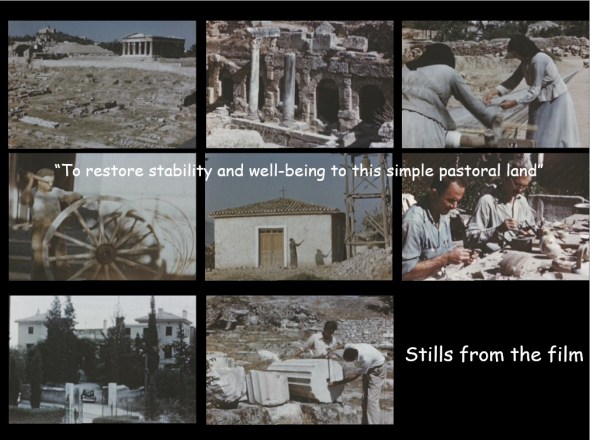
Stills from Triumph Over Time
Francis H. Bacon: Bearer of Precious Gifts from the Dardanelles
Posted: June 9, 2019 Filed under: Archaeology, Archival Research, Art History, Biography, History of Archaeology, Mediterranean Studies, Philhellenism | Tags: Assos Escavations, Francis H. Bacon, Frank Calvert, Stargazer 18 CommentsI first came to know Bacon’s name when, as a student of the American School of Classical Studies at Athens (ASCSA or the School hereafter) in 1989-1990, I was asked to report on the Assos Excavations during the School’s trip to Asia Minor. Assos, an affluent, ancient Greek city in the Çanakkale Province and a colony of Lesbos, is known for having erected the only Doric temple in Asia Minor, where the dominant style was Ionic. Francis Henry Bacon (1856-1940) was the architect of the excavations, which were funded by the Archaeological Institute of America (AIA) and took place from 1881 to 1883, as well as one of the three co-authors (with Clarke and Koldewey) of a final publication that was not completed until 1921. Although Bacon’s name appears second, the publication would not have appeared without his dedication and persistence. Joseph T. Clarke (1856-1920) had given up on it long before, and Robert J. Koldewey (1855-1925) had dedicated most of his life to uncovering Babylon.

In 1878, Francis H. Bacon and Joseph T. Clarke bought a sailboat, the “Dorian,” in London and sailed to Athens by way of Holland, the Rhine, the Danube, the Black Sea, and the Aegean. Here a self-sketch by Bacon while examining a marble lekythos at the National Archaeological Museum. Source: MIT Libraries, Institute Archives and Special Collections.
To Know One’s Country as a Foreign Land
Posted: May 5, 2019 Filed under: Archival Research, Biography, Book Reviews, Food and Travel, History of Archaeology, Modern Greek History, Philhellenism, Women's Studies | Tags: Alice Leslie Walker Cosmopoulos, American College for Girls, Anne Kirschner Sakellariou, Charlotte Eleanor Ferguson, Eva Palmer Sikelianos, Jackie Coogan, John Watson Logan 9 CommentsI have always found informal travel accounts fascinating. By informal, I mean accounts found in personal diaries or letters. Occasionally, they are published posthumously by the writer’s relatives (usually for family consumption) and attract little attention because of their mundane nature. Until recently, such letters and diaries of anonymous folk were avoided by historians who considered their content subjective or inaccurate. After all, why use the private diary of an American expatriate in Greece as a source, when the event (e.g., a local revolution) was described in more detail in the newspapers or other official reports?
I, on the other hand, pay particular attention to these types of publications because they provide valuable information, otherwise undocumented, about the level of local awareness, participation or aloofness within foreign communities. Gilbert K. Chesterton (1874-1936), an English writer and philosopher, once said that “the whole object of travel is not to set foot on foreign land: it is at last to set foot on one’s own country as a foreign land.” It’s the second part of Chesterton’s comment that makes me delve into the travel accounts of foreigners-mostly Americans in my case–who have experienced Greece as a foreign land. Here I am not interested in the tourist but instead the engaged traveler, the expatriate, or, in rare cases, the committed immigrant (that is the foreigner who has almost “gone native”).
My latest source of inspiration for getting “to know my country as a foreign land” is a privately published collection of letters which came to my attention after a visit to the newly established Archives of the American College of Greece. There, Dr. Demetra Papakonstantinou, an accomplished archaeologist who now serves as the College’s Archivist, graciously shared with me a copy of a book titled Odyssey of a Learning Teacher (Greece and the Near East 1924-1925). Published in 2005 by David L. Aronson, the book contains transcriptions of the letters that his mother, Charlotte Eleanor Ferguson, a graduate from Mount Holyoke College and a teacher at the American College for Girls (what is now Pierce College), sent to her family in 1924-25. (The original letters are now part of the American School of Greece Archives.)

Front cover photograph: Charlotte Ferguson and Helen Larrabee departing from New York.
On Finding Inspiration in Small Things: The Story of a Pencil Portrait
Posted: April 2, 2019 Filed under: Archaeology, Archival Research, Art History, Biography, Classics, History of Archaeology, Philhellenism | Tags: American School of Classical Studies at Athens, Aristeides E. Phoutrides, Bert Hodge Hill, George Demetrios, John A. Huybers 14 CommentsMy story begins six years ago when we inventoried Bert H. Hill’s collection of photos at the item level. Among the images were early portraits of Hill when he was a little boy, and later, a handsome young man. A graduate of the University of Vermont (B.A. 1895) and Columbia University (M.A. 1900), Hill subsequently attended the American School of Classical Studies (ASCSA or the School hereafter) as a fellow for two years (1901-1903). He then secured a job as the Assistant Curator of Classical Antiquities at the Museum of Fine Arts in Boston (1903-1905) and lecturer at Wellesley College where he taught classes in sculpture. Bert Hodge Hill (1874-1958) was only 32 years old when he was appointed director of the ASCSA in 1906, a position he held until 1926.

Bert Hodge Hill, ca. 1910s. ASCSA Archives, Bert H. Hill Papers.
While processing the images my eye fell on a small portrait (12 x 9 cm) that was not a print but instead a well-executed drawing of Hill’s profile in pencil. On the back, Hill had scribbled “Huybers” and “BHH”. An initial web search for “Huybers artist” produced four of his pencil sketches in the Harvard Art Museums, a gift from George Demetrios in 1933 (keep the name in mind); the artist was identified as John A. Huybers.

Portrait of Bert Hodge Hill by John A. Huybers, ca. 1915-1920. ASCSA Archives, Bert H. Hill Papers.
Professors to the Rescue: Americans in the Aegean at the End of the Great War, 1918-1919.
Posted: January 3, 2019 Filed under: Archival Research, Biography, History of Archaeology, Philhellenism | Tags: A. Winsor Weld, American Red Cross Greek Commission, Cyril G. Hopkins, Edward Capps, Henry B. Dewing, Horace S. Oakley 4 Comments“Islands and coast Asia Minor still crowded with refugees. Stop. Number there still to be repatriated estimated three hundred thousand. Stop. We are maintaining three stations in Mytilene district clothing alone being available, but food urgently needed. Stop. Above statements based on personal inspection this Commission. Stop. We recommend that work in Aegean be immediately extended to other islands like Chios, Samos and to opposite coast which can be reached by sea transport which can be secured by Greek governments. Stop.”
The text quoted above is a small portion of a long telegram (47 lines) that Colonel Edward Capps sent to Harvey D. Gibson, member of the American Red Cross War Council in Paris, on December 12, 1918 (NACP, Greece, ARC Commission to, 964.62/08). The telegram reported the activities of the American Red Cross (ARC hereafter) since arrival of its Greek Commission in Athens on October 23rd.
 This is not the first time I am writing about the activities of the ARC in Greece. In 2011, together with Jack L. Davis, then Director of the American School of Classical Studies at Athens (ASCSA or the School hereafter), we organized and subsequently published the proceedings of a conference titled Philhellenism, Philanthropy, or Political Convenience: American Archaeology in Greece (Princeton 2013). Davis’s paper, “The American School of Classical Studies and the Politics of Volunteerism,” discussed the involvement of members of the ASCSA, through enlistment in the Greek Commission of the ARC, in humanitarian aid in eastern Macedonia, as well as in the repatriation of Greek citizens who had been taken as hostages to Bulgaria. Later in 2015, on the occasion of the centenary of the Battle of Gallipoli, I was invited to participate in a conference about The First World War in the Mediterranean and the Role of Lemnos, with a paper that discussed the humanitarian activities of the ARC Greek Commission in the eastern Aegean at the end of the Great War. Read the rest of this entry »

 From the Archivist's Notebook