That Unspeakable Stoa
Posted: May 1, 2014 Filed under: Archaeology, Archival Research, Classics, History, History of Archaeology, Philhellenism, Women's Studies | Tags: American School of Classical Studies at Athens, Athenian Agora, Homer A. Thompson, Nancy Mitford, Stoa of Attalos 4 Comments
Posted by Lizabeth Ward Papageorgiou
Lizabeth Ward Papageorgiou here contributes to the Archivist’s Notebook an essay about Nancy Mitford’s visit to the Athenian Agora during the re-construction of the Stoa of Attalos in 1955. Unhappy with the building, Mitford, one of the famous Mitford sisters, wrote acidic comments about it in the press as well as to the Director of the Agora Excavations, Homer A. Thompson. Lizabeth (Liz), who studied Art History at the Institute of Fine Arts in New York University, found Mitford’s letters when she catalogued Thompson’s vast correspondence for the Archives of the American School of Classical Studies at Athens a few years ago. Her extensive catalogue of Homer Thompson’s papers is available at: http://www.ascsa.edu.gr/index.php/archives/thompson-finding-aid/
Over a decade ago, I archived the papers of Homer A. Thompson. Two of his letters are the subject of this article.
It [Athens] is probably the ugliest capital in Europe . . . [with] formless conglomerations of modern buildings overlooked by an immortal monument . . . . The traffic is noisier, wilder, and more evidently intent on homicide than that of Paris, and consists entirely of enormous pastel-colored American motor-cars.
Nancy Mitford, “Wicked Thoughts in Greece”, The Sunday Times, 24 July 1955.
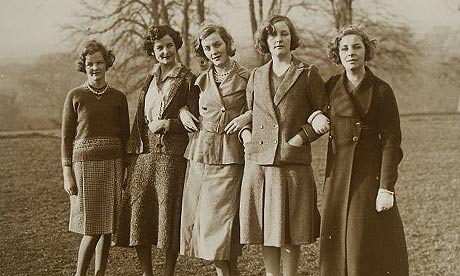
The Mitford sisters
Nancy Mitford (1904–1973), acclaimed author of comedies of English upper class manners (The Pursuit of Love), biographies (Madame de Pompadour), essays and reviews, was the eldest of six intelligent, beautiful and sometimes scandalous daughters of Lord and Lady Redesdale (Ben Macintyre described the sisters as Diana the Fascist, Jessica the Communist, Unity the Hitler-lover; Nancy the Novelist; Deborah the Duchess and Pamela the unobtrusive poultry connoisseur).1 In the summer of 1955, she traveled in Greece. She spent time with Patrick Leigh Fermor, who was living in Nikos Ghikas’s house on Hydra; went to Tatoi, the summer residence of King Paul; and visited friends in Spetses, Crete and the Peloponnese.2
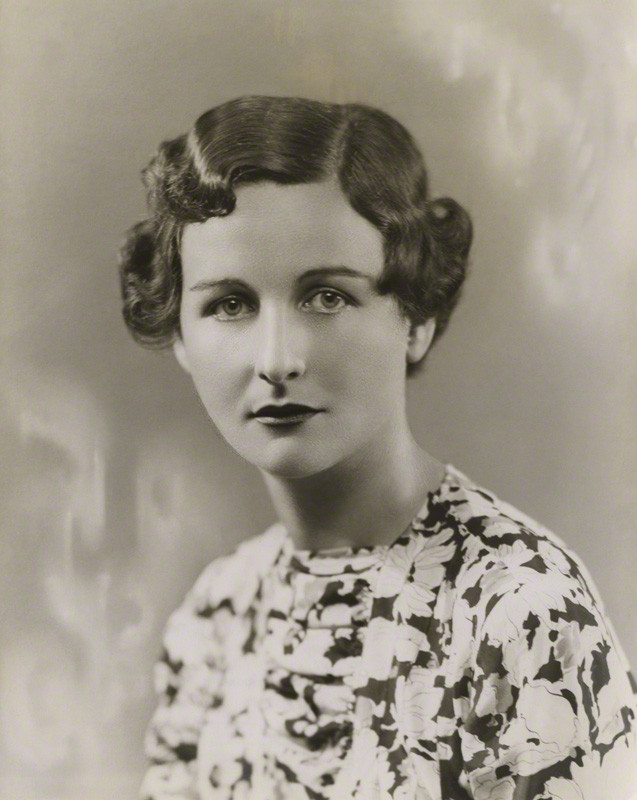
Nancy Mitford, 1932
When she was in Athens, she stayed at the Grand Bretagne and visited the ancient sites. One day she went to the Ancient Agora, but since the reconstruction of the Stoa of Attalos was not finished—it was covered with scaffolding and only the lower storey and colonnades had been reconstructed—Mitford must have needed permission to visit the site and one of the Agora staff to guide her. Homer A. Thompson, director of the Agora excavations from 1945 to 1967 and deeply involved with all aspects of the reconstruction of the Stoa, often mentioned visitors to the Agora in his letters to his wife, Dorothy Burr Thompson; but he made no mention of a visit by Nancy Mitford. Possibly Judith Perlzweig or C. W. J. Eliot, who bore the brunt of conducting visitors through the excavations and museum, served as her guide.3
Shortly after Mitford returned to her home in Paris, she wrote an article about her trip to Greece for The Sunday Times. Published on 24 July 1955, the title, “Wicked Thoughts in Greece”, gave readers a heads up that this was going to be another of her scathing attacks. Opening with the declaration that Athens is probably the ugliest capital in Europe, full of homicidal drivers and enormous pastel-colored American motor-cars, she continued to deplore the hideous newness of Athens, which from the air is a desert of khaki-coloured cement. But she did find an oasis in Plaka, where she delighted in the classical monuments, churches and old houses, until . . .
Alas! After ten minutes of happy wandering the dream is shattered and the dreadful wasteland of the Agora appears. Here the American School of Classical Studies seems to have torn down whole streets in order to search for a few pots. Here the Americans are building, in a ghastly graveyard marble, the Stoa, said to be ‘of Attalos’, but really of Mr. Homer A. Thompson. And here a gracious garden will be planted, complete, no doubt, with floral clock.

The Stoa of Attalos under construction, 1955. Photo: ASCSA, Agora Excavations
A few pages later, describing her visit to Knossos, she again attacked the reconstruction of the Stoa of Attalos:
. . . Knossos, a fraudulent reconstruction like the Stoa, English this time, alas, and built in an art nouveau style reminiscent of Paris metro stations. It is evident that Anglo-Saxons should be kept away from Mediterranean sites . . . . Knossos, however, matters less than the Stoa, because it is out in the country and does not spoil anything else. The Stoa in all its vileness hits the eye from the Acropolis and the Temple of Hephaestus. It is as though the French had allowed Frank Lloyd Wright to build his idea of a Petit Trianon at the bottom of the tapis vert at Versailles. Read the rest of this entry »
“A Greek Author Travels to the Country of the New Myth”: The Voyage of Elias Venezis to America in 1949
Posted: April 1, 2014 Filed under: American Studies, Book Reviews, Intellectual HIstory, Modern Greek History, Modern Greek Literature | Tags: American School of Classical Studies at Athens, Andreas Karantonis, Eleni Nikolaidi, Elias Venezis, Gennadius Library, Αμερικανική γη, Γιώργος Θεοτοκάς, Δοκίμιο για την Αμερική, Ηλίας Βενέζης, Land of America, Yiorgos Theotokas 6 CommentsThis essay comprises the text of a talk that I presented in the Cotsen Hall auditorium of the American School of Classical Studies at Athens (ASCSA), April 9, 2013, at an evening devoted to novelist Elias Venezis, whose papers reside in the ASCSA Archives. The text was also published (in Greek ) in the “Athens Book Review,” in an issue dedicated to Venezis. Since my essay discusses two of Greece’s most important novelists’ impressions from their journeys to America, I thought that it also deserved to be published in English and be made available to an American audience (here, I must thank my friend and former colleague Stefanie Kennell for her wonderful translation). For half of my life I have studied and worked in a Greek-American environment; there interest lies in examining how foreigners (usually described as philhellenes) perceive(d) Greece, and it is rarely discussed, at least in the broader community of the American School, how Greeks experienced America at critical times, such as in the first decade following WW II. The two authors, Elias Venezis and Yiorgos Theotokas, traveled in America during the period of the Marshall plan and the beginning of the Cold War, just before strong anti-Americanism began developing in Greece. For both, the voyage to America was a journey to a mythical land — as implied by the title of this essay, which is drawn from the title of a talk (“Ένας Έλλην συγγραφεύς στη χώρα του νέου μύθου”) that Venezis delivered at the Greek American Cultural Institution in 1950, immediately after his return from America.

“The Thirties Generation” in 1963
For those who are not familiar with Modern Greek Literature, I should also add a few remarks about the so-called literary “Generation of the Thirties.” As commonly employed, this term describes a group (all male) of novelists, poets, and artists, who came of age in the 1930s. These men continued to be very productive and influential in the following three decades, to the point that a myth with regenerative power was built around them, one that still aspires and inspires (Leontis 2013). Nobel-prize laureate poets Yiorgos Seferis and Odysseus Elytis, novelists Angelos Terzakis, Stratis Myrivilis, Elias Venezis and Yiorgos Theotokas, are some of the most accomplished and distinguished “members” of the “Generation of the Thirties.” The personal papers of most of them have been deposited at the American School of Classical Studies.

Elias Venezis
In 2009, at an event devoted to Yiorgos Theotokas and the republication of his Essay on America, I was introduced to Greek travel literature about America. Theotokas was among the first writers of the so-called “Generation of the Thirties” who visited America a few years after the end of World War II. While taking receipt of Elias Venezis’s personal papers in 2010, I came upon the manuscript of Land of America and then, in discussions with the author’s daughter, Anna Venezi Kosmetatou, I was made aware of the fact that Venezis was actually the first of the famous “Generation of the Thirties” to travel to the U.S., in 1949.
Except for Theotokas’ Essay on America (Δοκίμιο για την Αμερική), which had the good fortune to be re-published a few years ago, travel writing of this type is difficult or impossible to find on the shelves of Athenian bookstores. When I looked for Land of America at a well-known bookstore in downtown Athens, clerks told me that it was the first time they had heard that Venezis had written a book of this sort. Perhaps this is because, in the age of globalization, trips to America have lost some of the magic and myth that used to surround them. Already in the 1970s, as Vassilis Lambropoulos writes, “with the spread of cinema and even more the advent of television in Greece, travel writing is losing its primary function and sparkle. The public does not need the guidance of an eyewitness to get to know foreign countries.”

Αμερικανική γη (Land of America) by Elias Venezis
Unlike the other writers and intellectuals who visited the U.S. in the 1950s and 1960s, Venezis began his long journey without the support of the American government. The famous program of cultural exchanges sponsored by the the U.S. Information and Educational Exchange Act of 1948, popularly known as the Smith-Mundt Act, does not seem to have been implemented immediately in Greece. What is certain is that Elias Venezis and his wife either did not know about or did not expect American government support when they decided in the summer of 1949 to cross the Atlantic. On the opposite shore was Venezis’s brother, Thanos Mellos and his wife, the mezzo-soprano Eleni Nikolaidi, who had settled there just a year before.
Thanos Mellos wrote to his brother Elias and his wife on May 6, 1949, from New York: “I’ve told Elias that a place has been confirmed for his trip to America on a merchant ship that sails from a port in France. Perhaps there’s a way he can embark even from Greece. The trip won’t cost a cent. The steamship owner’s a friend of ours, and he’s offering it to us for free. You only have to get your papers ready, Elias, and send me a telegram.” Read the rest of this entry »
Two Academics “Ruin” the Spirit of Valentine’s Day: A Response to “My heart is beating.”
Posted: February 18, 2014 Filed under: Archaeology, Archival Research, History of Archaeology, Mediterranean Studies | Tags: American School of Classical Studies at Athens, Carl W. Blegen, Effie de Jong, Effie Skinner, Elizabeth Pierce Blegen, Mycenaean frescoes, Piet de Jong, Tiryns Leave a comment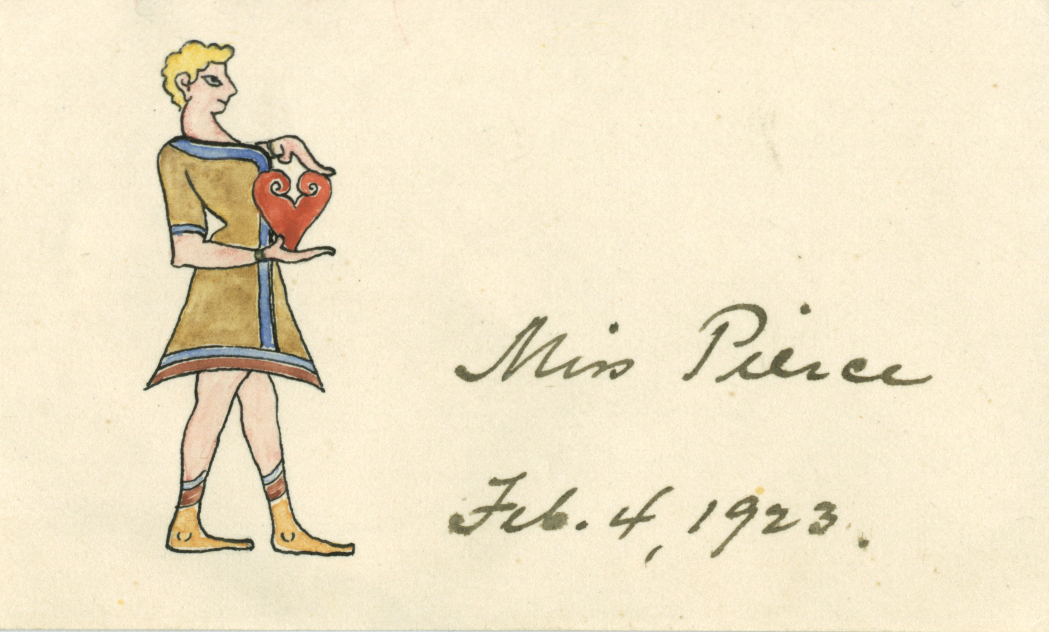 Emily Egan and Jack Davis, two “over-intellectuals” from the University of Cincinnati, could not resist the temptation to explore the Bronze Age antecedents of the Valentine card sent by Carl Blegen to Elizabeth Pierce in 1923. Check out their remarks below.
It is always dangerous to over-intellectualise love, particularly when expressed by a man to a woman on Love’s own holiday, but it is difficult, nonetheless, for scholars to avoid casting an academic eye on the caricature produced by Piet de Jong for Carl Blegen’s 1923 Valentine to his future wife, Elizabeth Pierce (see “My heart is beating: February 13, 1923”), as posted recently to this blog by Natalia Vogeikoff. For the drawing that de Jong produced must be a caricature of Blegen himself, one immediately recognizable from the distinctive blond hair. That makes this modest little drawing one of the very first in a series that de Jong famously executed in Greece during the 1920s and 1930s, and that were later collected and published by Rachel Hood in 1998. Read the rest of this entry »
“My heart is beating…”: February 13, 1923
Posted: February 14, 2014 Filed under: Archaeology, Archival Research, History of Archaeology | Tags: American School of Classical Studies at Athens, Carl W. Blegen, Elizabeth Pierce Blegen, Piet de Jong, Robert Pounder, Valentine's Day 9 Comments
This little Valentine was included in a letter mailed from Athens to Rome in early February 1923. Carl Blegen, Secretary of the American School of Classical Studies at Athens, asked his friend and artist Piet de Jong to draw the Valentine for his beloved Elizabeth Pierce. The Bronze Age figure on the card alluded to his recent work with Alan Wace which argued that the Mycenaean culture of mainland Greece had nothing to do with Minoan colonization, as Sir Arthur Evans had believed, and should instead be called “Helladic.” The image certainly hits the mark. Read the rest of this entry »
Letters From a New Home: Early 20th Century Athens Through the Eyes of Zillah Dinsmoor
Posted: February 1, 2014 Filed under: Archaeology, Archival Research, History of Archaeology, Modern Greek History | Tags: American School of Classical Studies at Athens, William Bell Dinsmoor, Zillah Pierce Dinsmoor 4 CommentsJacquelyn H. Clements here contributes to the Archivist’s Notebook a fun essay about living in Greece in the early 1910s. She draws her inspiration from the letters that a young bride, Zillah Pierce Dinsmoor, sent from Athens to her mother in America. Jacquelyn, who is completing her doctoral thesis in Classical Archaeology at Johns Hopkins University, is also an aspiring photographer. She would like to live in Greece in the future and model herself after Alison Frantz, the well-known American archaeologist and photographer. You can look at Jacquelyn’s photography at: http://www.jacquelynclements.com
Students and scholars who study at the American School of Classical Studies at Athens (ASCSA) have often been accompanied by their spouses, significant others, and children who live with them here in Athens. In the early 20th century, Zillah Pierce Dinsmoor was one of these women who traveled to Athens along with her husband, architect William Bell Dinsmoor. During her time abroad, Zillah wrote frequent letters to her mother, Emma E. Pierce, back home in Massachusetts. Zillah’s correspondence from a foreign land provides a unique picture of life in Athens in the early 20th century, and a life at the American School that bears many resemblances, as well as striking differences, to our life here today.

Zillah Pierce Dinsmoor on the balcony of the Director’s House at ASCSA, ca. 1910 (Dinsmoor Family Papers, ASCSA Archives). Click to enlarge
In my Regular year at the ASCSA (2010-2011), I began volunteering in the School’s Archives along with fellow students William Bruce and Katie Lamberto. Our task was to undertake the tedious project of transcribing Zillah’s letters, and like any major archival project, it was faced with some trepidation, at least on my part. Her letters fill five boxes with multiple folders apiece, comprising hundreds of crumbling papers written in florid handwriting, sometimes encircling the borders of the pages when she ran out of room. In two years of transcribing Zillah’s letters, I’ve managed to read about seventy. Her musings are filled with detailed descriptions of daily life in Athens with “Billy,” (as she refers to her husband William) and their travels, both within Greece and also to England, France, and trans-Atlantic voyages. On occasion, I have been treated to photographs, placards, and small sketches as well, in addition to the occasional caret of commentary by Billy, his streamlined penmanship contrasting sharply to Zillah’s flowing cursive. Read the rest of this entry »

 From the Archivist's Notebook