“You Undoubtedly Remember Mr. L. E. Feldmahn”: The Bulgarian Dolls of the Near East Foundation
Posted: August 31, 2024 Filed under: Archaeology, Archival Research, Biography, Economic History, Greek Folk Art, Greek Folklore, History, History of Archaeology, Mediterranean Studies, Modern Greek History, Philhellenism, Uncategorized | Tags: Dolls, Leonty E. Feldmahn, Near East Foundation, Near East Industries, Near East Industries Sofia, Near East Relief Museum, Priscilla Capps Hill, Rockefeller Archives Center 2 CommentsJack L. Davis, Carl W. Blegen Professor of Greek Archaeology at the University of Cincinnati and a former director of the American School of Classical Studies at Athens (2007-2012), here contributes an essay about Leonty E. Feldmahn, the man who conceived and produced in the 1930s the Bulgarian dolls of the Near East Foundation.
One rewarding sidelight of researching institutional history is that, from time to time, it affords an opportunity to resurrect once well-known individuals who have been lost to history. Here I call attention to a fascinating man, who, throughout much of his life, made outsize contributions to addressing one Balkan refugee crisis that resulted from the Russian Revolution of 1917. In the years prior to World War II, his activities in Bulgaria were sometimes tangential to those of certain individuals known to readers of this blog through the intermediary of the Near East Industries subsidiary of the Near East Foundation.
I only learned of Leonty E. Feldmahn recently and by accident. I didn’t remember him from any earlier reading. Feldmahn is not mentioned in the standard history of the Near East Foundation, or on the Foundation’s historical web site. He appears only three times in the New York Times: when he was awarded the Bulgarian Cross for Philanthropy from King Boris (he had in 1923 established “a playground and children’s club in Sofia serving 4200 poor children,” December 31, 1935, p. 17); earlier in 1935, when the character of the playground and club was described in detail (April 21, 1935, pp. 78, 80); and in his obituary (January 6, 1962, p. 16).
Orientations in Sunlight: With Durrell in Rhodes
Posted: November 1, 2019 Filed under: Archival Research, Biography, Book Reviews, History, Mediterranean Studies, Modern Greek History | Tags: Florestano di Fausto, Italian Colonies, Lawrence Durrell, Marine Venus, Mario Lago, Rhodes 9 Comments“In Rhodes the days drop as softly as fruit from trees. Some belong to the dazzling ages of Cleobolus and the tyrants, some to the gloomy Tiberius, some to the crusaders. They follow each other in scales and modes too quickly almost to be captured in the nets of form,” wrote Lawrence Durrell (1912-1990) in the first pages of his acclaimed memoir Reflections on a Marine Venus: A Companion to the Landscape of Rhodes (1953). More than seventy years later, if Durrell were still alive, he would have added “… some to the crusaders, some to the Italians.”

Durrell was stationed in Rhodes for two years when the Dodecanese was under British Administration (1945-1947). As Information Officer, he supervised the publication of three daily papers, in Greek, Turkish, and Italian. (I found copies of the Greek one, ΧΡΟΝΟΣ, in the Nicholas Mavris Papers in the ASCSA Archives. Mavris, a prominent member of the Greek American community, in 1948 became the first governor commissioner of the freed Dodecanese.)
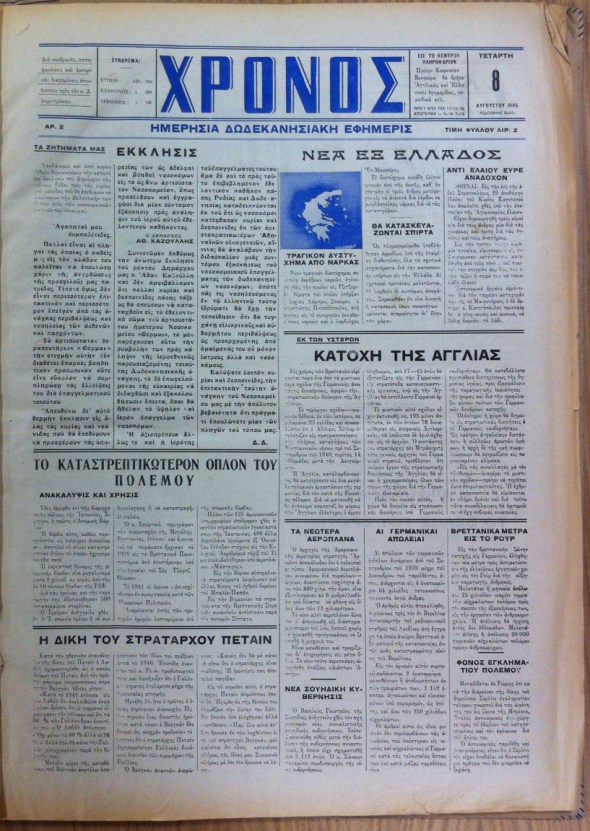
ΧΡΟΝΟΣ, Aug. 8, 1945. ASCSA Archives, Nicholas Mavris Papers.
WW II had just ended and the fate of the Dodecanese was still uncertain. Despite their Greek past, these islands in the southeastern part of the Aegean (also known as Southern Sporades) did not join Greece until 1947, having passed from the Ottomans directly to the Italians in 1913, from the Italians to the Germans in 1943, and from them to the British. In 1946, the Allied Forces in Paris finally agreed upon the integration of the Dodecanese with Greece. It was not until the 31st of March 1947, however, that the British officially delivered the administration of the Dodecanese to the Greek State.
Durrell did not write Marine Venus while on Rhodes but a few years later, relying on his memory and “sifting into the material, now some old notes from a forgotten scrapbook, now a letter” (Marine Venus, p. 3).[1]
“Of Paradise Terrestre” Read the rest of this entry »
On Communism and Hellenism: An Archaeologist’s Perspective
Posted: March 1, 2016 Filed under: American Studies, Archaeology, Archival Research, Biography, History, History of Archaeology, Intellectual HIstory, Modern Greek History, Philhellenism | Tags: Alison Frantz, American School of Classical Studies at Athens, Carl W. Blegen, Communism, Donald C. McKay, Hellenism 3 CommentsPosted by Despina Lalaki
Despina Lalaki holds a PhD in Historical Sociology from the New School university while she currently teaches at the The New York City College of Technology-CUNY. The essay she contributed to ‘From the Archivist’s Notebook’ is largely an excerpt from her article “On the Social Construction of Hellenism: Cold War Narratives of Modernity, Development, and Democracy for Greece,” in The Journal of Historical Sociology, 25:4, 2012, pp. 552-577. Her essay draws inspiration from an unpublished manuscript by archaeologist Carl W. Blegen, titled “The United States and Greece” and written in 1946-1948.
Carl W. Blegen (1887-1971) is one of the most eminent archaeologists of the Greek Bronze Age. Nevertheless, he intimately knew Modern Greece, too. In 1910, at the age of twenty-three, he first visited the country as a student of the American School of Classical Studies at Athens (hereafter ASCSA), and by the time of his death in 1971 he had made Greece his home and his final resting place, having experienced first hand the land and its people in the most troublesome moments of their modern history. In 1918, for instance, he participated in the Greek Commission of the American Red Cross, assisting with the repatriation and rehabilitation of thousands of refugees who during the war had been held as prisoners in Bulgaria. During WWII, he was recruited by the Office of Strategic Services (OSS) to head the Greek desk of the Foreign Nationalities Branch (FNB) in Washington D.C., which was following European and Mediterranean ethnic groups living in the United States and recording their knowledge of political trends and conditions affecting their native lands.

J. W. Foster (left) and Carl W. Blegen (right) standing at the headquarters of the Allied Mission for Observing the Greek Elections (AMFOGE), 1946. Photo by Nat Farbman. The LIFE Picture Collection/Getty Images/Ideal Image.
“This Horrible Crime Will Have to be Paid For”: The Sinking of the LUSITANIA
Posted: December 15, 2015 Filed under: Archival Research, Book Reviews, History, History of Archaeology | Tags: Carl W. Blegen, Erik Larson, Lusitania, Oscar Broneer, William Bell Dinsmoor, Zillah Pierce Dinsmoor 1 CommentJack L. Davis, Carl W. Blegen Professor of Greek Archaeology at the University of Cincinnati and a former director of the American School of Classical Studies at Athens (2007-2012), here reviews Erik Larson’s most recent book Dead Wake: The Last Crossing of the LUSITANIA, and briefly reflects on the history of the ASCSA during the Great War.

“Today we learned of the sinking of the Lusitania by a German submarine. This horrible crime will have to be paid for by Germany some day.”
Carl W. Blegen, May 9, 1915
I confess that I have long been a fan of any Erik Larson novel, from the time my mother-in-law gave me The Devil in the White City: Murder, Magic, and Madness at the Fair That Changed America (2003). But did I say novel? His non-fiction tales read like novels, and The Devil is currently being made into a major motion picture (starring Leonardo DiCaprio and directed by Martin Scorsese). For my birthday this year, my mother-in-law Nan hit another homerun: Dead Wake: The Last Crossing of the Lusitania — a terrific (and fast) read. (I finished it in just over two days, one of them on a trans-Atlantic flight, a suitable environment for reading about an oceanic disaster!) Read the rest of this entry »
Schliemann of Troy: The Story of a Linguistic Genius
Posted: April 2, 2015 Filed under: Archaeology, Archival Research, Education, History, History of Archaeology, Language Studies, Women's Studies | Tags: Emil Ludwig, Heinrich Schliemann, Sophia Schliemann 3 Comments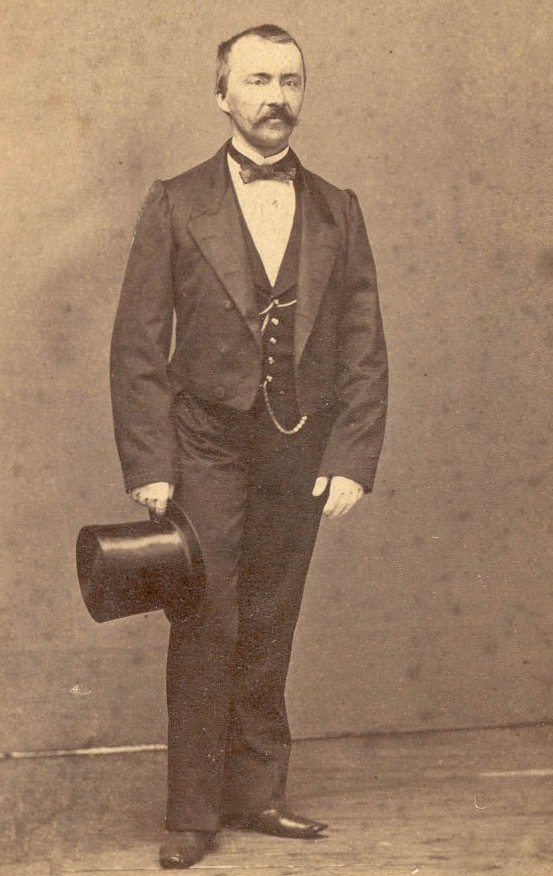
Heinrich Schliemann in the 1850s (ASCSA, Gennadius Library Archives, Heinrich Schliemann Papers)
Schliemann the legendary excavator of Troy and Mycenae hardly needs an introduction. A host of publications deal with the last twenty years of his life and the results of his excavations. It is only recently, however, that any interest has been taken in Schliemann’s “non-Greek” past, his early years, when he was a successful merchant, an obsessive traveler, and a compulsive linguist. What else can we call a man who taught himself to read, write, and speak more than fifteen languages? Read the rest of this entry »

 From the Archivist's Notebook