“Dollars and Dreams”: American Archaeologists on the Hunt for Greek American Money in Chicago
Posted: July 2, 2016 Filed under: Archival Research, History of Archaeology, Modern Greek History, Philhellenism | Tags: American School of Classical Studies at Athens, Chicago University, George Bourlos, Gertrude E. Smith, John L. Manta, Oscar Broneer Leave a comment
A still from The Aunt from Chicago (Η θεία από το Σικάγο) with the eccentric Greek American aunt (played by Georgia Vasileiadou) in the middle.
The Aunt from Chicago is one of the most beloved films in the history of Greek cinema. Produced in 1957, it became an instant hit and remained in demand for many decades. The movie had all the ingredients of a successful production: a great set and superior performances by the best actors of its time. As much as the film is a satire on the conservatism of the Greek family, it is also a subtle mockery of the “aunt’s” Americanization.
Proud of their successful relatives in America, but also feeling uncomfortable with their rapid assimilation by American culture, Greek intellectuals such as novelists Elias Venezis and Yorgos Theotokas tried to rationalize the loss of national identity by the Greek migrants. If, before WW II, stories of hardship and suffering prevailed over stories of success, after the war America’s new supremacy left little room for a narrative of failure. Instead, a new transnational narrative wanted Greek migrants — with their age-old values and in light of the bravery they had demonstrated during the war — to have contributed to the building of a new America. Novelist Yorgos Theotokas in his Essay on America (Δοκίμιο για την Αμερική), in the wake of a visit to the United States in 1953, would go so far as to claim that “From now on, the American people will be—to a small, but considerable extent—descendants of Greeks also” (Laliotou 2004, p. 86). (For a thorough study of the Greek migration in America, see Ioanna Laliotou, Transatlantic Subjects: Acts of Migration and Cultures of Transnationalism between Greece and America, Chicago 2004.)
Dorothy Burr Thompson’s Love for the Spirit of the Primitive
Posted: May 1, 2016 Filed under: Archaeology, Archival Research, Biography, Greek Folk Art, History of Archaeology, Mediterranean Studies, Women's Studies | Tags: American School of Classical Studies at Athens, Boeotia, Bryn Mawr College, Dorothy Burr Thompson, Eutresis Excavation, George Cram Cook, Parapoungia (Leuctra), Susan Glaspell 6 Comments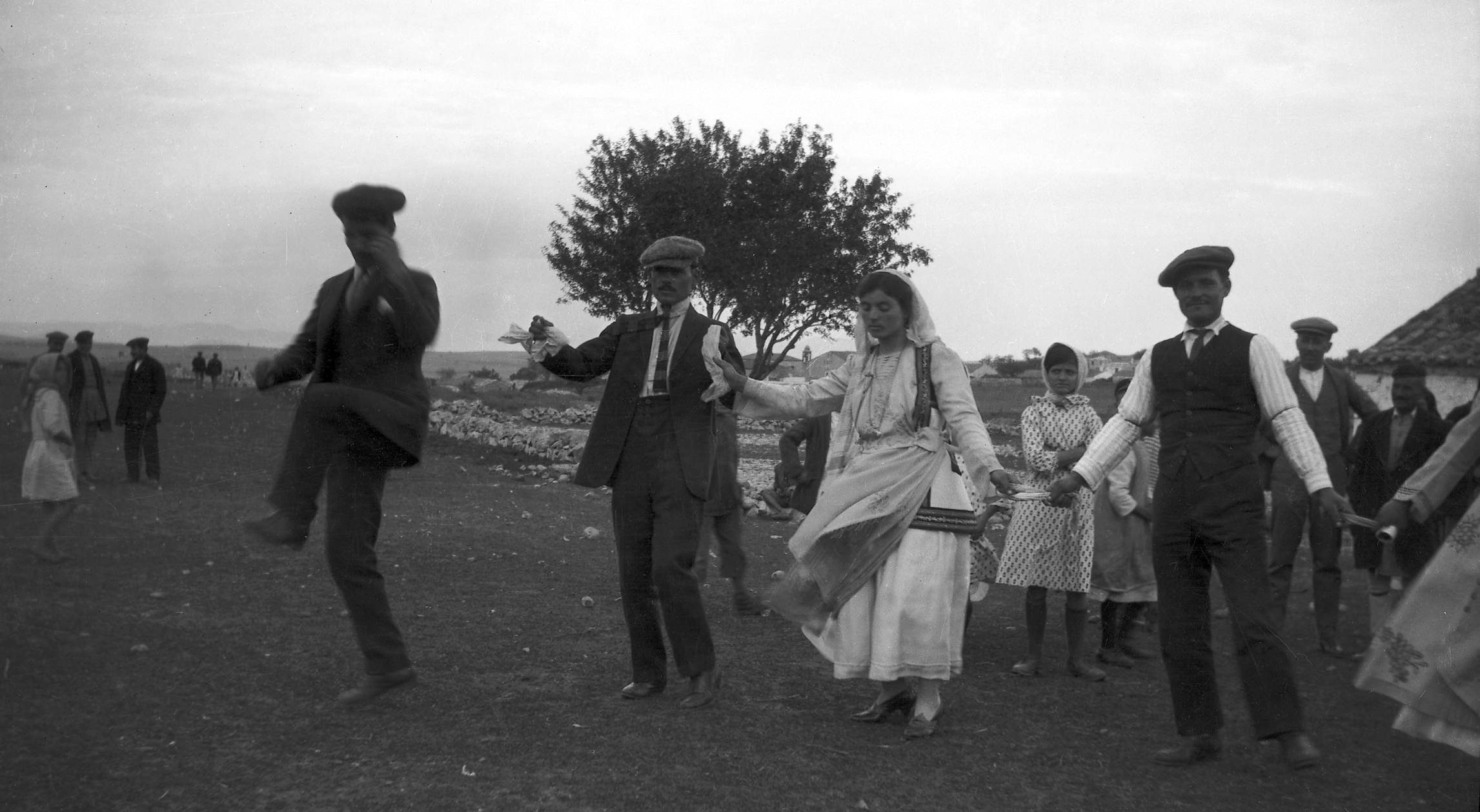
Dorothy Burr photographing wedding dance at Parapoungia 1924. ASCSA Archives, Dorothy Burr Thompson Photographic Collection.
“By myself in a Boeotian village, with the cry of the wind and drunken men in my ears! I love this place; it is so full of interest and a sense of real thing – seeing weddings whereat one reddens a finger… plodding one’s weary way homeward over purple fields to the din of bells like an organ cadence, knowing villagers… Oh, it is so full of life…” scribbled Dorothy Burr in her personal diary on November 9, 1924.
She was twenty-four years old and had come to Greece the year before, to study at the American School of Classical Studies at Athens (ASCSA or the School hereafter). Before that, she had lived in Philadelphia and studied at Bryn Mawr College. After attending the year-long program of the ASCSA, she and Hazel Hansen, another student of the School, were invited by archaeologist Hetty Goldman to dig at the Neolithic site of Eutresis, not far from Thebes, in Boeotia. Read the rest of this entry »
Clash of the Titans: The Controversy Behind Loring Hall
Posted: April 1, 2016 Filed under: Archaeology, Archival Research, Biography, History of Archaeology, Women's Studies | Tags: American School of Classical Studies at Athens, British School of Athens, Edward Capps, Loring Hall, Lucy Shoe Meritt, M. Carey Thomas, Ruth Emerson Fletcher, Thomas H. Mawson, William Caleb Loring 10 Comments
Loring Hall at 61 Speusippou (Souidias today), 1929. Source: ASCSA Archives
Reading Louis Lord’s History of the early years of the American School of Classical Studies at Athens (hereafter ASCSA or School), one gets a sanitized and condensed account of the building’s history (Lord 1947, 203-204). From his description, which largely concentrates on the final phase of the project, one could hardly imagine that 16 years of complicated negotiations preceded its official opening in February of 1930; in fact, a women’s hostel had been the dream of several important women, including the exceptional but controversial M. Carey Thomas, President of Bryn Mawr College (1894-1922), before various forces finally named it after a man, Judge William Caleb Loring, and made it co-ed. Read the rest of this entry »
On Communism and Hellenism: An Archaeologist’s Perspective
Posted: March 1, 2016 Filed under: American Studies, Archaeology, Archival Research, Biography, History, History of Archaeology, Intellectual HIstory, Modern Greek History, Philhellenism | Tags: Alison Frantz, American School of Classical Studies at Athens, Carl W. Blegen, Communism, Donald C. McKay, Hellenism 3 CommentsPosted by Despina Lalaki
Despina Lalaki holds a PhD in Historical Sociology from the New School university while she currently teaches at the The New York City College of Technology-CUNY. The essay she contributed to ‘From the Archivist’s Notebook’ is largely an excerpt from her article “On the Social Construction of Hellenism: Cold War Narratives of Modernity, Development, and Democracy for Greece,” in The Journal of Historical Sociology, 25:4, 2012, pp. 552-577. Her essay draws inspiration from an unpublished manuscript by archaeologist Carl W. Blegen, titled “The United States and Greece” and written in 1946-1948.
Carl W. Blegen (1887-1971) is one of the most eminent archaeologists of the Greek Bronze Age. Nevertheless, he intimately knew Modern Greece, too. In 1910, at the age of twenty-three, he first visited the country as a student of the American School of Classical Studies at Athens (hereafter ASCSA), and by the time of his death in 1971 he had made Greece his home and his final resting place, having experienced first hand the land and its people in the most troublesome moments of their modern history. In 1918, for instance, he participated in the Greek Commission of the American Red Cross, assisting with the repatriation and rehabilitation of thousands of refugees who during the war had been held as prisoners in Bulgaria. During WWII, he was recruited by the Office of Strategic Services (OSS) to head the Greek desk of the Foreign Nationalities Branch (FNB) in Washington D.C., which was following European and Mediterranean ethnic groups living in the United States and recording their knowledge of political trends and conditions affecting their native lands.

J. W. Foster (left) and Carl W. Blegen (right) standing at the headquarters of the Allied Mission for Observing the Greek Elections (AMFOGE), 1946. Photo by Nat Farbman. The LIFE Picture Collection/Getty Images/Ideal Image.
“The Best Laid Plans… Often Go Awry”: A Tale of Two Museums
Posted: February 1, 2016 Filed under: Archaeology, Archival Research, History of Archaeology, Modern Greek History | Tags: Ada Small Moore, American School of Classical Studies at Athens, Corinth Museum, Edward Capps, Konstantinos Kourouniotis, Lesvos Museum, Mytilene, Rhys Carpenter, Richard Stillwell, W. Stuart Thomspon 7 CommentsIn the spring of 1934, the construction of two new archaeological museums was completed in Greece, both under the auspices of the American School of Classical Studies at Athens (ASCSA or the School hereafter) and by the same architect, W. Stuart Thompson. Thompson had designed the Gennadius Library a few years earlier. The dedication of the Corinth Museum was grand and attended by most significant officers of the Greek Government. There was no dedication for the Lesvos Museum. Of the two museums, the one in Corinth is still standing and functioning, while the other on the island of Mytilene (Lesvos) collapsed shortly after its erection. Read the rest of this entry »

 From the Archivist's Notebook